Thursday, October 27, 2011

An instant classic -- 2011 World Series Game 6


Tonight's Game 6 of the World Series at first looked like it would be a forgettable one: a sloppy game with multiple errors, a letdown for the National League. Instead, by the end of the night it turned into one of the all-time classic baseball games.

Four hours and 33 minutes is a long time for a baseball game, but the tension, the back-and-forth reversals and the thrill of seeing a "goat" redeem himself Thursday night made every moment exciting.

The Texas Rangers would have won the series with a victory Thursday, and if you weren't watching, the St. Louis Cardinals not once, but twice, were down to their last strike.

In the bottom of the ninth, David Freese (right) -- who had a committed a costly error earlier which the Rangers took advantage of to take the lead -- tripled to score two and tie the game. An inning later, Texas took the lead again in the top of the 10th and got one strike away from victory in the bottom of the frame, but Lance Berkman drove in the tying run. An inning after that, Freese struck again with a walkoff home run to win the game for the Cardinals and force a seventh game on Friday.

Tonight's game joined a number of famous World Series Game 6s: 1975 (Fisk's blast at Fenway off the foul pole), 1986 (Bill Buckner's error), 1993 (Joe Carter's walk-off to win the series) and 2002 (the Angels rally to beat the Giants). Of course, none of those games had Twitter through which far-off fans could commiserate. To wit:

As Texas pulled ahead and the game went into the ninth, I posted the following:

Dang, what an entertaining baseball game this has been. #WorldSeries#Postseason
Oct 28 via webFavoriteRetweetReply

(Times and dates shown on these Tweets are GMT.)

A few moments later, the Cards were down to their last strike when Freese tripled to right just past the reach of outfielder Nelson Cruz, scoring two to tie the game and make up for an earlier error. That hit brought the following reactions online:

When Freese made that error earlier, I thought "what if he redeems himself later with a walk-off homer?" Here we are
Oct 28 via UberSocial for BlackBerryFavoriteRetweetReply


best fucking sport on the planet.
Oct 28 via webFavoriteRetweetReply


Heck, even I got a little excited:

Man, I'm gonna retweet myself here, with emphasis: DAMN, what an entertaining baseball game this has been! #WorldSeries#Postseason
Oct 28 via webFavoriteRetweetReply


Outspoken Florida Marlins Manager Ozzie Guillen and Braves Pitcher Peter Moylan (writing from his native Australia) were also impressed:

Wuaoooooo crazy game
Oct 28 via txtFavoriteRetweetReply


What a game, what a series!
Oct 28 via Tweetbot for iPhoneFavoriteRetweetReply


The game now tied, it went into the tenth. Reining AL MVP Josh Hamilton then blasted a monster shot into the bleachers to once again put the Rangers on the brink of their first world title:

1er hr des Séries d,après-saison de Hamilton et bon pour 2 points et contre Motte! Ah la la, Texas sont trop dûs, 9-7 Texas en 10e
Oct 28 via FacebookFavoriteRetweetReply


WOW
Oct 28 via webFavoriteRetweetReply


Cardinals fans looked forlorn, with good reason. They had the bottom of the lineup coming up, including the pitcher with no pinch hitters left on the bench:

I hate baseball. Not only does it break your heart, it takes five hours to do it.
Oct 28 via twiccaFavoriteRetweetReply


If Cardinals find a way to tie game with the hitters they've got coming up, Spielberg should be filming.
Oct 28 via Twitter for iPhoneFavoriteRetweetReply


But, whaddya know? Rally time! St. Louis gets two runs with a ground out and -- after a fan-infuriating intentional walk to superstar Albert Pujols -- an RBI single to right from Lance Berkman:

I haven't followed the Rangers but I find it hard to believe that Darren Oliver was the best option to get the last 3 outs to win the WS
Oct 28 via Twitter for iPhoneFavoriteRetweetReply


People saw this game was becoming a classic:

All fans of other sports will now bow down before their intergalactic overlord
Oct 28 via TweetDeckFavoriteRetweetReply


Well, most people did:

WHAT'S HAPPENING?! Do I need to be watching this World Series?!
Oct 28 via webFavoriteRetweetReply


As the game moved past midnight (Eastern Time), this became a game not to go to bed during -- even if you start work at 4 a.m.:

Looks like KTVU gets a slightly tired Sal Castaneda tomorrow.
Oct 28 via webFavoriteRetweetReply


Told u before we were excited now u see why
Oct 28 via webFavoriteRetweetReply


Of course, politics gets into everything:

9-9, someone alert Herman Cain
Oct 28 via Twitter for iPhoneFavoriteRetweetReply


Then Freese strikes again ... home run to straightaway center and we're off to game 7! The reaction, by now, is predictable:

Jesus, Mary and Joseph
Oct 28 via TweetDeckFavoriteRetweetReply


Amazing! Game 7 here we go!
Oct 28 via webFavoriteRetweetReply


Freese's story will be the headlines tomorrow, if Twitter's any indication:

The night of Freese! From goat to redemption to hero. Wow #WorldSeries
Oct 28 via UberSocial for BlackBerryFavoriteRetweetReply


Personally, I had to give a shout out to the sports editor at Santa Clara University's student newspaper. He called it:

Posted 47 mins before it happened MT @nicko229 Freese made that error, I thought "what if he redeems himself later with a walk-off homer?"
Oct 28 via webFavoriteRetweetReply


Dang that rain that postponed game six until tonight instead of last night. Now Game 7 will be Friday night, when I have to cover a football game for the San Mateo Times. At least I'm not the only one who'll miss out:

As much as I love covering HS football... I wish I had tomorrow night off...
Oct 28 via TweetDeckFavoriteRetweetReply


Well, time to DVR the game, hope the PA announcer at Terra Nova High says nothing and keep the radio off on my way home!

(Go Cards!)

Monday, October 24, 2011

FCC responds to complaint over BART phone service disruption

A few weeks ago, I filed a complaint with the Federal Communications Commission against the Bay Area Rapid Transit agency after it shut down cell repeaters in its tunnels in an apparent attempt to stifle a protest.

It turns out, I was one of many who complained to the FCC about the disruption. Today, I got a mailed response from the FCC about the situation. Here it is:


It's a form letter. In fact, other people got the exact same letter a month ago. But it's a bit heartening to see that the matter wasn't dismissed out of hand. Will the FCC come down on BART for its disruption?

Perhaps to peremptorily address the issue, the BART Board of Directors will be discussing a cell phone disruption policy at its Thursday (Oct. 27) meeting. This policy, said to include input from the ACLU and BART's Citizen's Review Board, would enable BART to disrupt cell service "only when [the District] determines that there is strong evidence of imminent unlawful activity that threatens the safety of District passengers, employees and other members of the public, the destruction of District property, or the substantial disruption of public transit services."

I'm a bit troubled by the ambiguity of the statement. Under the policy above, the previous disruption -- of which I seriously disapprove -- would still have been possible had BART's general manager approved of it beforehand.

While the draft policy does include a few examples of the "extraordinary circumstances" in which a disruption is possible, the list is still ambiguous. Listed among those special circumstances are when phones are used: as explosive detonators; to facilitate "violent criminal activity ... such as hostage situations"; in specific plans to destroy BART property; and when there are plans to "substantially disrupt public transit services." If, for example, a few members of OpBART plan to briefly prevent a train from moving (as happened at an earlier protest), is that a "substantial" disruption of public transit services?

As it is, without an exception for non-violent civil disobedience, I don't see how this policy would result in any difference than the phone service disruption we saw in August.

Saturday, October 22, 2011

Review: Alice's Restaurant

Alice's Restaurant, 1599 Sanchez Street, San Francisco.

A while back, my family's favorite sit-down Chinese restaurant in San Francisco, Eliza's, closed. Since then, we've been looking for a replacement.

A few family members have lately been going to Alice's in Noe Valley, and when invited to join the clan this weekend, I took advantage of the opportunity. I don't know if it's a full replacement for Eliza's, but Alice's certainly merited a return visit.

Alice's (1599 Sanchez Street, at the corner of 29th and Sanchez streets) is in a nice corner location, with big windows. The neon on the front sign seems a little out of place in the otherwise residential street, but makes for nice, clean lines. The simple decorations and straight tables inside suggest a good measure of organization.

Prices: Our party of 11 ordered an assortment of dishes, all between $7 and $10 on the fairly simple menu.

Pot Stickers, $5.25
Appetizers: We stuck with with pot stickers. They were nice and hot, brown in exactly the right places. Good quality meat and seasonings inside.

Main dishes: We tried a good assortment. Since we had four kids under 10 (five if you count Charlotte), we only got one spicy dish. Our choices included:

Kung Pao chicken $8.25
Kung Pao Chicken: Our one spicy dish. Flavorful, but too many peanuts (especially after we asked it to be customized with cashews instead).

Orange chicken: This dish was ordered a little mild for the kids. It had a strong marmalade-like orange flavor (which was good), and it was darker and with a bit more kick than the equivalent dish the young'uns usually get at Panda Express.

Sesame chicken, $8.50
Sesame chicken: Good texture, generous with the sesame seeds. Good, fresh shredded vegetables (carrots, squash, etc.). Chicken, however, was a bit bland.

Asparagus with black-bean sauce: Tame, but generous portion for a side dish.

Alice's Chow Mein: Good, but more flavorings (chicken, water chestnuts, peppers) than actual noodles.

Alice's Chow Fun, $6.95

Alice's Chow Fun: Also good, but opposite of the chow mein: far more noodles than flavorings, to the point where the noodles were almost all one tasted -- with the exception of a strong flavor of Thai basil, which made it taste fresh.

Service: Great service! The waiter personally rolled six helpings of mu-shu pork after seeing we had problems. The water refills came frequently and the food was brought out nice and hot and put directly on the table where the people who most hungrily eyed it were sitting.

Overall: It's location (out of Chinatown or other heavily Asian neighborhoods) might make its authenticity suspect, but the staff and food were both very good. The food flavor was a bit tame compared to some of the more-authentic Chinese restaurants I've been to, but the freshness of the Hunan menu and the good service were huge points in Alice's favor.

I don't think it will get on my list of most-visited restaurants, but I would happily return to Alice's.

Thursday, October 20, 2011

Berlyn Cosman taught me that life was fleeting - RIP as her killer goes free

Sometimes one is reminded of a almost-forgotten chapter from their past by a random smell, hearing a special song, or finding an old trinket.

Or seeing a newspaper headline like the one I saw today: "Man convicting of killing CV student on prom night granted parole."

Berlyn Cosman (1973-1991)
Berlyn Cosman was a promising all-league basketball player at Crescenta Valley High in the early 1990s. She had earned a basketball scholarship to a university in Missouri and was expected to do well in college. She was young, pretty, smart and could drain shots from all around the key.

On May 31, 1991, three weeks from graduation, she attended her senior prom in Los Angeles and then drove down with friends to the Disneyland area for an all-night party, to be followed a trip to the theme park the next day. At some point during the night, there was an argument with a non-student friend of one of the partygoers named Paul Crowder. Cosman retreated to a different room in the hotel to sleep. Some time later, Crowder came into the room carrying a gun. He said he tripped entering the room and the gun went off. Prosecutors said he intentionally fired into the room.

Whatever the case (and I'm inclined to believe the latter), a bullet hit Cosman in the head and she died the next day. The community mourned, and Crowder was convicted of second-degree murder and sentenced to 19 years-to-life. He was -- as the headline says -- granted parole this week. A letter to the court from Mark Cosman, Berlyn's father, saying he approved of the parole was a key factor in the decision.

Friends and I (top row, second from left) at the 
1991 Crescenta Valley High School prom.
I didn't know Berlyn personally, but I was at that Prom (though not at the party) that night as a recent CV High grad accompanying a current student (a Japanese exchange student named Tomoko, whom I was friends with). That's me in the top row, second from left in the photo to the right.

I had followed Berlyn's basketball career in the Glendale News-Press, where I was to begin sportswriting within a year. The afternoon after the prom, I was coincidentally walking by Crowder's house on Honolulu Avenue at the exact same time he was arrested after fleeing to his home (I saw police surrounding the building and a helicopter overhead).

I went to Berlyn's funeral later that week in Montrose. I later became friends with others who were at the party (they were frequent customers of the late, great Enterprise Arcade on Foothill Boulevard -- where parts of the movie "River's Edge" were filmed and I worked at the time). Paul Crowder's brother Mike played basketball at CV the next couple years while I covered the team and he obviously had to live with what his brother did.

I closely followed News-Press reporter Amy Koval's accounts of Crowder's trial that fall and recently bought a book written by Mark Cosman about dealing with the loss of a child to get his perspective. Obviously, then, I was strongly affected by what happened that night.

Why? Because what occured in that Orange County hotel room was my first real exposure to the fact that life was fleeting, that horrible things can happen to people you know. I've seen a lot of terrible things in the 20 years since, but Berlyn's death still affects me to this day.

But I also have to say that Mark Cosman's apparent forgiveness of Crowder is one of the most gracious things I have ever seen. My wife and I recently welcomed our daughter to the world, and I don't know if I could be so forgiving after such a horrible loss. He's a better man than I am.

Tuesday, October 18, 2011

Omni predicts the distant future of 2010 -- Part II: Technology

Omni Magazine, July 1982
Cover of Omni's July 1982 issue.

A while back, I outlined some of the wildly incorrect predicted 2010 prices from 1980's The Omni Future Almanac. Today, I want to point out some things the Omni editors got right.

And, because it's funnier, some more stuff they got wrong.

Successes
First, a couple slam dunks. On page 206, the editors wrote that video recording technology (initially the VCR) would not only let people watch what they want, when they wanted it, but that the practice would drive programmers and ad people crazy. They even got the terminology right:

The use of home video recorders for this type of "time shifting" will cause major problems for broadcasters who must predict to their advertisers which market will be watching which program at a specific time. Fans of daytime television programs, for example, will watch soap operas when their schedules permit — probably in prime time — utterly skewing ratings and confusing advertising plans.

Another swish -- e-mail would quickly become a communications medium to be reckoned with. While it sings the praises of the yet-to-come “paperless office” Omni's Almanac also (on page 181) talks about the amazing new technology of “electronic mail.” Apparently, in this miracle technology:

Messages are typed into the computer, which instantaneously sends the letter to its destination and files all requested copies. The recipient gets the message — either on his screen or through his printer — when he asks his computer for the mail.

E-mail was predicted to be common in interoffice business by 1990 and most correspondence would be e-mail (though that term wasn’t used by Omni) by the year 2000. The book also said the post office would struggle to compete. That much is true.

Mixed bags
On some matters, Omni had a mixed track record. Take health care costs. Omni predicted (on page 157) that an average familiy's health care costs would drop from 10.1 percent of a family's income in 1980 to about eight percent in 2000. Well, three failed decades of health care policy later, A middle-income family with individual coverage spends on average 22 percent of household income on health care -- and some spend up to 50 percent. A similar middle-income family with employer based coverage spends 8 percent percent of their income on health care costs.

In business, Omni suggested that General Motors would be profitable for many years thanks to fuel cell technology in its vehicles, ”but by 2010 the Detroit giant could vanish from the leading ranks of corporate conglomeration” (p. 178). Well, they got that last part right (still waiting on the fuel cells).

In the wishful thinking department, Omni's predicted the success of Genentech, still based on a sprawling South San Francisco campus but recently acquired by Roche. Of course, Omni also said that Genentech and or Cetus (another biotech company bought by Chiron in 1991 after staggering loses) “will create pharmaceuticals that will effectively cure diabetes and suppress the cancer tendencies in smokers.” Say what?

Just plain wrong
While Omni got some things right, or at least right to a degree, it was very off in other areas. Take basic economics. The magazine's editor thought that the average amount of their income spent by an American family on housing would drop from 21.3 percent in 1980 to about 19 percent in 2000. Well, in 2009, the average US family spent about 34 percent of their income on housing. (I blame the torrid San Francisco housing market!).

Of course, no discussion about the "future" is complete without a section on robots. On page 178, the Future Almanac predicts that the Soviet Union "will standardize the robots industry." Widespread use of robots would give the proletariat workers more free time and thus result in more political tension. Nothing about the Berlin Wall falling, however.

In the United States, Omni predicted, robots will be used extensively in office, service industries and manufacturing. Occupations which would become obsolete include bank tellers, supermarket cashiers, "movie ticket operators," car wash workers and stock clerks. "Factory assembly lines will be a nostalgic reminder of the past." Tell that to the population of Flint.

Another interesting area would be the use of robots in the restaurant business:

Short-order food preparation also appears likely to be overtaken by robotics. These firms could implement a robot food-serving system as early as 1985. Gas stations will also be totally serviced by robots. While the tank is being filled, a credit card will be put into the machine to register payment and complete the transaction.

That sounds like this:
Courtesy: The Fiscal Times

Omni predicted widespread use of robots only among the wealthy and upper middle class, however. That's probably why you don't have one. Except maybe a Roomba.

I was going to give Omni credit for its prescience in saying that robot space probes would be very successful -- until the book said that robot space probes would probe "other solar systems." No robot will make it to another solar system in the next 10,000 years, barring breakthrough in warp drive.

Still, we should be glad that robots aren't quite as widespread as Omni thought they would be:

Friday, October 14, 2011

Dexter Clay, a 'redshirt' who survived to write about leadership

Let's face it: it didn't pay to wear a red shirt on the original Star Trek series.

Red, the uniform color of security officers (and engineers) on the show, was a practical death sentence. One estimate showed about 1 in 7 of the Enterprise's crew was killed in Star Trek, the original series. Of those corpses, a staggering 70 percent wore red shirts.

The "red shirt" phenomenon -- when a bunch of main cast members and a guy in a red shirt face a deadly situation, it's the guy in the red shirt who dies -- became a TV trope, even parodied to great success in Galaxy Quest. So it's no surprise that when Star Trek: The Next Generation (TNG) began in 1987, they gave security officers another color (yellow) to wear. Still, security was a hazardous job and you kept expecting security officers to die with regularity. And, informally, us fans still called them "redshirts."

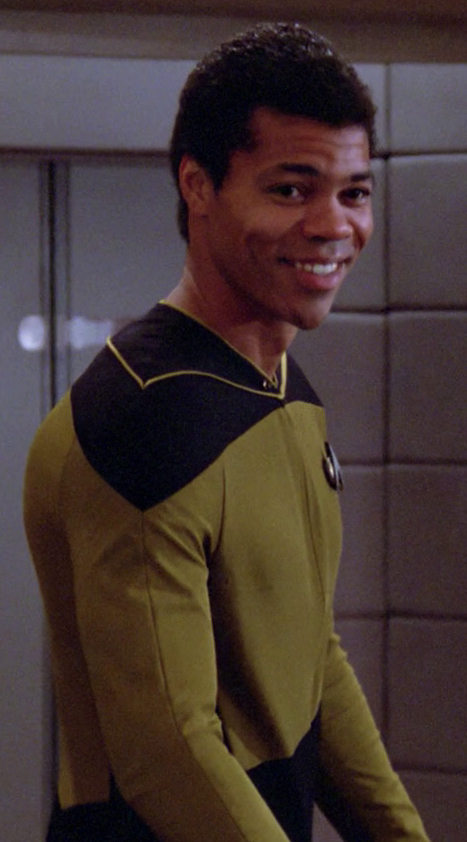
So it was somewhat unexpected during the first two years of the show when a certain officer kept reappearing. He got into a number of scraps, for sure, but the tall African-American security officer made appearance after appearance. He never got a line. He was never named. But he was never killed, either.

My real name is Dexter Clay, but my Star Trek
character never got one.
Flash-forward 20-something years, and we now have the Internet (and DVDs of the entire series). After two decades of exposure to his face, I finally got curious enough the other day to try and find out the security officer's name.

It was no easy task, even for an accomplished Googler such as myself. No name, either for the actor or the character? Enter Memory-Alpha, the Star Trek wiki. The security officer didn't make an appearance in any credits, making my job difficult. I first tried perusing a list of Enterprise-D crew members with no luck. Then, finally, I decided to examine entries for episodes he was in, in an attempt to get a name. Sure enough, in the entry for the pilot, "Encounter at Farpoint," there he was in the uncredited co-stars list: Dexter Clay -- Security Guard.

A quick, conventional Google search helped from there. With the IMDB showed only a couple credits (one episode of TNG and a bit part in a movie), Memory-Alpha showed that Clay had actually appeared in 29 episodes! That's more than such "regular" crew members as Guinan or Pulaski.

And no, he never was named or given a line.

It turns out that, prior to acting, Clay had been a professional football player, for both the 1980 Houston Oilers and the 1981 New York Jets, although he apparently never got into a game due to injuries. Besides playing the security guard in two TNG seasons, Clay also served three years as a stand-in for Michael Dorn (Worf).

Since his time on Star Trek, Clay has become a writer. His 2007 book about a high school football team, KatyNation, got good reviews on Amazon, as did his 1998 look into race relations, Black Eye on America.

Clay has apparently made it a goal of his to find out what makes good a good leader (although looking at Capt. Picard's thoughtfulness might be a good place to start), and has made numerous radio appearances in support of his book and philosophy.

While there are no copies of Clay's books at local libraries for me to review, it's sure gratifying to see at least one "red shirt" who didn't succumb to curiosity.

Unlike these guys: