Showing posts with label BART. Show all posts

Monday, October 24, 2011

FCC responds to complaint over BART phone service disruption

A few weeks ago, I filed a complaint with the Federal Communications Commission against the Bay Area Rapid Transit agency after it shut down cell repeaters in its tunnels in an apparent attempt to stifle a protest.

It turns out, I was one of many who complained to the FCC about the disruption. Today, I got a mailed response from the FCC about the situation. Here it is:


It's a form letter. In fact, other people got the exact same letter a month ago. But it's a bit heartening to see that the matter wasn't dismissed out of hand. Will the FCC come down on BART for its disruption?

Perhaps to peremptorily address the issue, the BART Board of Directors will be discussing a cell phone disruption policy at its Thursday (Oct. 27) meeting. This policy, said to include input from the ACLU and BART's Citizen's Review Board, would enable BART to disrupt cell service "only when [the District] determines that there is strong evidence of imminent unlawful activity that threatens the safety of District passengers, employees and other members of the public, the destruction of District property, or the substantial disruption of public transit services."

I'm a bit troubled by the ambiguity of the statement. Under the policy above, the previous disruption -- of which I seriously disapprove -- would still have been possible had BART's general manager approved of it beforehand.

While the draft policy does include a few examples of the "extraordinary circumstances" in which a disruption is possible, the list is still ambiguous. Listed among those special circumstances are when phones are used: as explosive detonators; to facilitate "violent criminal activity ... such as hostage situations"; in specific plans to destroy BART property; and when there are plans to "substantially disrupt public transit services." If, for example, a few members of OpBART plan to briefly prevent a train from moving (as happened at an earlier protest), is that a "substantial" disruption of public transit services?

As it is, without an exception for non-violent civil disobedience, I don't see how this policy would result in any difference than the phone service disruption we saw in August.

Thursday, October 13, 2011

The fog of war(planes)

Blue Angels: "We came, we saw, we flew off."

On Sunday I decided to brave the Embarcadero crowds and take one of the young'uns downtown to see the Blue Angels.

The Blue Angels, the US Navy's premier aerial acrobatics team have been a fixture of San Francisco's Fleet Week for decades. The have brought cheers and also jeers, mainly due to noise complaints, but also their symbolism in an area where the military can be unpopular.

The Snowbirds complete
a loop.
We exited BART at Embarcadero Station and walked about a mile-and-a-half up to Pier 37, where we set up a picnic about two hours prior to the scheduled start of the Blue Angels' demonstration. Luckily, there were a few opening acts.

First up were our neighbors from our north, the Snowbirds (left), representing Canada's Armed Forces. While their jets weren't quite as fast or powerful as the Blue Angels' F-18s, the Snowbirds made up for it by using their greater numbers (nine CT-114 jets). The numbers enabled the Snowbirds to pull off some pretty complicated tricks -- such as drawing a heart in the sky with smoke, then piercing it -- back-to-back-to-back as smaller groups broke off and performed along various parts of the waterfront.


Canada's Snowbirds fly in tight formation during their Oct. 9, 2011 show in San Francisco.


F-15 on afterburner.
Next up were a couple single-plane demonstrations, a Marine Corps F/A-18 and a US Air Force F-15, which delighted the crowd with very-low (and very loud), high-subsonic passes on afterburner (right). It also did a fairly good cobra maneuver and generously showed its high-thrust abilities with quick climbs from the deck to about 15,000 feet and back down again.

Another highlight was seeing a United Airlines 747 pass low and do some pretty tricky tight turns that you don't want done on your next flight to Chicago, but are pretty impressive at an air show. The big, lumbering jumbo jet was a surprisingly exciting part of the show.

(Click on the pictures to "embiggen." The photos are perfectly cromulent.)


A United Airlines 747-400 does some impressive low passes over the San Francisco waterfront.

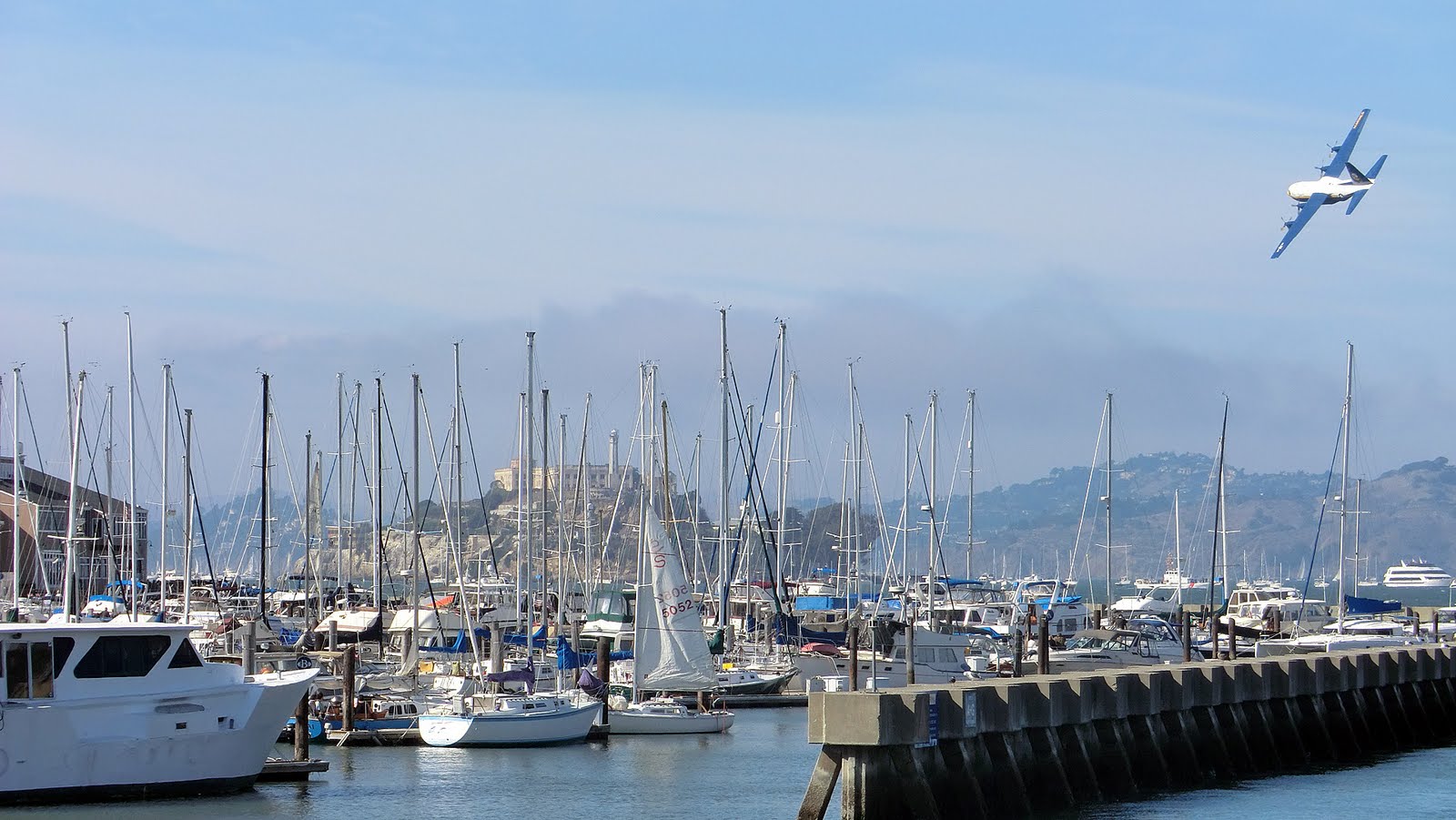
My son and I had enjoyed the show, thus far, and its a good thing we did, too. When the Blue Angel's C-130 support craft, "Fat Albert," (below) appeared and did a few tricks, the crowd was led to believe the main show was about to start and got excited. As "Albert" left, the F-18s came into sight and began circling.

And circling.

And circling.

The Blue Angels' C-130 support plane, "Fat Albert," does low-level turns for the fans.

Turns out some fog had rolled in, and the Blue Angels didn't feel that conditions were safe to fly 18 inches apart 20 feet above the water. They eventually had to cancel the demonstration. Alas, while the crowd was disappointed, I think a majority understood. Certainly, we had been amused in the meantime.

The fog, seen here over Alcatraz, which caused the Blue Angels to cancel  their Sunday performance.

Thursday, September 8, 2011

Who defines a journalist? Apparently BART police ...

#opbart @awesome_hubris tell me #anonymous press is @vinceinthebay
(Photo by Steve Rhodes, via Flckr.)

A protest at a San Francisco BART station on Thursday outlined the continually evolving struggle to define what makes a journalist and, even worse, the government's role in that definition.

I've blogged here recently about the continuing series of protests against BART after District police shot and killed a man who was reportedly threatening them with a knife and the (in my opinion unconscionable) decision to cut cellular phone service in the stations in order to curtail protests. Another protest on Thursday brought the issue of defining journalists to the forefront.

Instructor Justin Beck, a former San Francisco Chronicle writer and avid Twitterer who taught me last spring in Journalism 226, decided it would be a great teaching experience to take his San Francisco State University online journalism students to the protests as an exercise in live blogging/tweeting an ongoing news event. Things got hectic when, according to the students' Twitter timeline, officers dispersing the crowd began to question the student journalists' lack of professional credentials.

At least one student, Brad Wilson, reported he was handcuffed and detained after being stuck in a throng of protestors that were locked in the BART station by police.


The SFSU student newspaper reported that seven students were detained, the longest for more than two hours. Other media stated that more than 20 people were detained or arrested. Wilson told me via Twitter that he was not cited after Beck stood up for him and the other students.

While the police may claim the students, and other media who were also cited at the event, were exacerbating the protests, the issue about the credentials is a key one. Who should be deciding who are and who aren't journalists? BART police think they are the ones who should decide, it seems.

First, let's address the issue of whether "student journalists" are, in fact, "journalists." To me, it's no question that student journalists have the same rights as professional journalists. In fact, a groundbreaking case on whether police have the rights to search newsrooms is based on a case involving a school paper. In Zurcher vs. Stanford Daily (436 U.S. 547 (1978)), the US Supreme Court ruled that -- at the time -- police may search a newsroom seeking evidence of crimes covered by a media outlet. So outraged was the press and the public, that Congress passed the Privacy Act of 1980, which greatly limits the circumstances in which a newsroom can be searched. Therefore, case law has established that "student journalists" are just plain "journalists."

So to the larger issue; who defines what makes a journalist? Many cities have tried. Lake Oswego, Ore., tried to define a journalist as someone who works for an established media outlet, in an apparent attempt to filter out bloggers from covering certain meetings. In discussing a shield law for journalists a couple years back, senators attempted to limit the "journalist" tag to professionally affiliated journalists.

These definitions simply do not fit the realities of today's journalism. These days, one is more likely to find out local news via a blog, such as SFist or Patch than they would the big city paper. These smaller outlets rarely have much full-time staff and depend on volunteer or freelance contributors for their content.

Many scholarly papers have debated this issue. A growing consensus is going to a definition based on function (i.e., what are these people doing?) instead of a one based on status (who do these people work for?).

Debate over a federal shield law brought the issue front and center, according to an article at Mashable:
According to David Ardia, the director of the Citizen Media Law Project at Harvard Law School, “A functional definition is the way to define journalism. We don’t want to create a definition or guidelines that work only with the current journalistic model. The best definition looks at the activities. Were they conducted with the purpose of providing information to the public? That’s the core and puts the public at the center.”

Were these students seeking to provide information to the public? Damn straight they were. In fact, they were learning how to do so properly. So, to paraphrase The Treasure of the Sierra Madre, "Press passes? We don't need no stinkin' press passes."

At least the students had a sense of humor about being detained:

Tuesday, August 30, 2011

Guy Fawkes is no hero, Anonymous BART protestors

Guy Fawkes is not the hero "Anonymous" makes him out to be.

On Jan. 1, 2009, a police officer employed by the BART transit agency shot and killed a subdued man named Oscar Grant, who was suspected of fighting on a train. The officer who fired the shot said he thought he was holding his TASER at the time, and was later convicted of involuntary manslaughter. The shooting and the verdict brought massive protests in parts of the Bay Area. In July 2011, another BART officer shot and killed a man named Charles Hill at Civic Center station. Hill was reported to police after reportedly seeming belligerent and intoxicated.

A large protest against Hill's death and alleged heavy-handed techniques of BART officers briefly closed the Civic Center Station later that month. When another demonstration about the shootings was scheduled for August 2011, BART officials, mindful of how social media is used to coordinate protests in this day and age, ordered cellular phone repeaters in the underground stations be shut down in an attempt to corral protests.

The effort backfired spectacularly, as people from First Amendment supporters to tech columnists lambasted the move and multiple protests against the cell service shutdown have shut down stations and frustrated commuters. Key organization for the protests has been supplied by the loose association of individuals known as "Anonymous," which initially gained widespread notoriety by supporting the information-sharing website Wikileaks.

It's here where it gets interesting. "Anonymous" supporters, in protests from London to San Francisco, have taken to wearing Guy Fawkes masks like those sported by the anti-hero "V" in Alan Moore's classic early 1980s comic "V for Vendetta." These protesters, as seen at the top of the page, apparently seek to emulate the anarchist hero (seen below) of the comic-books (later collected in graphic novel form). At the end of the movie adaptation of the books, scores of protesters in Guy Fawkes masks are symbolically seen helping to bring down a fascist British government.


The problem is that Guy Fawkes was no hero. He planned to blow up Parliament, killing the King, Lords, and MPs inside, in order to found a repressive Catholic theocracy. While V had a specific reason to wear a Guy Fawkes mask because he also intended to blow up Parliament (which is done on page 7 of the comics and at the climax of the movie), I'm not seeing why Anonymous has adopted the symbol. Yes, the comic V was an anarchist, as no doubt are some Anonymous supporters, but Fawkes himself was very much the man these people would be fighting against -- a mercenary for hire who fought for a number of countries that supported his religious philosophy. Indeed, basically a Christian jihadist. Fawkes thus has no place being the figurehead of a non-violent protest movement.

But, BART is also not blameless here. When officials such as spokesman Linton Johnson claim "there's no right to free speech" on train platforms, they may be legally correct but morally wrong. Preventing communications in order to disrupt a protest does, in fact, remind me of the repressive government in "V for Vendetta," who are always letting the public know they are in charge (see right).

Of course, this thing makes me wonder: how many Anonymous folks read Moore's other seminal work, Watchmen, where good intentions went very awry (in form of exploding squid)?

Friday, April 15, 2011

SFSU students and opinions on mass transit

(The following is a repost from a class blog.)

Gas prices are near all-time highs, parking near campus has been horrible for decades, and bridge tolls have risen for those who must cross the bay.

All negatives for those who want to drive to San Francisco State.

More than 1.1 million trips are taken on BART or Muni each weekday, according to the Federal Transit Database. Advocates say it’s better for the environment and you don’t have to worry about parking.

Still there are SF State students who prefer the freedom of driving, as well as many who think parking at SFSU isn't worth the hassle. This audio "man on the street" story talks to both sides: Direct Link: Transit Man on the Street by John Baker