Showing posts with label economics. Show all posts

Sunday, March 3, 2013

International Spam, in South City

Image of Spam cans from Grocery Outlet in South San Francisco showing Arabic and Japanese markings

A new Grocery Outlet store opened last year in South San Francisco, and I've had the opportunity to shop there a few times. They prices are generally pretty good, although selection can be limited (and be mindful of expiration dates -- things are often being sold just days before the sell by dates).

The store saves money by buying in bulk, overstock, etc. Another way it saves money is by having export-marked food items whose order has apparently fallen through. I recently bought some Welch's grape juice marked for overseas sale, for example.

But the most apparent example was when I last month bought two cans of Spam (yes, I enjoy Spam in non-emailed form).

One (above, right) had markings in an Asian language (possibly Japanese). The other (above left) had what appeared to be Arabic markings and the warning "Pork — Not for Muslims." I'm not sure where that latter can is intended to be sold — maybe India because of the English markings, or Saudi Arabia for the Filipino guest workers (Spam is apparently popular in the Philippines).

Some may worry about "export-quality" items, but I think buying items such as the above is an interesting look into how the outside world sees American product.

Thursday, November 17, 2011

CSU teachers hold one-day strike to protest pay freeze, fee increases

CSU Faculty Association members demonstrate at CSU East Bay. Photo by Justin Beck, via Twitter.

Teachers from the California State University system protested today at two campuses after two years without pay raises, and they used social media in an attempt to urge students to support their cause.

Professors rallied at both CSU East Bay and CSU Dominguez Hills -- the first-ever labor action since the California Faculty Association got collective bargaining rights in 1983.

Demonstrators at CSU East Bay marched in front of multiple sides of the Hayward campus. According to witnesses on scene, the crowd was loud and active …

About 50 faculty and staff on Harder Rd side of #CSUEB campus. Chant "what's this about? EDUCATION!" #csustrike@XpressNews
Nov 17 via Twitter for iPhoneFavoriteRetweetReply


Union officials said via Twitter that the dispute isn’t just over their pay, but also over escalating student fees and staff cutbacks over the past 13 years, despite raises to administrative pay during that same time period:

Change in CSU Salaries & Student Fees, 1998-2010 (adjusted for inflation, base year 1998) #csustrike#highered#occupyhttp://t.co/gyWsq00v
Nov 17 via webFavoriteRetweetReply


The teachers, adept at giving grades, gave a failing one to CSU Chancellor Charles Reed:


A San Diego State professor explained that cutting CSU classes while raising tuition harms those who would most benefit from the system:

#csustrike majority of our students are working class, first generation college, and students of color.
Nov 17 via Twitter for iPhoneFavoriteRetweetReply


The demonstration got some support from students:

"I definitely support them, they don't paid enough for what they do." Autumn Stanley, sfsu freshman BETA major. #csustrike#jour650
Nov 17 via Twitter for AndroidFavoriteRetweetReply


Supporters at some campuses even organized transportation to the universities where demonstrations took place:

#csustrike 12:45 bus leaves in one hour! There is still time to get on the bus and join us at CSUDH.
Nov 17 via webFavoriteRetweetReply


Students from San Bernardino come out in solidarity to support their faculty #reclaimcsu#csustrikehttp://t.co/UDcTVvAl
Nov 17 via Twitter for BlackBerry®FavoriteRetweetReply


At both CSU Dominguez Hills and CSU East Bay, the campus was described as being virtually empty:

DH campus=a ghost town except 4 the picket areas. No 1 will strike huh Charlie? Ur as good a prognosticator as u r a Chancellor. #csustrike
Nov 17 via webFavoriteRetweetReply


CSU public relations staff felt compelled to do a little damage control and reply to posts on the Web, such as this post from a CSU Northridge student:

@calstate maybe the board of trustees should take a pay cut too. Every member! I'm sure they're making over 100k a year.
Nov 17 via Twitter for iPadFavoriteRetweetReply


Which brought this response:

SergiosThoughtsSergio Valencia
in reply to @SergiosThoughts

@sergiosthoughts There is no pay to cut. The members on the CSU Board of Trustees are volunteers so they get zero dollars.
Nov 17 via HootSuiteFavoriteRetweetReply


Video taken at the CSU East Bay protest showed a peaceful demonstration, with picketers circling and traffic patiently waiting for its turn to cross:

How i spent my mornng -- CSU Strike, 11.17.2011 http://t.co/7QnKbLDS#CSUStrike
Nov 17 via Tweet ButtonFavoriteRetweetReply


Some classes at Dominguez Hills and East Bay were cancelled, and classes at other campuses saw their routine disrupted:

Because of the #csustrike my class is at Shakeys tonite.
Nov 17 via Twitter for iPhoneFavoriteRetweetReply

Thursday, November 10, 2011

Time to ditch ballot box for online and mail-in voting

Turnout was light in San Mateo County for Tuesday's election.

I worked as a poll worker in Tuesday’s election here in South San Francisco and, as seen in the photo above, most of my time was free — we had only 29 people vote at Precinct 1801, my table. The two other precincts also stashed in the Sunshine Gardens Elementary cafeteria had similar numbers.

The folks I worked with — a retired Pan-Am flight attendant, a South San Francisco High senior getting bonus points (and a day off) for his government class, and our smart-alec inspector — helped pass the time. As did Steve Jobs’ biography.

Part of the reason for our low turnout was no doubt the lackluster ballot (right). While folks in nearby San Francisco had an exciting mayor’s race, we only had a community college bond, a board election and a city council race with two incumbents running. While the lone city council challenger had a nickname of “Midnight,” as usual, incumbency prevailed.

More than one person told us “thanks for volunteering” as they left the polls. It was all I could do to point out that I was hardly volunteering — I was in it for the cash.

So let’s see what the County of San Mateo bought at my precinct for its cash: three general poll workers at $125 each plus an inspector at $150, so $525 for 29 votes. Or, $18.10 per vote — not counting the salaries of the county technicians that occasionally checked in on us, or the labor/gas needed to transport our four voting machines, ballots, supplies, etc. from the San Mateo area to South San Francisco. Times that by the 440 precincts in San Mateo County and there’s a lot of money.

If not for people saving 44 cents by dropping off their mail-in ballots for free, it would have been a very quiet day at my polls. At least there was some cute kids' art (left) to look at.

One reason for the poor showing was that about half of the registered voters in our precinct of 600-odd people are registered to vote by mail. And with our lackluster ballot, this would have been an ideal election to have an ALL-mail election. It’s been done before. By eliminating the poll workers alone, hundreds of thousands of dollars could be saved, even if vote by mail ballots are sent out with postage paid — which they somehow inexplicably aren’t.

San Mateo County had just 22.3 percent turnout for this election, including mail-in ballots. In fact, there were 54,262 votes cast by mail, compared to just 19,604 people voting at the polls. So an all-mail election makes sense to me.

Or, how about online voting? Surely if there’s enough security in place to file my tax returns online, there’s enough for me to vote online. (Note, this would be alongside an option for mail-ins — we don’t want to keep people without computers from voting.)

“But,” some might say, “if we let people vote at home, we don’t know who’s REALLY voting.” But isn’t that the case now? As mentioned, half the people in the precinct I worked are registered to vote by mail anyway. And heck, election workers aren’t allowed to ask for ID in California, so who’s to tell if there’s fraud going on now?

In this age where technology is improving at the same time that governments are having to find ways to save money, doesn’t doing away with polling places altogether make sense?

As the chart I made below shows, there was a rush of voters trying to vote at my precinct just after working hours, suggesting people are having trouble finding time to vote. Give them the option to go online with a pin/password, and I’d bet you’d get much HIGHER turnout if polling places were eliminated.

Votes by hour in Precinct 1801.

Saturday, November 5, 2011

SF Mayor finances: Lee, Chiu and Yee

The San Francisco Mayoral election is coming up Tuesday and the outcome is fuzzy amid swirling rumors of ethics violations and questions of just who can win in the City’s first major test of ranked-choice voting. One thing is clear, however: it’s an expensive race.

An analysis of several major mayoral candidates’ finances this weekend shows that millions of dollars have been both collected and spent by candidates for a position that pays $252,000 per year.

Using campaign finance links from the California Secretary of State’s office and the San Francisco Ethics Commission, I examined the complicated process of filing finance reports for several mayoral campaigns.

In the interests of time, I selected the three candidates (out of the 16 declared) who seem to get the most attention in the press or on social media: the incumbent, Ed Lee, and challengers David Chiu and Leland Yee. If someone chooses to go to the relevant part of the California Secretary of State’s website and analyze the other candidates, I’d be happy to provide a link to that analysis.

I realize this list is neither fair nor exhaustive, and the selection process was rather arbitrary. I also spent a great deal more time analyzing Lee’s finances, both because he is the incumbent and seemed to have more donors than the other candidates. But there is no ulterior motive behind which three candidates were selected, other than I thought they’d be the most interesting. I do not have a favored candidate in the race — in fact, I do not live in San Francisco.

The following was largely based on each candidate’s “Form 460” (a document filed with the California Fair Political Practices Commission listing contributions and expenses) for the period covering Sept. 25 to Oct. 22, 2011, the most-recent filing period.
______

Ed Lee, the incumbent.
First, Edwin Lee, the current mayor. According to documents filed with the San Francisco Ethics Commission, Lee (as of Oct. 31, 2011) has taken in $1,334,576.67 in contributions, loans and public funds and spent $1,722,713.93. Lee still had $136,472.48 in his campaign war chest.

Unlike Chiu and Yee, whose Form 460s for the time period ran 96 and 97 pages, respectively, Lee’s Form 460 was a staggering 455 pages long. Some of Lee’s notable donors include: John Fair, manager of Lefty O’Doul’s ($500 on Sept. 30); the Rev. A. Cecil Williams of Glide Memorial Church ($250 on Sept. 29); and Matthew Janopaul, former COO of Fender Musical Instruments (of Fender Guitar fame) and current co-owner of Pasta Pomodoro restaurants ($500).

Lee gets some cross-Bay love, collecting donations from Joseph Yew, Oakland’s Finance Director ($250 on Oct. 17), and embattled Oakland Mayor Jean Quan ($500 on Oct. 20).

Interestingly, Lee collected numerous donations from several individuals who directly owe their jobs to San Francisco’s “interim” mayor. These include: Lisa Ang, Lee’s deputy communications director ($340 on Sept. 25); Lily Madjus, another deputy communications director ($150 a few days later); Craig Dziedzic, acting general manager of the SF Department of Emergency Management ($500 on Oct. 6); and Jacalyn Fong, acting director of contract administration ($100 on Oct. 18).

One of the more controversial donations Lee accepted might be from Mohammed Nuru, San Francisco’s director of public works, who gave $500 on Sept. 29. Nuru was appointed to his current post by Lee when Ed Reiskin was appointed SF's new Director of Transportation, despite allegations against Nuru of sexism and racism.

Lee is a golf fan, and continues to benefit from the largess of the Professional Golfers Association. Remember his 2009 gift from the PGA of two tickets for the President’s Cup at Harding Park? Well, Tom Clark, the PGA Tour's executive director of the Presidents Cup, gave Lee $500 on Oct. 4, and Brian Goin, a director of the PGA tour, also gave $500.

The business community likes Lee. October gifts of $500 to Lee’s campaign came from Carl Guardino, President of the Silicon Valley Leadership Group; former state Assemblyman and current transportation consultant Richard Katz; Yelp CEO Jeremy Stoppelman (seeking good reviews, Ed?); and Zynga founder Mark Pincus. Twitter chief financial officer Ali Rowghani gave Lee a $500 contribution on Oct. 10 — six months after Lee pushed to give the social media firm payroll tax breaks to keep Twitter’s HQ in San Francisco.

So what’s the money been used for? For one thing, those yard and window signs you see all over the city aren’t cheap. Lee’s campaign paid the Wilmes Company, Inc., $27,887.21 for signage. Lee’s campaign also reimbursed staffer Thomas Li $2 for a Muni ride — what, he doesn’t have a Clipper Card?

But much of the campaign work is contracted out. “Ed Lee for Mayor, 2011” paid Phil Giarrizzo Campaigns multiple payments totalling more than $125,000 in the four-week period, and listed that it still owes the consulting firm $50,000.

The campaign also paid more than $110,000 to Sadler Strategic Media, Inc. for “professional services.” Sadler, in turn, paid SCN Strategies, a political firm known for dirt digging, almost $23,000 during the period.

Sadler also bought more than $50,000 worth of TV air time from stations KTVU, KRON, KPIX and KTSF, as well as $19,528.75 worth of local cable ads from National Cable Communications.
______

David Chiu.
The documents of Board of Supervisors President David Chiu were fairly simple, compared to Lee’s. According to documents filed with the San Francisco Ethics Commission, Chiu (as of Oct. 22, 2011) has taken in $623,138 in contributions, loans and public funds and spent $839,442.21. Chiu still had a healthy $321,511.99 in his campaign war chest.

Chiu’s most-recent four-week donor/expenses tally shows he took in $72,607.51 between Sept. 25 and Oct. 22 from individual contributors and businesses. There were fewer marquee donors on Chiu’s list, the most-notable being donations of $500 each from concert promoter Gregg Perloff, founder of Another Planet Entertainment, and his wife. Chiu collected $500 from a number of contributors, including Jessica Garcia-Kohl, director of development of the Housing Trust of Santa Clara County and Brown and Toland CEO Richard Fish. Fish, whose doctor's group operates at several Bay Area hospitals, seems to be hedging his bets, because he also gave $500 to Ed Lee the same date.

Expenditures for Chiu’s campaign seem heavily media-oriented. Chiu paid about $88,000 to JPM&M political consultants to handle most buys. Chiu, whose supervisorial district includes Chinatown, has invested heavily in Chinese over-the-air media, including $17,995 to Chinese TV station KTSF and $7,875 to Sing-Tao Chinese radio. In English, Chiu has been putting a lot of money into print ads — including $24,352.06 to the San Francisco Chronicle, which endorsed him. Payback, or simply advertising to the readers of a newspaper known to be friendly to you?

Chiu also took out ads in the San Francisco Bay Guardian ($5,174) and its competitor, San Francisco Weekly ($3,000), as well as a $7,000 buy in the San Francisco Examiner.

Being in a mayoral campaign involves a lot of traveling, and the carless Chiu (who usually bikes or takes Muni) owes Hertz $578.36, according to its unpaid debt sheet.
______

Leland Yee.
State Senator Leland Yee’s documents also were simpler than those from Lee. According to documents filed with the San Francisco Ethics Commission, Yee (as of Nov. 3, 2011) has taken in $1,311,759 in contributions, loans and public funds and spent $1,313,301.37. Yee still had $56,310.60 in his campaign war chest.

Yee’s most-recent four-week donor/expenses tally shows he took in $70,969 between Sept. 25 and Oct. 22 from individual contributors and businesses, including $100 from Fattoush, a Middle Eastern restaurant at 1361 Church Street, and a $500 contribution to himself. But Yee also returned several donations, including $500 on Oct. 14 to hedge fund manager David Corriea, president of Parnas Holdings.

Yee is popular with fellow politicians, collecting $100 from Redwood City Planning Commissioner Jeff Gee and $500 from the re-election campaign fund of Los Angeles-area State Senator Alex Padilla.

Yee’s campaign made 16 separate payments between Sept. 25 and Oct. 22 to Stearns Consulting, a campaign management firm which also claims Chiu as a client (although I could not find any payments from Chiu to Stearns). The payments totaled $128,758.20, with the largest single payment for $50,000. According to Yee’s records, most of these payments were passed on to various television stations for commercial airtime. The documents also show that Yee still owed Stearns about $22,000 as of late October.

Friday, November 4, 2011

High-speed rail expensive, but worth it

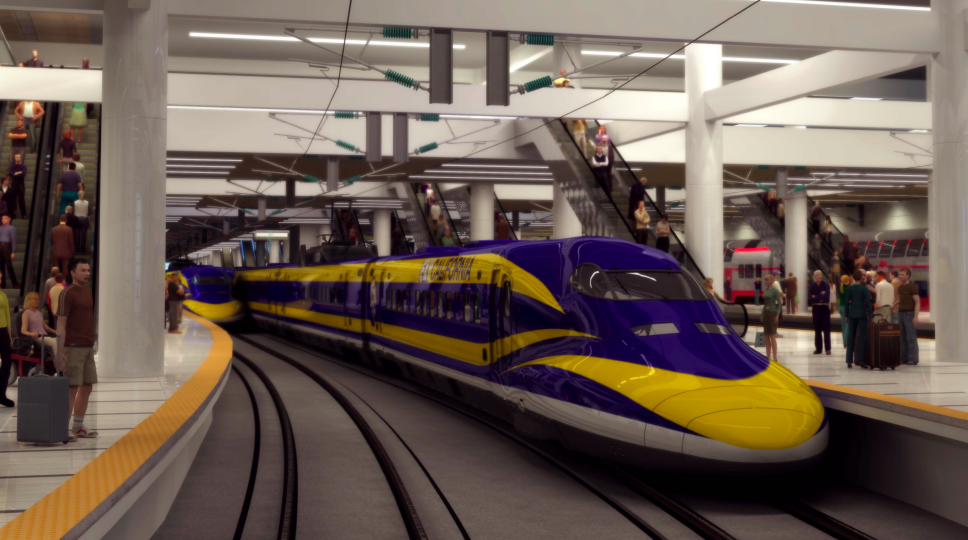
Artists' rendering of a high-speed train in San Francisco's new Transbay Terminal.

Three years ago tonight, I was in Perth, Western Australia, where I wrote stories on this blog about reactions to the US elections from Aussie college students and about the experiences of an American abroad on a historic election night.

Prior to leaving the country, I had voted by mail. Ever private in my politics, I only recommended people support one issue: Proposition 1A — the California High Speed Rail initiative.

California’s high-speed rail system is envisioned as an 800-mile system linking Southern California with Sacramento and the Bay Area at speeds up to 220 mph. The system is partially designed to compensate for a growing California population that Scientific American estimated in 2009 would otherwise require an extra 3,000 miles of highway lanes, five large airport runways and 91 airport gates by 2030 — improvements that were estimated to cost $100 billion.

In that regard, the California High-Speed Rail System integrates several principals of the Bay Area Metropolitan Transportation Commission’s 2035 plan, namely: Its downtown-to-downtown ideal serves the plan’s goals of primarily serving urban dwellers; It jibes with the ideal of “crisis brings opportunity,” — using the current economic upheaval to shift from over-reliance on cars and airplanes to more-sustainable alternatives, such as passenger rail; and, the system would have an effect on the MTC’s Regional Airport Systems plan by reducing intra-California flights.

Planning began with feasibility studies in the late 1990s, and a statewide initiative — initially based on an additional sales tax rather than a bond — was twice postponed while planners hoped for more-favorable economic conditions. When finally put on the ballot in 2008, the $9.95-billion bond proposition passed with 52.6 percent of the vote, a minor upset during an economic recession. It seemed like that high-speed rail would soon connect Northern and Southern California.

Flash-forward three years later, bad economic times and — especially — NIMBYs have stalled the project. While construction is still scheduled to begin sometime next year, opposition has increased. Joining the NIMBYs (covered in a previous post) are some financial conservatives who have balked at the anticipated costs of the project.

Last week, the financial news got even grimmer, as the California High Seed Rail Authority released a revised business plan. That plan estimated that — instead of the original $45 billion the entire plan would cost, the costs had climbed to an estimated $99 billion.

High-speed rail opponents and media critics went bananas, as might be expected. They criticized the more-than doubling of the original costs, continued to disbelieve projected ridership and questioned the need for the system altogether.

I beg to disagree.

What the media didn’t play up and the opponents have ignored are predictions that the HSR project will:

  • Be entirely self-sufficient operationally;
  • Generate 100,000 direct and indirect jobs over five years in the Central Valley alone during construction;
  • Generate 4,500 permanent jobs after construction is completed — compared to 100,000-400,000 in the rest of California by 2040;
  • Result in 8 billion fewer vehicle miles traveled;
  • Save 146 million hours;
  • Reduce CO2 emissions by 3 million tons.

Financially, a clarification should be made. The $98.5 million estimated cost includes a predicted three-percent inflation rate (which, off the top of my head means a cost “only” in the high $60 billion in today’s dollars). That out of the way, let's look at some of the real economic issues.

What if high-speed wasn’t built? Then, according to San José Mayor Chuck Reed, as quoted in the Silicon Valley Business Journal, California businesses and taxpayers would need $170 billion to add 2,300 lane-miles of freeway, four additional airport runways and 115 airline gates to accommodate the state’s increasing transportation needs (numbers slightly less than the ones above from Scientific American).

High-speed rail is expensive, but a bargain in comparison to the alternative. It needs to be built.

And locally, the opposition needs to settle down. As seen below, a very large percentage of San Mateo County voters supported Prop. 1A. Quoting wholesale from a previous post I made on this topic: “high-speed rail is an extremely positive project for San Mateo County as a whole, with great benefits from proposed stops at San Francisco International Airport and a possible stop in the South County. In addition, high-speed rail will be in a position to assist Caltrain with electrification and grade separation projects.”


I used to live in San Mateo on East 40th Avenue, one block from the tracks, so I understand the concerns of nearby residents. But there is a big picture and I hope that this post can remind Atherton and Menlo Park residents (and those in their respective city governments, which have filed suits against the project) of that big picture.

Friday, September 30, 2011

Omni predicts the distant future of 2010 -- Part I: Inflation

Omni magazine predicted the future, or did it?

Omni was a strange combination of a science magazine and a science fiction journal that published from 1978 to 1996. It specialized in "gonzo" science journalism, as well as publishing cutting-edge sci-fi.

In 1980, the editors published The Omni Future Almanac, which aimed to predict the trends of the next 30 years or so. Some predictions, they got pretty close on -- I plan to look at their views on e-mail and the Internet later. Some predictions were not so good -- the geo-political ones, for example (who saw that darn Berlin Wall falling within the next ten years?).

One area that Omni tried to predict was consumer costs. As the chart below shows, and remember that these predictions were made during the stagflation of the late Carter Administration, they were not so accurate about 2010 prices:

From Omni predicts 2010 prices

Wow! Obviously the rate of inflation has gone down. My local Safeway wants $1.49 (club card price) for a head of iceberg lettuce, not $5. The most-recent Big Mac index I could find shows the sandwich goes for about $4.07 in the United States, making $22 for a pound of ground beef seem high. The average monthly rent for a three-bedroom apartment in the San Francisco market is $2,662, not $10,000 (although a million dollars for a home purchase is close!). Current New York MTA subway fare is $2.25, not $20. The average US car sold for $28,000 in 2009, not $70,000. $2.75 for a daily newspaper? What's a newspaper?

The price of gas mark is interesting. Omni thought that better fuel efficiency in cars would drive down demand and greater drilling in Alaska and elsewhere would increase supplies, making the costs of fuel DROP significantly after 1990 to about $2 per gallon in 2010. The average price of gas in California right now is $3.84 per gallon. Interesting to see how geopolitics (and SUVs) affected gas price predictions.

To be fair, Omni also predicted that secretaries would now be making $95,000 a year and the average public high school teacher would pull in $110,000, over-estimating current rates in both cases. Of course, Omni also said a Major League Baseball player with "average skills" would make $330,000 per year. In 2010, the mean salary for a MLB player was about $3.3 million!

So the next time you see an economist predict the rate of inflation, take it with a grain of salt.