Wednesday, September 7, 2011

Bad military strategy rampant in Star Wars movie series

George Lucas' Star Wars series -- at least the original holy trinity -- is seen by many as extolling the virtues of Joseph Campbell's power of the heroic myth. The series has other highlights as well, I've personally written how Lucas channeled classic archetypes of organizational theory in the films, as an example.

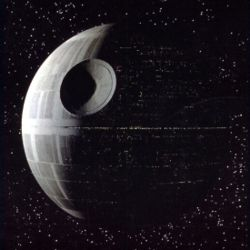
One thing Lucas has never been up on, however, was military strategy. Examples: in The Phantom Menace, a giant invasion force lands far from Naboo's capital, giving opponents time to organize guerilla warfare. The Empire never launches more than a squadron of TIE Fighters against the Rebels attacking the Death Star (right), despite some sources saying the battlestation had more than 7,000 on board. And don't get me started on the poor aim of Stormtroopers!

I've always thought the worst example of Imperial poor battle planning was when Vader kills an Imperial admiral in The Empire Strikes Back because he dropped the fleet out of hyperspace close to Hoth, hoping to surprise the Rebels. Any good tactical commander would've gone for the surprise.

But no, 34 years later I have finally discovered the worst example of strategic military planning in the movies. This scene, from late in the original movie, stood out to me when I saw it on cable last week.

From the shooting script (and preserved in the movie, despite all Lucas' modifications):

INTERIOR: MILLENNIUM FALCON -- COCKPIT.

Han, removes his gloves and smiling, is at the controls of the
ship. Chewie moves into the aft section to check the damage.
Leia is seated near Han.

HAN: Not a bad bit of rescuing, huh? You know, sometimes I even amaze myself.

LEIA: That doesn't sound too hard. Besides, they let us go. It's the
only explanation for the ease of our escape.

HAN: Easy...you call that easy?

LEIA: They're tracking us!

HAN: Not this ship, sister.

Frustrated, Leia shakes her head.

OK, so if Leia knew the Empire was tracking the Millennium Falcon, and the location of the Rebel Base was such a secret that Leia was unwilling to reveal it to the point where it got her home planet destroyed ... then why the fuck did she have the Falcon go straight to the Rebel base?????

C'mon George, you're killing me!

Tuesday, September 6, 2011

Volvos can crunch spreadsheets?


Wow, I knew the Swedes were tech savvy, but who knew this car could run Microsoft applications? (Click on photo to embiggen.)

Friday, September 2, 2011

Returning a 14-years overdue library book

It took a decade-and-a-half, but I have finally completed a long-postponed good deed.

Sometime in the fall of 1997, while attending Humboldt State University, I was riding the bus from Eureka back to my Arcata home when I found a book on the floor. It was a tome entitled, “The Philosophy of Nietzsche” (left) and markings clearly identified it as belonging to the library at College of the Redwoods.

I briefly perused the book, loosely browsing Nietzsche’s musings on “Man vs. Superman” and learned “Thus Spoke Zarathustra” came from the German philosopher’s writings.

There were no other passengers in my area of bus to whom it might belong, so I thought I’d hold onto the book until the next time I got down to College of the Redwoods, about seven miles south of Eureka. Having recently visited there, I thought it would be just a few weeks until I got back.

It turns out that being a poor, carless student with a full load of classes at HSU meant I never returned to the small community college while I lived on the North Coast. Nietzsche’s book was eventually integrated into my personal library’s philosophy section, with the vague understanding that I would return it if ever I got the chance. After graduation, I visited the Arcata-Eureka area a few times, but I was on very tight timelines or just plain forgot every time.

The guilt built each time I saw the book on my shelf.

Flash-forward to this week. My sister, who lives in the backwoods of Humboldt County, had a baby (a boy) in Eureka on Wednesday and I planned a visit. I decided to take the opportunity to return the book, which I had found again and set aside during a recent book purge at my house.

After some searching around the construction-plagued campus (below), I finally found the library and asked for a senior librarian. I was introduced to “Tim,” to whom I explained the situation.


I apologized to Tim for having held onto the book for 14 years and lamented the fact that some poor student had probably paid for the book a decade previous. He seemed a bit bemused.

“Better late than never,” Tim said. “It’s been on a journey.”

The library staff thanked me and I left campus a slightly happier man. Returning lost items gives me joy. It’s a shame, however I still haven’t reunited the camera I found at Comic-Con with its owners.

Tuesday, August 30, 2011

Guy Fawkes is no hero, Anonymous BART protestors

Guy Fawkes is not the hero "Anonymous" makes him out to be.

On Jan. 1, 2009, a police officer employed by the BART transit agency shot and killed a subdued man named Oscar Grant, who was suspected of fighting on a train. The officer who fired the shot said he thought he was holding his TASER at the time, and was later convicted of involuntary manslaughter. The shooting and the verdict brought massive protests in parts of the Bay Area. In July 2011, another BART officer shot and killed a man named Charles Hill at Civic Center station. Hill was reported to police after reportedly seeming belligerent and intoxicated.

A large protest against Hill's death and alleged heavy-handed techniques of BART officers briefly closed the Civic Center Station later that month. When another demonstration about the shootings was scheduled for August 2011, BART officials, mindful of how social media is used to coordinate protests in this day and age, ordered cellular phone repeaters in the underground stations be shut down in an attempt to corral protests.

The effort backfired spectacularly, as people from First Amendment supporters to tech columnists lambasted the move and multiple protests against the cell service shutdown have shut down stations and frustrated commuters. Key organization for the protests has been supplied by the loose association of individuals known as "Anonymous," which initially gained widespread notoriety by supporting the information-sharing website Wikileaks.

It's here where it gets interesting. "Anonymous" supporters, in protests from London to San Francisco, have taken to wearing Guy Fawkes masks like those sported by the anti-hero "V" in Alan Moore's classic early 1980s comic "V for Vendetta." These protesters, as seen at the top of the page, apparently seek to emulate the anarchist hero (seen below) of the comic-books (later collected in graphic novel form). At the end of the movie adaptation of the books, scores of protesters in Guy Fawkes masks are symbolically seen helping to bring down a fascist British government.


The problem is that Guy Fawkes was no hero. He planned to blow up Parliament, killing the King, Lords, and MPs inside, in order to found a repressive Catholic theocracy. While V had a specific reason to wear a Guy Fawkes mask because he also intended to blow up Parliament (which is done on page 7 of the comics and at the climax of the movie), I'm not seeing why Anonymous has adopted the symbol. Yes, the comic V was an anarchist, as no doubt are some Anonymous supporters, but Fawkes himself was very much the man these people would be fighting against -- a mercenary for hire who fought for a number of countries that supported his religious philosophy. Indeed, basically a Christian jihadist. Fawkes thus has no place being the figurehead of a non-violent protest movement.

But, BART is also not blameless here. When officials such as spokesman Linton Johnson claim "there's no right to free speech" on train platforms, they may be legally correct but morally wrong. Preventing communications in order to disrupt a protest does, in fact, remind me of the repressive government in "V for Vendetta," who are always letting the public know they are in charge (see right).

Of course, this thing makes me wonder: how many Anonymous folks read Moore's other seminal work, Watchmen, where good intentions went very awry (in form of exploding squid)?

Monday, August 29, 2011

Obesity and poverty: Burger King takes food stamps?


The Western World, and the United States in particular, is one of the few places in the world where obesity rates are higher in poor families than in the general population.

Reasons for this are many, ranging from the prevalence of "food deserts" in poor communities, to the ease of buying preprocessed food for time-strapped families working multiple jobs, to the relatively low cost of fast food in relation to healthy food.

Well, the picture below -- taken at a Burger King in San Francisco's Civic Center -- highlights another potential reason. This fast food restaurant is directly marketing its product to the poor, advertising it will accept EBT (Electronic Benefits Transfer, the modern equivalent of food stamps) as payment. It's not difficult to see how poverty and obesity are related in this context.


This is a depressing development. I realize there's not much in the way of markets in the Tenderloin area, but I'd still like to see public benefits used for more-healthy food. I certainly would rather my state representatives, such as my State Senator Leland Yee, address this issue instead of unconstitutional bans on video game sales.

Monday, August 15, 2011

Leaving my wife for Debbie Gibson?

Bowing to a fit of nostaglia, I recently began following my high-school crush -- '80s pop goddess Debbie Gibson -- on Twitter. She's been posting some old photos from her heyday on the microblogging site, and when I responded to one of her and future Internet meme Rick Astley this afternoon, Debbie liked it enough to retweet, which led to the following discussion with the missus:


The missus' response was "I hope you, Debbie and (Kid 1) are very happy together. I guess (Kid 2) and I will just have to cry ourselves to sleep tonight."

Ah, when you put it that way ... Sorry Debbie!

Wednesday, July 27, 2011

Defensive indifference put Jerry Meals on the spot, so eliminate the stat

The bad call that ended Tuesday's 19-inning Braves-Pirates game.

Back in 2009, I called defensive indifference the "most-unfair baseball stat." Tuesday night's Pirates-Braves game, which ended in a controversial fashion, cemented my hate of the statistic.

In the bottom of the 19th inning, with one out and runners and second and third, the Braves' Scott Proctor hit a grounder to third, which Pirates third baseman Pedro Alvarez handled well and threw home, seemingly putting out Atlanta runner Julio Lugo by a mile. But umpire Jerry Meals controversially called Lugo "safe," ending the game with what some writers are calling the "worst call ever" because it ended an amazing baseball game (although I still think Don Dekinger's call in the 1985 World Series will have more of a longterm impact). The call here was so bad that the Pirates have filed a formal complaint with the MLB offices.

Where "defensive indifference" comes into play here was the fact that there were runners on second and third only because Atlanta's Jordan Schafer, who had singled, ran to second base a few pitches after his hit. The scorekeeper ruled Schafer's advance as "defensive indifference" because the Pirates made no effort to put him out.

But if Schafer had not advanced to second, it would have been a different game altogether because the advance eliminated the possibility of a double play. Proctor's grounder was hard enough that Alvarez could have gotten the runner at second and also the runner at first. If there'd been a double play, the inning would have been over. Therefore, Schafer's advance was critical to the Braves' win and I think simply labeling it as "defensive indifference" is a disservice.

Even the Pirates' announcers agreed as the play happened. "If a guy takes second base," one said, "give him a stolen base regardless."

I concur. Advancing is important. As I wrote earlier, "A runner stealing second -- or advancing on "defensive indifference" -- (...) reduces the potential options for a force play by 50 percent. ... A defense may indeed chose to concentrate on a batter rather than a runner, but any runner that advances makes the defense's job all that much harder."

Therefore, I am forced once again to state that "defensive indifference" is a horrible statistic that needs to be eliminated. Call them stolen bases, because every advance can change the game.

Monday, July 25, 2011

Lost and Found at Comic-Con

Do you know us?

This past weekend, the family took its annual pilgrimage to Comic-Con in San Diego. We had a good time, and I'll try and do a blog wrap-up later.

The wife and kids left Saturday morning, leaving me on my own for the final two days of the Con, including Sunday, where after spending six hours in line (three to pre-register for 2012 and another three for the Doctor Who panel), I -- as has become traditional -- wrapped the convention with a sing-along showing of "Once More, With Feeling," the Buffy musical episode. As it began, I saw that someone had left a Nikon camera on the seat in front of me. I kept an eye on it for the next hour, but no one came to claim it.

I then decided to try and reunite it with its owner by posting pictures online. Above is one of the only personal pictures I found on the camera. All the other photos are from panels (from Futurama to Glee to Sons of Anarchy, plus others I am withholding to use as ID questions) in either Ballroom 20 or Hall H at the San Diego Convention Center.

Why did I not simply turn it into lost and found? Because there were no doubt hundreds of items lost and/or found at the convention, including many cameras -- in fact, other Nikon cameras. I'm hoping showing the picture above might give me a better shot of reuniting owner and camera than the owner's simply cold-calling the Convention Center.

So if you know the girls above, contact me via the e-mail address on my profile page. I'll ask some question to verify (Description? What article was the camera in? What other panels had pictures on the camera? etc.) and make arrangements for its return.

Monday, July 18, 2011

The missus is on StreetView, butt ...


A couple weeks ago, I pointed out that StreetView cars are becoming ubiquitous, even showing up in my neighborhood.

Well, the new pictures came up on StreetView this week, and it turns out my wife made the cut -- although it may not be the most-flattering of angles (above) ...

Tuesday, July 12, 2011

The hippification of Bob St. Clair

Bob St. Clair was one of pro football’s most-feared tackles in the 1950s and 1960s. The burly (6-foot, 9-inch, 263 pounds) St. Clair was one of the San Francisco 49ers’ most-potent weapons, blocking on both offense and defense, and led the Red and Gold by being named to nine all-NFL teams and five Pro Bowls.

St. Clair was elected to the Pro Football Hall of Fame in 1990 for his accomplishments.

After retiring from the NFL, St. Clair got into politics, serving first as a councilmember in Daly City, then as a member of the San Mateo County Board of Supervisors from 1967-1975. By all accounts, he was as nimble politically as he was on the gridiron.

A few years back, when I worked in Redwood City’s Hall of Justice as a public safety dispatcher, I would look at the pictures on the walls honoring former supervisors while on breaks. St. Clair’s photos always stood out to me, not only because he was head and shoulders above his fellow supervisors, but because of a gradual process I can only call … “hippification” while on the Board.

Over the course of six or seven years, you can watch as St. Clair transformed in official group photos from an uptight, if tall, “suit” into a ‘70s fashion disaster, complete with denim jacket, long-ish hair and tinted glasses. It’s both amusing and gratifying that San Mateo County had such “hip” (or should that be “groovy?”) representation.

Here’s the relevant pictures, taken earlier today while I was in the building for jury duty (for which I was quickly dismissed – guy was accused of stealing a Blackberry. I think the alleged thief was doing the victim a favor!). Please forgive the picture quality, as these were taken with an iPhone 3G in low light and of a framed phtograph covered by glass (hence the glare/reflections).

In 1968 (below), St. Clair (standing left) was well-groomed, wearing a smart tie and looking every bit the 1960s politician:


In 1969, St. Clair (sitting center) defied tradition with a khaki jacket, but still was conservative in his dress:


By 1970, St. Clair's hair (back row, middle) was a little shaggy, in line with the times, but still wouldn't raise many eybrows:


The same in 1971 (St. Clair in the center):


Here we go! By 1973, St. Clair (far right) looked as if he were going on safari,his open coat and lack of tie defying tradition:


Finally, by 1973, St. Clair (center) clearly doesn't give a frak about what others think. He's going to make a hole for legislation like he opened the pocket for Y.A. Tittle. Check out the hair, glasses and coat:


I met St.Clair a few times back in 2001, when I served as extra mid-week security for Candlestick Park after the terrorist attacks of that year. St. Clair, at the time a 49ers consultant, would drop in a few times a week to visit the offices and would check in with me at the gate. He seemed a really nice fellow.

And his hair was short.
Friday, July 1, 2011

Streetview cars are everywhere, even on TV

It seems Google is becoming ubiquitous in our lives (this blog you're reading is on a service owned by Google, for example), to the point where "Google" has become a verb.

Google's Streetview service has become a godsend to wandering travelers and armchair explorers (I used it prior to my 2008 Australia trip to plan walking routes around the neighborhoods I'd be visiting). It has also brought protests from those who say the service violates privacy, even though it does no such thing.

It's no surprise, then, that Google's Streetview cars have been constantly going through neighborhoods to update photos. A car was seen in my neighborhood in March, for example.

Still I was surprised that while watching "Burn Notice," about 54 minutes into last night's episode (counting commercials), I saw a Google Streetview car go by in the background (below).


The chances of a TV show shooting at the exact same time a Streetview car goes by might seem low, but -- as I wrote above -- the cars are all over the place now. It's probably for that reason that the editors of Burn Notice left the shot with the very-noticeable Streetview car in the show instead of using another take -- it's more realistic that way!