Saturday, September 17, 2011

What happened to media coverage of San Francisco prep sports?

Is the lack of preps coverage related to the lack of fans,
or is the lack of fans related to the lack of coverage?

As usual during the last 20 or so Septembers, I've been covering high school football for local newspapers the last couple weekends. This afternoon, I covered El Camino High's visit to Lincoln High, where the photo above was taken.

There once was a time were the San Francisco High School Championship would bring 50,000 people to Kezar Stadium, but there were probably as many people on the field Saturday as in the stands. While an estimated 500,000 people attended high school sporting events in 2009-2010, attendance is no doubt well down from its peak era.

Of course, it ultimately comes down to a waning interest in both participation and outside interest in high school sports due to the availability of other activities (e.g., video games and the freakin' Internet). One factor might be the relative lack of media coverage at "prep" sports today. I was the only person reporting today's game for a newspaper. A decade ago, the same game might have brought at least four print media reporters and a crew from a TV show such as "High School Sports Focus." Is the lack of media coverage of high school sports a symptom or a cause of low attendance?

Locally, I trace a lot of the decline in local media coverage to Hearst's acquisition of the Chronicle about 10 years back. Then, as now, the Chronicle had very little high school sports coverage. But the Hearst-owned Examiner had healthy preps coverage and did fairly well. So when the Examiner staff took over the Chronicle, one might have thought that Hearst would bring its coverage over there. Not the case. Prep coverage in the Chronicle is virtually nonexistent.

The Fang family, which owned the thrice-weekly Independent, which had a decent local sports section, took over the Examiner, and covered local sports well (at least until it came under Anschutz ownership). Of course, an eventual casualty of Fang ownership of the Examiner was the very existence of the Independent (the Fangs apparently couldn't afford to keep two papers going). So, over time, the city of San Francisco was left with minimal high school sports coverage.

But new technology is giving prep sports coverage hope. While the local sports pages of local papers like The San Mateo County Times has shrunken precipitously, other media have stepped in to take up some of the slack. The only other reporter at the game was from SanFranPreps.com, a local site started by a San Francisco State University graduate to cover local sports. In this, its second year, SanFranPreps has gotten successful enough it can start paying its writers, or so its editor told me last week. Over the past five years or so, MaxPreps.com has revolutionized the coverage and visibility of high school sports. Even the somewhat-maligned Patch.com from AOL has somewhat helped improve local sports coverage.

So, while the crowds are not at the games anymore, and the "traditional" media has almost abandoned prep coverage (and limited local coverage as a whole), new media offers a ray of hope -- albeit a slight one.

Friday, September 16, 2011

KaBOOM! explodes South City's Orange Park playground


It’s no secret that local governments are in dire straights. The recession has depleted the coffers of local agencies and resulted in huge cuts in local budgets.

Even my own city of residence, South San Francisco, has cut its budget by more than $700,000 and that “low” level of cuts was only possible thanks to a heavy dip into the reserves. So it was no surprise that when it came time to renovate the playground at Orange Park — absolutely my kid’s favorite playground in the region — the city looked for a way to cut costs.

The City entered a public/private partnership with KaBOOM!, a non-profit organization that has built hundreds of playgrounds across the country. Former Daly City Parks and Recreation Commissioner Eric Zeemering, who is also former SFSU public administration professor, told me last year that KaBOOM! “bring(s) a great group of volunteers together and really do(es) fantastic work.”

After a months-long process of fundraising and volunteer recruitment, the new playground opened late last month. The result of that work is up at the top of this post.

To review, let’s look at how Orange Park’s main playground used to be (2007 photo):


All of that was ripped out, including a pair of train play sets that my son loved playing on. Now there’s just a big vacant space on the formerly busy playground:


My son misses the old trains. I understand there was a limit to what KaBoom could donate, but why did they have to rip ALL the old playground equipment out? I know the City said it was due to it not meeting safety codes, but if it were an actual hazard, wouldn't they have ripped it out long before now?

Nevertheless, both my kid and others seemed to enjoy the new equipment (left). It was obviously clean, the slides were still nice and slick, there were no jagged edges and there was a refreshing lack of graffiti. In short, what they still did have at the playground was very nice.


And, of course, the old place didn’t have such dire safety warnings:


Public/private partnerships have proven to be a valuable way to leverage limited funds. Cities can’t do it on their own anymore, and organizations such as KaBOOM! (which was hilariously featured in an episode of Parks and Recreation) might just be key to local governments’ ability to deliver services.

But citizens need to beware of the strings attached, and next time, keep the train!

Monday, September 12, 2011

Local blog tips from SFist and CurbedSF

Local online journalism is as much about fingers on the keys as it is boots on the ground, according to editorial staff from a pair of respected blogs focusing on local news and features in San Francisco.

Sally Kuchar, editor at SF.Curbed.com, and Andrew Dalton, associate editor of SFist.com, addressed students in a journalism seminar at San Francisco State on Wednesday and pointed out that a lot of the work needed to put together a good local blog is perusing other websites that cover the same issues.

For example, Kuchar said she checks a syndicated Google Reader feed hourly and spends a lot of time perusing local blogs and online photo collections, such as those on Flickr. Tips through the website itself are also important. Of course, if one does use something from another site, they must be sure to cite their sources — even if that source was just used as “inspiration.”

Dalton noted that one important thing a local blog needs to do is interact. For example, the SFist staff does not simply put headlines up on SFist’s Twitter feed, it actively interacts with its readers. The hope is that readers will feel that there are real people behind the posts, not just robots.

Tips learned:
1. Don’t be afraid to read the competition;
2. Expand beyond the traditional web feeds, check Flickr and the like;
3. Cite your sources;
4. Interact!;
5. Don’t be afraid to post frequently, just keep the quality high.

Finally, although quality is of extreme importance, much as it is in traditional journalism, local sites shouldn’t be afraid to use a bit of quantity in their social media feeds, according to both editors. With readers checking going onto the Internet at different, non-consistent times of day, they might miss an article posted at an earlier time. Local news sites should feel secure that occasionally reposting the same story link might find it a new audience at a later time.

Friday, September 9, 2011

On the cusp of the Silver Age: Challengers of the Unknown

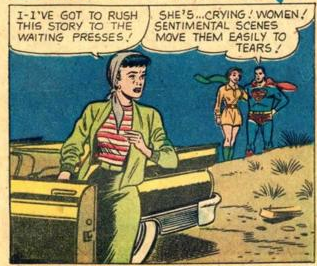
Most serious comic book fans know the time between the Golden and Silver ages was a strange era for comics. Wertham's Seduction of the Innocent had left the publishers in an aimless funk, their crime comics cancelled, their superhero books toned down and their business failing.

And with misogynistic writing like that to the right (from Action Comics No. 260, where Superman pretends to have an affair with his disguised 15-year-old cousin Supergirl for a typically convoluted plot reason), who can blame readers for leaving the medium?

While the 1956 introduction of the Silver Age Flash started the industry's revival, 1961's Fantastic Four No. 1 cemented it. But as famous as the FF is, the concepts of scientific adventurers (or, as Mark Waid later called them, "Imaginauts"), was actually predated a few years earlier with DC's Challengers of the Unknown -- not coincidentally co-created by Jack Kirby, who also co-created the Fantastic Four.

The group debuted in Showcase No. 6 (February 1957) as four acquaintances -- Kyle "Ace" Morgan, Matthew "Red" Ryan, Leslie "Rocky" Davis, and Walter Mark "Prof" Haley -- miraculously survived a plane crash unscathed. They concluded that since they were "living on borrowed time," they should band together for hazardous adventures. I recently checked out a collected edition of the Challengers' first stories from a local library, and you can really see the sense of adventuring and exploration (rather than simply fighting bad guys) that was later to be the hallmark of the best early FF stories.

Not to say there weren't some silly moments that marked the Challengers as products of their Cold War, "American Can-do," era. For example, in the panel below, an alien is on the loose and the Challengers are concerned its appearance will harm industrial production:


In another silly panel, the amazing concept of a "rock formation" in a city, is cause for worry:


What city doesn't have a rock formation somewhere? Sigh.

Still the Challengers were good fun in their early appearances, if not up to the amazing standard that the Fantastic Four would set less than five years later.

Thursday, September 8, 2011

Who defines a journalist? Apparently BART police ...

#opbart @awesome_hubris tell me #anonymous press is @vinceinthebay
(Photo by Steve Rhodes, via Flckr.)

A protest at a San Francisco BART station on Thursday outlined the continually evolving struggle to define what makes a journalist and, even worse, the government's role in that definition.

I've blogged here recently about the continuing series of protests against BART after District police shot and killed a man who was reportedly threatening them with a knife and the (in my opinion unconscionable) decision to cut cellular phone service in the stations in order to curtail protests. Another protest on Thursday brought the issue of defining journalists to the forefront.

Instructor Justin Beck, a former San Francisco Chronicle writer and avid Twitterer who taught me last spring in Journalism 226, decided it would be a great teaching experience to take his San Francisco State University online journalism students to the protests as an exercise in live blogging/tweeting an ongoing news event. Things got hectic when, according to the students' Twitter timeline, officers dispersing the crowd began to question the student journalists' lack of professional credentials.

At least one student, Brad Wilson, reported he was handcuffed and detained after being stuck in a throng of protestors that were locked in the BART station by police.


The SFSU student newspaper reported that seven students were detained, the longest for more than two hours. Other media stated that more than 20 people were detained or arrested. Wilson told me via Twitter that he was not cited after Beck stood up for him and the other students.

While the police may claim the students, and other media who were also cited at the event, were exacerbating the protests, the issue about the credentials is a key one. Who should be deciding who are and who aren't journalists? BART police think they are the ones who should decide, it seems.

First, let's address the issue of whether "student journalists" are, in fact, "journalists." To me, it's no question that student journalists have the same rights as professional journalists. In fact, a groundbreaking case on whether police have the rights to search newsrooms is based on a case involving a school paper. In Zurcher vs. Stanford Daily (436 U.S. 547 (1978)), the US Supreme Court ruled that -- at the time -- police may search a newsroom seeking evidence of crimes covered by a media outlet. So outraged was the press and the public, that Congress passed the Privacy Act of 1980, which greatly limits the circumstances in which a newsroom can be searched. Therefore, case law has established that "student journalists" are just plain "journalists."

So to the larger issue; who defines what makes a journalist? Many cities have tried. Lake Oswego, Ore., tried to define a journalist as someone who works for an established media outlet, in an apparent attempt to filter out bloggers from covering certain meetings. In discussing a shield law for journalists a couple years back, senators attempted to limit the "journalist" tag to professionally affiliated journalists.

These definitions simply do not fit the realities of today's journalism. These days, one is more likely to find out local news via a blog, such as SFist or Patch than they would the big city paper. These smaller outlets rarely have much full-time staff and depend on volunteer or freelance contributors for their content.

Many scholarly papers have debated this issue. A growing consensus is going to a definition based on function (i.e., what are these people doing?) instead of a one based on status (who do these people work for?).

Debate over a federal shield law brought the issue front and center, according to an article at Mashable:
According to David Ardia, the director of the Citizen Media Law Project at Harvard Law School, “A functional definition is the way to define journalism. We don’t want to create a definition or guidelines that work only with the current journalistic model. The best definition looks at the activities. Were they conducted with the purpose of providing information to the public? That’s the core and puts the public at the center.”

Were these students seeking to provide information to the public? Damn straight they were. In fact, they were learning how to do so properly. So, to paraphrase The Treasure of the Sierra Madre, "Press passes? We don't need no stinkin' press passes."

At least the students had a sense of humor about being detained:

Wednesday, September 7, 2011

Bad military strategy rampant in Star Wars movie series

George Lucas' Star Wars series -- at least the original holy trinity -- is seen by many as extolling the virtues of Joseph Campbell's power of the heroic myth. The series has other highlights as well, I've personally written how Lucas channeled classic archetypes of organizational theory in the films, as an example.

One thing Lucas has never been up on, however, was military strategy. Examples: in The Phantom Menace, a giant invasion force lands far from Naboo's capital, giving opponents time to organize guerilla warfare. The Empire never launches more than a squadron of TIE Fighters against the Rebels attacking the Death Star (right), despite some sources saying the battlestation had more than 7,000 on board. And don't get me started on the poor aim of Stormtroopers!

I've always thought the worst example of Imperial poor battle planning was when Vader kills an Imperial admiral in The Empire Strikes Back because he dropped the fleet out of hyperspace close to Hoth, hoping to surprise the Rebels. Any good tactical commander would've gone for the surprise.

But no, 34 years later I have finally discovered the worst example of strategic military planning in the movies. This scene, from late in the original movie, stood out to me when I saw it on cable last week.

From the shooting script (and preserved in the movie, despite all Lucas' modifications):

INTERIOR: MILLENNIUM FALCON -- COCKPIT.

Han, removes his gloves and smiling, is at the controls of the
ship. Chewie moves into the aft section to check the damage.
Leia is seated near Han.

HAN: Not a bad bit of rescuing, huh? You know, sometimes I even amaze myself.

LEIA: That doesn't sound too hard. Besides, they let us go. It's the
only explanation for the ease of our escape.

HAN: Easy...you call that easy?

LEIA: They're tracking us!

HAN: Not this ship, sister.

Frustrated, Leia shakes her head.

OK, so if Leia knew the Empire was tracking the Millennium Falcon, and the location of the Rebel Base was such a secret that Leia was unwilling to reveal it to the point where it got her home planet destroyed ... then why the fuck did she have the Falcon go straight to the Rebel base?????

C'mon George, you're killing me!

Tuesday, September 6, 2011

Volvos can crunch spreadsheets?


Wow, I knew the Swedes were tech savvy, but who knew this car could run Microsoft applications? (Click on photo to embiggen.)

Friday, September 2, 2011

Returning a 14-years overdue library book

It took a decade-and-a-half, but I have finally completed a long-postponed good deed.

Sometime in the fall of 1997, while attending Humboldt State University, I was riding the bus from Eureka back to my Arcata home when I found a book on the floor. It was a tome entitled, “The Philosophy of Nietzsche” (left) and markings clearly identified it as belonging to the library at College of the Redwoods.

I briefly perused the book, loosely browsing Nietzsche’s musings on “Man vs. Superman” and learned “Thus Spoke Zarathustra” came from the German philosopher’s writings.

There were no other passengers in my area of bus to whom it might belong, so I thought I’d hold onto the book until the next time I got down to College of the Redwoods, about seven miles south of Eureka. Having recently visited there, I thought it would be just a few weeks until I got back.

It turns out that being a poor, carless student with a full load of classes at HSU meant I never returned to the small community college while I lived on the North Coast. Nietzsche’s book was eventually integrated into my personal library’s philosophy section, with the vague understanding that I would return it if ever I got the chance. After graduation, I visited the Arcata-Eureka area a few times, but I was on very tight timelines or just plain forgot every time.

The guilt built each time I saw the book on my shelf.

Flash-forward to this week. My sister, who lives in the backwoods of Humboldt County, had a baby (a boy) in Eureka on Wednesday and I planned a visit. I decided to take the opportunity to return the book, which I had found again and set aside during a recent book purge at my house.

After some searching around the construction-plagued campus (below), I finally found the library and asked for a senior librarian. I was introduced to “Tim,” to whom I explained the situation.


I apologized to Tim for having held onto the book for 14 years and lamented the fact that some poor student had probably paid for the book a decade previous. He seemed a bit bemused.

“Better late than never,” Tim said. “It’s been on a journey.”

The library staff thanked me and I left campus a slightly happier man. Returning lost items gives me joy. It’s a shame, however I still haven’t reunited the camera I found at Comic-Con with its owners.

Tuesday, August 30, 2011

Guy Fawkes is no hero, Anonymous BART protestors

Guy Fawkes is not the hero "Anonymous" makes him out to be.

On Jan. 1, 2009, a police officer employed by the BART transit agency shot and killed a subdued man named Oscar Grant, who was suspected of fighting on a train. The officer who fired the shot said he thought he was holding his TASER at the time, and was later convicted of involuntary manslaughter. The shooting and the verdict brought massive protests in parts of the Bay Area. In July 2011, another BART officer shot and killed a man named Charles Hill at Civic Center station. Hill was reported to police after reportedly seeming belligerent and intoxicated.

A large protest against Hill's death and alleged heavy-handed techniques of BART officers briefly closed the Civic Center Station later that month. When another demonstration about the shootings was scheduled for August 2011, BART officials, mindful of how social media is used to coordinate protests in this day and age, ordered cellular phone repeaters in the underground stations be shut down in an attempt to corral protests.

The effort backfired spectacularly, as people from First Amendment supporters to tech columnists lambasted the move and multiple protests against the cell service shutdown have shut down stations and frustrated commuters. Key organization for the protests has been supplied by the loose association of individuals known as "Anonymous," which initially gained widespread notoriety by supporting the information-sharing website Wikileaks.

It's here where it gets interesting. "Anonymous" supporters, in protests from London to San Francisco, have taken to wearing Guy Fawkes masks like those sported by the anti-hero "V" in Alan Moore's classic early 1980s comic "V for Vendetta." These protesters, as seen at the top of the page, apparently seek to emulate the anarchist hero (seen below) of the comic-books (later collected in graphic novel form). At the end of the movie adaptation of the books, scores of protesters in Guy Fawkes masks are symbolically seen helping to bring down a fascist British government.


The problem is that Guy Fawkes was no hero. He planned to blow up Parliament, killing the King, Lords, and MPs inside, in order to found a repressive Catholic theocracy. While V had a specific reason to wear a Guy Fawkes mask because he also intended to blow up Parliament (which is done on page 7 of the comics and at the climax of the movie), I'm not seeing why Anonymous has adopted the symbol. Yes, the comic V was an anarchist, as no doubt are some Anonymous supporters, but Fawkes himself was very much the man these people would be fighting against -- a mercenary for hire who fought for a number of countries that supported his religious philosophy. Indeed, basically a Christian jihadist. Fawkes thus has no place being the figurehead of a non-violent protest movement.

But, BART is also not blameless here. When officials such as spokesman Linton Johnson claim "there's no right to free speech" on train platforms, they may be legally correct but morally wrong. Preventing communications in order to disrupt a protest does, in fact, remind me of the repressive government in "V for Vendetta," who are always letting the public know they are in charge (see right).

Of course, this thing makes me wonder: how many Anonymous folks read Moore's other seminal work, Watchmen, where good intentions went very awry (in form of exploding squid)?

Monday, August 29, 2011

Obesity and poverty: Burger King takes food stamps?


The Western World, and the United States in particular, is one of the few places in the world where obesity rates are higher in poor families than in the general population.

Reasons for this are many, ranging from the prevalence of "food deserts" in poor communities, to the ease of buying preprocessed food for time-strapped families working multiple jobs, to the relatively low cost of fast food in relation to healthy food.

Well, the picture below -- taken at a Burger King in San Francisco's Civic Center -- highlights another potential reason. This fast food restaurant is directly marketing its product to the poor, advertising it will accept EBT (Electronic Benefits Transfer, the modern equivalent of food stamps) as payment. It's not difficult to see how poverty and obesity are related in this context.


This is a depressing development. I realize there's not much in the way of markets in the Tenderloin area, but I'd still like to see public benefits used for more-healthy food. I certainly would rather my state representatives, such as my State Senator Leland Yee, address this issue instead of unconstitutional bans on video game sales.

Monday, August 15, 2011

Leaving my wife for Debbie Gibson?

Bowing to a fit of nostaglia, I recently began following my high-school crush -- '80s pop goddess Debbie Gibson -- on Twitter. She's been posting some old photos from her heyday on the microblogging site, and when I responded to one of her and future Internet meme Rick Astley this afternoon, Debbie liked it enough to retweet, which led to the following discussion with the missus:


The missus' response was "I hope you, Debbie and (Kid 1) are very happy together. I guess (Kid 2) and I will just have to cry ourselves to sleep tonight."

Ah, when you put it that way ... Sorry Debbie!