Thursday, November 17, 2011

CSU teachers hold one-day strike to protest pay freeze, fee increases

CSU Faculty Association members demonstrate at CSU East Bay. Photo by Justin Beck, via Twitter.

Teachers from the California State University system protested today at two campuses after two years without pay raises, and they used social media in an attempt to urge students to support their cause.

Professors rallied at both CSU East Bay and CSU Dominguez Hills -- the first-ever labor action since the California Faculty Association got collective bargaining rights in 1983.

Demonstrators at CSU East Bay marched in front of multiple sides of the Hayward campus. According to witnesses on scene, the crowd was loud and active …

About 50 faculty and staff on Harder Rd side of #CSUEB campus. Chant "what's this about? EDUCATION!" #csustrike@XpressNews
Nov 17 via Twitter for iPhoneFavoriteRetweetReply


Union officials said via Twitter that the dispute isn’t just over their pay, but also over escalating student fees and staff cutbacks over the past 13 years, despite raises to administrative pay during that same time period:

Change in CSU Salaries & Student Fees, 1998-2010 (adjusted for inflation, base year 1998) #csustrike#highered#occupyhttp://t.co/gyWsq00v
Nov 17 via webFavoriteRetweetReply


The teachers, adept at giving grades, gave a failing one to CSU Chancellor Charles Reed:


A San Diego State professor explained that cutting CSU classes while raising tuition harms those who would most benefit from the system:

#csustrike majority of our students are working class, first generation college, and students of color.
Nov 17 via Twitter for iPhoneFavoriteRetweetReply


The demonstration got some support from students:

"I definitely support them, they don't paid enough for what they do." Autumn Stanley, sfsu freshman BETA major. #csustrike#jour650
Nov 17 via Twitter for AndroidFavoriteRetweetReply


Supporters at some campuses even organized transportation to the universities where demonstrations took place:

#csustrike 12:45 bus leaves in one hour! There is still time to get on the bus and join us at CSUDH.
Nov 17 via webFavoriteRetweetReply


Students from San Bernardino come out in solidarity to support their faculty #reclaimcsu#csustrikehttp://t.co/UDcTVvAl
Nov 17 via Twitter for BlackBerry®FavoriteRetweetReply


At both CSU Dominguez Hills and CSU East Bay, the campus was described as being virtually empty:

DH campus=a ghost town except 4 the picket areas. No 1 will strike huh Charlie? Ur as good a prognosticator as u r a Chancellor. #csustrike
Nov 17 via webFavoriteRetweetReply


CSU public relations staff felt compelled to do a little damage control and reply to posts on the Web, such as this post from a CSU Northridge student:

@calstate maybe the board of trustees should take a pay cut too. Every member! I'm sure they're making over 100k a year.
Nov 17 via Twitter for iPadFavoriteRetweetReply


Which brought this response:

SergiosThoughtsSergio Valencia
in reply to @SergiosThoughts

@sergiosthoughts There is no pay to cut. The members on the CSU Board of Trustees are volunteers so they get zero dollars.
Nov 17 via HootSuiteFavoriteRetweetReply


Video taken at the CSU East Bay protest showed a peaceful demonstration, with picketers circling and traffic patiently waiting for its turn to cross:

How i spent my mornng -- CSU Strike, 11.17.2011 http://t.co/7QnKbLDS#CSUStrike
Nov 17 via Tweet ButtonFavoriteRetweetReply


Some classes at Dominguez Hills and East Bay were cancelled, and classes at other campuses saw their routine disrupted:

Because of the #csustrike my class is at Shakeys tonite.
Nov 17 via Twitter for iPhoneFavoriteRetweetReply

Wednesday, November 16, 2011

My favorite South San Francisco eateries

I'm not a great foodie, but I do know what I like. I don't get too fancy or too adventurous, but I am willing to go out on a limb now and then, foodwise.

So my list of favorite places to eat in South San Francisco doesn't get too fancy or adventurous either. The restaurants on the list below are not necessarily the best (I've never been to the Basque Cultural Center, for example) or the ones I most visit (no fast food places), but are the restaurants to which I most like to go.

First, a map of the locations below:

View South San Francisco eateries in a larger map

I tried to balance the list out a bit in terms of geography, type of food served and how often I go to a particular place. In no particular order:

Pho The Gioi

Pho The Gioi
2239 Gellert Blvd / (650) 754-1888
Genre: Vietnamese
Yelp Review

While in a strip mall, Pho The Gioi’s generous portions of pho and other spicy noodle dishes make you think you’re in a far-fancier place. The location (Next to Pak and Save and OSH) is a great attraction for west of El Camino Real suburbanites. Admittedly the food is not the real attraction at Pho The Gioi. There is a well-reviewed Vietnamese place downtown (Ben Tre, 219 Grand Avenue), but I’ve not been there.
___

Little Lucca's

Little Lucca Sandwich Shop
724 El Camino Real / (650) 589-8916
Genre: sandwiches
Yelp review

Little Lucca looks like a house left over from the days before suburbanization, when single family homes lined El Camino Real – “The King’s Highway.” And the sandwiches at Little Lucca really are made for a king — piled so high that one really can’t get their mouth around it (unless they’re a snake). There’s always a line out the screen door into the front yard (remember, this place is basically a house) at lunchtime, but an efficient line crew moves the queue swiftly.
___

Darby Dan's

Darby Dan's Sandwiches
733 Airport Blvd / (650) 876-0122
Genre: sandwiches
Yelp review

Completely on the other side of town from Little Lucca, Darby Dan’s is in a much-more traditional setting than the other sandwich shop. A favorite among bio-tech workers on the east side of Highway 101 (although located just on the west side), Darby’s Dan’s specialty is the eponymous Darby Dan sandwich: salami, pepperoni and mortadella piled high with garlic mayonnaise on Dutch crunch. It’s a spacious restaurant on the inside (right): especially compared to its seat-less crosstown rival. If you’re downtown and don’t want either a “corporate” sandwich or one from a questionable deli, hike a few blocks north to Darby Dan’s.
____

El Taco de Oro

El Taco de Oro
Usually in front of Orange Park (W Orange Ave. and Tennis Drive) / No phone
Genre: Mexican/taqueria/food truck
Yelp review (for Alviso location)

Part of a chain of taco trucks that usually is ensconced in South Bay locations, the El Taco de Oro truck has a prime location. Usually parked from mid-morning to dusk in front of South City’s largest park, it serves several niches: From moms taking their kids to the playground; to athletes needing fuel for their pickup soccer games on the adjacent athletic fields; and to members of the community who make special trips to the truck. At $1 per taco (try the al pastor), $3 for a large burrito, it’s a great deal, in an uncrowded location.
___

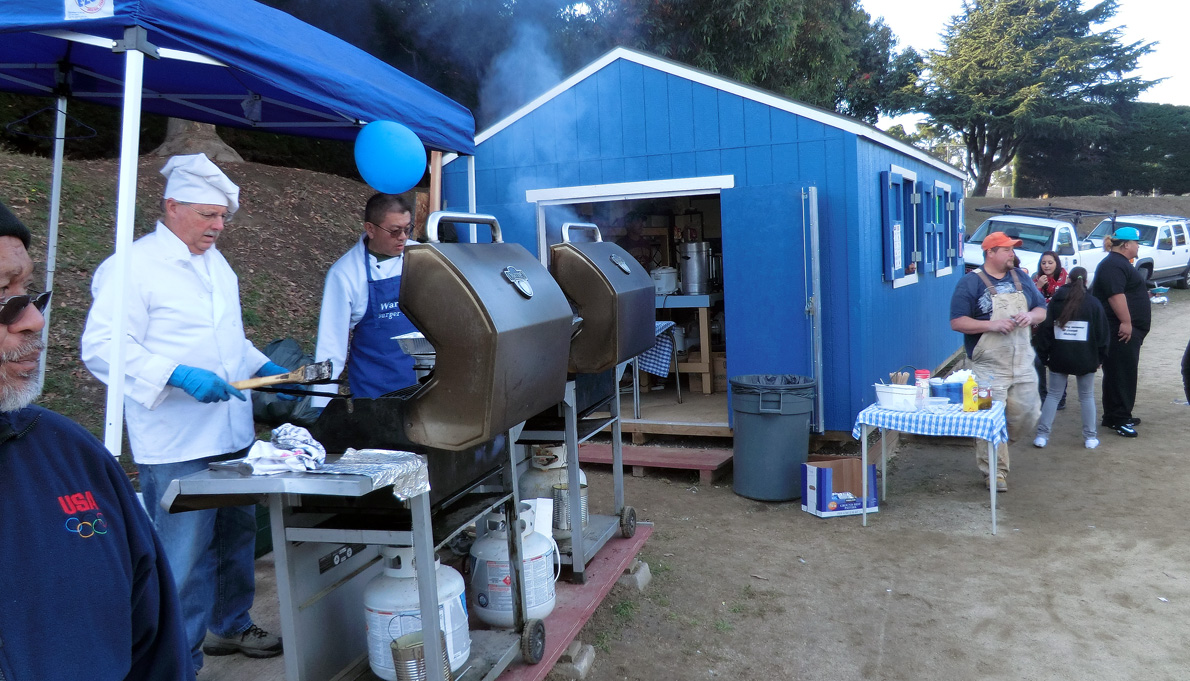
The "snack shack" at the SSF High football field

South San Francisco High Snack Shack
400 B Street (football field) / No phone
Genre: American and Polynesian comfort food

A kind of an “out-there” choice, considering it’s usually only open five nights per year (10 this season, because El Camino shared the South City High field this fall). But it’s a favorite of mine. The char-broiled smell of burgers and sausages wafting over the football field is a fall tradition in South City. Specialties include the decent-sized burgers (complete with a do-it-yourself fixings bar) and, reflecting the large Polynesian population in South San Francisco, the teriyaki bowl. All at reasonable prices that support local youth programs. Usually a hopeful diner would be out of luck by this time of year, but this season both South City and El Camino made the playoffs and South San Francisco hosts Willow Glen on Friday night at 7 p.m.
___

La Tapatia "Mexicatessen"

La Tapatia
411 Grand Ave / (650) 589-5881
Genre: Mexican/taqueria
Yelp review

One of South San Francisco’s best eateries doesn’t look like one. It looks like a small Mexican market – and in fact, it is. But walk back to the deli counter and there’s an amazing taqueria. Directly across from South San Francisco’s ornate City Hall, the carne asada and other burritos are delicious.
___

El Faro
435 El Camino Real / (650) 589-6288
Genre: Mexican
Yelp review

First-time visitors to this no-frills Mexican restaurant on the main road will come with low expectations. And, at first glance, they’ll be met when their take out comes packed in cheap Styrofoam and a paper bag full of chips. But — despite the packaging — the main dishes are filling and authentic. Claire swears by El Faro’s tostada, and I’ve shared many a carne asada plate (too many onions) with Ian. The place even has a drive-through!
___

Ristorante Buon Gusto
224 Grand Ave / (650) 742-9777
Genre: Italian
Yelp Review

If I had an Italian grandmother — or a Mafioso godfather — she would feed me like Buon Gusto. “Healthy” portions made with exactly the right amount of seasoning (even if it’s different every day due to the preference of the chef) and amazing, maybe even over-the-top, service enhances the family atmosphere. The interior décor is very busy, but the food (your standard array of pastas, beef, poultry and fish) is what you’ll be looking at.

Honorable mention
These places are good, but not quite up to the standards of the eateries above:

Gunters (1057 El Camino Real) is a good, old-fashioned coffee shop. Busy in the morning with probably the same crowd that’s been going there since 1957. If the laws hadn’t changed, you’d expect a cloud of smoke when you walked in the door. Good for a group breakfast.

Bogy’s Hofbrau (207 Linden Ave) lies on a downtown side street, and if you like roasted turkey or beef, mashed potatoes and other “down home” foods, consider this place. But the wide windows and uncomfortable seating detract from the dining atmosphere.

Genentech (1 DNA Way) has one of the best corporate cafes on the planet. Great food, lots of variety, decent prices. Free food on certain Fridays. Unfortunately one has to be an employee or their guest to eat there.

Royal Pin Donuts (551 El Camino Real) has great doughnuts, an atmospheric dining room and a quick (and rare, for doughnut shops) drive-through. I have to hold it off my main list, however, because if you’re there after 9 a.m. on a weekend your choices will be severely limited — and who wants to go out before 9 a.m. on weekends?

The only reason that Taqueria La Morena (307 Baden Ave) isn’t on the main list is that I thought more than one downtown taqueria would be excessive. Every bit as good as La Tapatia, but without the market and not on the main drag.

Chevys (141 Hickey Blvd) is the token big corporate chain restaurant on the list, mostly because of its excellent all-you-can-eat tortilla chips and salsa, its community fundraising and the fact that this branch is much less busy than the one at Stonestown.

Sunday, November 13, 2011

Bell Game 2011 - SSF beats El Camino eighth straight time, 34-9

Catching air
South City cheerleader Byanka Avalos is thrown into the air by teammates in an effort to excite the crowd before the Bell Game at South San Francisco High on Nov. 12, 2011.

Even in these days of declining interest in high school sports, there's usually a once-a-year occasion when a town rallies behind its high school teams.

In South San Francisco, that day is usually the second weekend in November, when the city's two high schools, South San Francisco High and El Camino High, face off in their annual Bell Game. While South City has typically dominated the match, winning 40 of 49 contests, it's always a day when the city rallies around its football like a small Texas oil town.

Last year, South City rallied in the final seconds to win 29-22. This year (in a game I covered for the San Mateo Times), after a close first half, the Warriors dominated in the second half to win 34-9.

Below is a slideshow I made covering the atmosphere of the local contest:

Thursday, November 10, 2011

Time to ditch ballot box for online and mail-in voting

Turnout was light in San Mateo County for Tuesday's election.

I worked as a poll worker in Tuesday’s election here in South San Francisco and, as seen in the photo above, most of my time was free — we had only 29 people vote at Precinct 1801, my table. The two other precincts also stashed in the Sunshine Gardens Elementary cafeteria had similar numbers.

The folks I worked with — a retired Pan-Am flight attendant, a South San Francisco High senior getting bonus points (and a day off) for his government class, and our smart-alec inspector — helped pass the time. As did Steve Jobs’ biography.

Part of the reason for our low turnout was no doubt the lackluster ballot (right). While folks in nearby San Francisco had an exciting mayor’s race, we only had a community college bond, a board election and a city council race with two incumbents running. While the lone city council challenger had a nickname of “Midnight,” as usual, incumbency prevailed.

More than one person told us “thanks for volunteering” as they left the polls. It was all I could do to point out that I was hardly volunteering — I was in it for the cash.

So let’s see what the County of San Mateo bought at my precinct for its cash: three general poll workers at $125 each plus an inspector at $150, so $525 for 29 votes. Or, $18.10 per vote — not counting the salaries of the county technicians that occasionally checked in on us, or the labor/gas needed to transport our four voting machines, ballots, supplies, etc. from the San Mateo area to South San Francisco. Times that by the 440 precincts in San Mateo County and there’s a lot of money.

If not for people saving 44 cents by dropping off their mail-in ballots for free, it would have been a very quiet day at my polls. At least there was some cute kids' art (left) to look at.

One reason for the poor showing was that about half of the registered voters in our precinct of 600-odd people are registered to vote by mail. And with our lackluster ballot, this would have been an ideal election to have an ALL-mail election. It’s been done before. By eliminating the poll workers alone, hundreds of thousands of dollars could be saved, even if vote by mail ballots are sent out with postage paid — which they somehow inexplicably aren’t.

San Mateo County had just 22.3 percent turnout for this election, including mail-in ballots. In fact, there were 54,262 votes cast by mail, compared to just 19,604 people voting at the polls. So an all-mail election makes sense to me.

Or, how about online voting? Surely if there’s enough security in place to file my tax returns online, there’s enough for me to vote online. (Note, this would be alongside an option for mail-ins — we don’t want to keep people without computers from voting.)

“But,” some might say, “if we let people vote at home, we don’t know who’s REALLY voting.” But isn’t that the case now? As mentioned, half the people in the precinct I worked are registered to vote by mail anyway. And heck, election workers aren’t allowed to ask for ID in California, so who’s to tell if there’s fraud going on now?

In this age where technology is improving at the same time that governments are having to find ways to save money, doesn’t doing away with polling places altogether make sense?

As the chart I made below shows, there was a rush of voters trying to vote at my precinct just after working hours, suggesting people are having trouble finding time to vote. Give them the option to go online with a pin/password, and I’d bet you’d get much HIGHER turnout if polling places were eliminated.

Votes by hour in Precinct 1801.

Saturday, November 5, 2011

SF Mayor finances: Lee, Chiu and Yee

The San Francisco Mayoral election is coming up Tuesday and the outcome is fuzzy amid swirling rumors of ethics violations and questions of just who can win in the City’s first major test of ranked-choice voting. One thing is clear, however: it’s an expensive race.

An analysis of several major mayoral candidates’ finances this weekend shows that millions of dollars have been both collected and spent by candidates for a position that pays $252,000 per year.

Using campaign finance links from the California Secretary of State’s office and the San Francisco Ethics Commission, I examined the complicated process of filing finance reports for several mayoral campaigns.

In the interests of time, I selected the three candidates (out of the 16 declared) who seem to get the most attention in the press or on social media: the incumbent, Ed Lee, and challengers David Chiu and Leland Yee. If someone chooses to go to the relevant part of the California Secretary of State’s website and analyze the other candidates, I’d be happy to provide a link to that analysis.

I realize this list is neither fair nor exhaustive, and the selection process was rather arbitrary. I also spent a great deal more time analyzing Lee’s finances, both because he is the incumbent and seemed to have more donors than the other candidates. But there is no ulterior motive behind which three candidates were selected, other than I thought they’d be the most interesting. I do not have a favored candidate in the race — in fact, I do not live in San Francisco.

The following was largely based on each candidate’s “Form 460” (a document filed with the California Fair Political Practices Commission listing contributions and expenses) for the period covering Sept. 25 to Oct. 22, 2011, the most-recent filing period.
______

Ed Lee, the incumbent.
First, Edwin Lee, the current mayor. According to documents filed with the San Francisco Ethics Commission, Lee (as of Oct. 31, 2011) has taken in $1,334,576.67 in contributions, loans and public funds and spent $1,722,713.93. Lee still had $136,472.48 in his campaign war chest.

Unlike Chiu and Yee, whose Form 460s for the time period ran 96 and 97 pages, respectively, Lee’s Form 460 was a staggering 455 pages long. Some of Lee’s notable donors include: John Fair, manager of Lefty O’Doul’s ($500 on Sept. 30); the Rev. A. Cecil Williams of Glide Memorial Church ($250 on Sept. 29); and Matthew Janopaul, former COO of Fender Musical Instruments (of Fender Guitar fame) and current co-owner of Pasta Pomodoro restaurants ($500).

Lee gets some cross-Bay love, collecting donations from Joseph Yew, Oakland’s Finance Director ($250 on Oct. 17), and embattled Oakland Mayor Jean Quan ($500 on Oct. 20).

Interestingly, Lee collected numerous donations from several individuals who directly owe their jobs to San Francisco’s “interim” mayor. These include: Lisa Ang, Lee’s deputy communications director ($340 on Sept. 25); Lily Madjus, another deputy communications director ($150 a few days later); Craig Dziedzic, acting general manager of the SF Department of Emergency Management ($500 on Oct. 6); and Jacalyn Fong, acting director of contract administration ($100 on Oct. 18).

One of the more controversial donations Lee accepted might be from Mohammed Nuru, San Francisco’s director of public works, who gave $500 on Sept. 29. Nuru was appointed to his current post by Lee when Ed Reiskin was appointed SF's new Director of Transportation, despite allegations against Nuru of sexism and racism.

Lee is a golf fan, and continues to benefit from the largess of the Professional Golfers Association. Remember his 2009 gift from the PGA of two tickets for the President’s Cup at Harding Park? Well, Tom Clark, the PGA Tour's executive director of the Presidents Cup, gave Lee $500 on Oct. 4, and Brian Goin, a director of the PGA tour, also gave $500.

The business community likes Lee. October gifts of $500 to Lee’s campaign came from Carl Guardino, President of the Silicon Valley Leadership Group; former state Assemblyman and current transportation consultant Richard Katz; Yelp CEO Jeremy Stoppelman (seeking good reviews, Ed?); and Zynga founder Mark Pincus. Twitter chief financial officer Ali Rowghani gave Lee a $500 contribution on Oct. 10 — six months after Lee pushed to give the social media firm payroll tax breaks to keep Twitter’s HQ in San Francisco.

So what’s the money been used for? For one thing, those yard and window signs you see all over the city aren’t cheap. Lee’s campaign paid the Wilmes Company, Inc., $27,887.21 for signage. Lee’s campaign also reimbursed staffer Thomas Li $2 for a Muni ride — what, he doesn’t have a Clipper Card?

But much of the campaign work is contracted out. “Ed Lee for Mayor, 2011” paid Phil Giarrizzo Campaigns multiple payments totalling more than $125,000 in the four-week period, and listed that it still owes the consulting firm $50,000.

The campaign also paid more than $110,000 to Sadler Strategic Media, Inc. for “professional services.” Sadler, in turn, paid SCN Strategies, a political firm known for dirt digging, almost $23,000 during the period.

Sadler also bought more than $50,000 worth of TV air time from stations KTVU, KRON, KPIX and KTSF, as well as $19,528.75 worth of local cable ads from National Cable Communications.
______

David Chiu.
The documents of Board of Supervisors President David Chiu were fairly simple, compared to Lee’s. According to documents filed with the San Francisco Ethics Commission, Chiu (as of Oct. 22, 2011) has taken in $623,138 in contributions, loans and public funds and spent $839,442.21. Chiu still had a healthy $321,511.99 in his campaign war chest.

Chiu’s most-recent four-week donor/expenses tally shows he took in $72,607.51 between Sept. 25 and Oct. 22 from individual contributors and businesses. There were fewer marquee donors on Chiu’s list, the most-notable being donations of $500 each from concert promoter Gregg Perloff, founder of Another Planet Entertainment, and his wife. Chiu collected $500 from a number of contributors, including Jessica Garcia-Kohl, director of development of the Housing Trust of Santa Clara County and Brown and Toland CEO Richard Fish. Fish, whose doctor's group operates at several Bay Area hospitals, seems to be hedging his bets, because he also gave $500 to Ed Lee the same date.

Expenditures for Chiu’s campaign seem heavily media-oriented. Chiu paid about $88,000 to JPM&M political consultants to handle most buys. Chiu, whose supervisorial district includes Chinatown, has invested heavily in Chinese over-the-air media, including $17,995 to Chinese TV station KTSF and $7,875 to Sing-Tao Chinese radio. In English, Chiu has been putting a lot of money into print ads — including $24,352.06 to the San Francisco Chronicle, which endorsed him. Payback, or simply advertising to the readers of a newspaper known to be friendly to you?

Chiu also took out ads in the San Francisco Bay Guardian ($5,174) and its competitor, San Francisco Weekly ($3,000), as well as a $7,000 buy in the San Francisco Examiner.

Being in a mayoral campaign involves a lot of traveling, and the carless Chiu (who usually bikes or takes Muni) owes Hertz $578.36, according to its unpaid debt sheet.
______

Leland Yee.
State Senator Leland Yee’s documents also were simpler than those from Lee. According to documents filed with the San Francisco Ethics Commission, Yee (as of Nov. 3, 2011) has taken in $1,311,759 in contributions, loans and public funds and spent $1,313,301.37. Yee still had $56,310.60 in his campaign war chest.

Yee’s most-recent four-week donor/expenses tally shows he took in $70,969 between Sept. 25 and Oct. 22 from individual contributors and businesses, including $100 from Fattoush, a Middle Eastern restaurant at 1361 Church Street, and a $500 contribution to himself. But Yee also returned several donations, including $500 on Oct. 14 to hedge fund manager David Corriea, president of Parnas Holdings.

Yee is popular with fellow politicians, collecting $100 from Redwood City Planning Commissioner Jeff Gee and $500 from the re-election campaign fund of Los Angeles-area State Senator Alex Padilla.

Yee’s campaign made 16 separate payments between Sept. 25 and Oct. 22 to Stearns Consulting, a campaign management firm which also claims Chiu as a client (although I could not find any payments from Chiu to Stearns). The payments totaled $128,758.20, with the largest single payment for $50,000. According to Yee’s records, most of these payments were passed on to various television stations for commercial airtime. The documents also show that Yee still owed Stearns about $22,000 as of late October.

Friday, November 4, 2011

High-speed rail expensive, but worth it

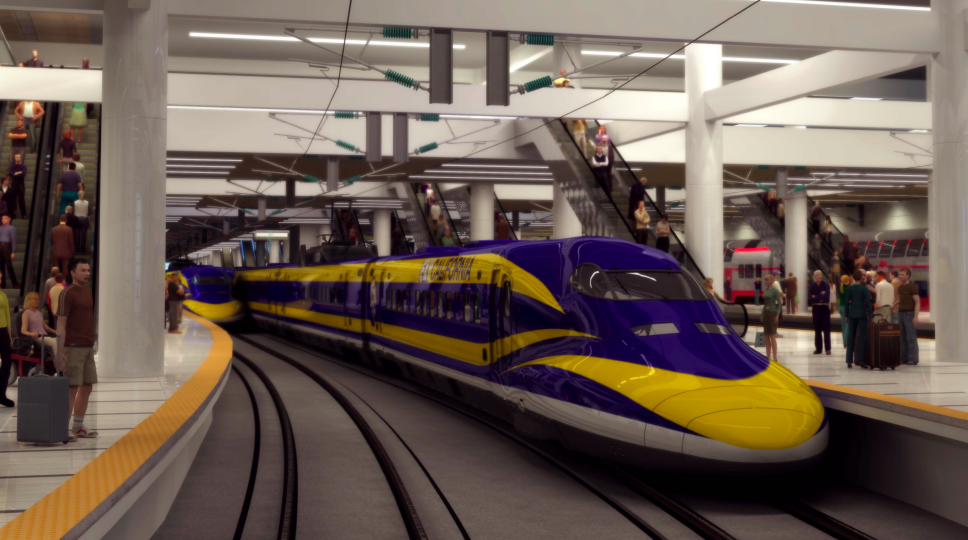
Artists' rendering of a high-speed train in San Francisco's new Transbay Terminal.

Three years ago tonight, I was in Perth, Western Australia, where I wrote stories on this blog about reactions to the US elections from Aussie college students and about the experiences of an American abroad on a historic election night.

Prior to leaving the country, I had voted by mail. Ever private in my politics, I only recommended people support one issue: Proposition 1A — the California High Speed Rail initiative.

California’s high-speed rail system is envisioned as an 800-mile system linking Southern California with Sacramento and the Bay Area at speeds up to 220 mph. The system is partially designed to compensate for a growing California population that Scientific American estimated in 2009 would otherwise require an extra 3,000 miles of highway lanes, five large airport runways and 91 airport gates by 2030 — improvements that were estimated to cost $100 billion.

In that regard, the California High-Speed Rail System integrates several principals of the Bay Area Metropolitan Transportation Commission’s 2035 plan, namely: Its downtown-to-downtown ideal serves the plan’s goals of primarily serving urban dwellers; It jibes with the ideal of “crisis brings opportunity,” — using the current economic upheaval to shift from over-reliance on cars and airplanes to more-sustainable alternatives, such as passenger rail; and, the system would have an effect on the MTC’s Regional Airport Systems plan by reducing intra-California flights.

Planning began with feasibility studies in the late 1990s, and a statewide initiative — initially based on an additional sales tax rather than a bond — was twice postponed while planners hoped for more-favorable economic conditions. When finally put on the ballot in 2008, the $9.95-billion bond proposition passed with 52.6 percent of the vote, a minor upset during an economic recession. It seemed like that high-speed rail would soon connect Northern and Southern California.

Flash-forward three years later, bad economic times and — especially — NIMBYs have stalled the project. While construction is still scheduled to begin sometime next year, opposition has increased. Joining the NIMBYs (covered in a previous post) are some financial conservatives who have balked at the anticipated costs of the project.

Last week, the financial news got even grimmer, as the California High Seed Rail Authority released a revised business plan. That plan estimated that — instead of the original $45 billion the entire plan would cost, the costs had climbed to an estimated $99 billion.

High-speed rail opponents and media critics went bananas, as might be expected. They criticized the more-than doubling of the original costs, continued to disbelieve projected ridership and questioned the need for the system altogether.

I beg to disagree.

What the media didn’t play up and the opponents have ignored are predictions that the HSR project will:

  • Be entirely self-sufficient operationally;
  • Generate 100,000 direct and indirect jobs over five years in the Central Valley alone during construction;
  • Generate 4,500 permanent jobs after construction is completed — compared to 100,000-400,000 in the rest of California by 2040;
  • Result in 8 billion fewer vehicle miles traveled;
  • Save 146 million hours;
  • Reduce CO2 emissions by 3 million tons.

Financially, a clarification should be made. The $98.5 million estimated cost includes a predicted three-percent inflation rate (which, off the top of my head means a cost “only” in the high $60 billion in today’s dollars). That out of the way, let's look at some of the real economic issues.

What if high-speed wasn’t built? Then, according to San José Mayor Chuck Reed, as quoted in the Silicon Valley Business Journal, California businesses and taxpayers would need $170 billion to add 2,300 lane-miles of freeway, four additional airport runways and 115 airline gates to accommodate the state’s increasing transportation needs (numbers slightly less than the ones above from Scientific American).

High-speed rail is expensive, but a bargain in comparison to the alternative. It needs to be built.

And locally, the opposition needs to settle down. As seen below, a very large percentage of San Mateo County voters supported Prop. 1A. Quoting wholesale from a previous post I made on this topic: “high-speed rail is an extremely positive project for San Mateo County as a whole, with great benefits from proposed stops at San Francisco International Airport and a possible stop in the South County. In addition, high-speed rail will be in a position to assist Caltrain with electrification and grade separation projects.”


I used to live in San Mateo on East 40th Avenue, one block from the tracks, so I understand the concerns of nearby residents. But there is a big picture and I hope that this post can remind Atherton and Menlo Park residents (and those in their respective city governments, which have filed suits against the project) of that big picture.

Eisner’s Tenement Trilogy — A Life Force (pt. 2)

Last week, I reviewed A Contract with God, and Other Tenement Stories, the first part of Will Eisner’s trilogy of graphic novels inspired by his depression-era childhood in New York. The “Contract with God” trilogy (named after the first book in the series) is a series of loosely related books set in tenement housing, centered around the (fictional) residents of 55 Dropsie Avenue in the Bronx.

I complained that A Contract with God seemed more like an anthology series, with the stories having little connection other than living in the Depression-era Bronx and being Jewish.

Eisner's second entry in the trilogy, however, gets it right. Every chapter in A Life Force flows logically from the next. The book, first released in 1983, shows a fully realized set of characters within a complex narrative.

The story largely revolves around the immediate family of Jacob Shtarkah, a carpenter who just finished the job he had been working on at the start of the novel and is promptly informed no more work is to be had. Shtarkah goes into a Depression-driven, well, depression. Seeing a cockroach -- the ultimate survivor -- in the alley into which he has collapsed in anguish, our protagonist wonders just what keeps the little guy going:


This debate into the ultimate meaning of life is delayed when real life intervenes. Eisner weaves a tight tale of 1934’s New York and how it affected its Jewish community. Eisner brings in story elements ranging from the mob, the Diaspora from Nazi Germany, some union busting, red baiting, the nature of fate … and of love:


While A Life Force has less sex than A Contract with God, it — thanks to the mob subplot — also has marginally more violence. A chance discovery at one point puts the main characters in danger.


Maybe the characters and situations in A Life Force are a little more fantastical than one might find in real life, but no more so than in most literature. A Life Force contains characters and situations that the reader can tell are inspired by real life -- unlike those in A Contract with God, which seemed like, "So-and-so heard from so-and-so that this happened to a friend of a friend."

Eisner's art in Contract was a little too caricaturist for the heady topics (date rate, child molestation, religious philosophy) that were in that book. In A Life Force, the art is tighter and more refined. Panels are easy to follow and the art is clean. In fact, the darker lines give the book a noir-ish feel.

The storytelling in this book was top-notch. Eisner has a lot of topics to deal with in A Life Force, but it does it well. Every issue, every character has an arc. While this book seems more like a standard period piece from the Thirties than stories ripped from Eisner’s past, A Life Force seems more real than the previous book because the characters are given space to develop and readers given time to get to know them.

Note: This is a review of the middle book in Will Eisner’s Tenement Trilogy. The other two books, A Contract with God, and Dropsie Avenue were reviewed in October and December.

Tuesday, November 1, 2011

San Francisco mayoral candidates and the gifts they receive

San Francisco City Hall.

People generally like to eat, listen to music and watch football, and when it comes to politicians, they really like receiving opportunities to do those things as gifts.

A review of public forms designed to reveal potential conflicts of interest showed that San Francisco Mayoral candidates have a propensity for accepting everything from toy trucks to 49ers tickets to — above all else — meals.

Every person elected or appointed to an official political position in California is required to annually file “Form 700” with the Fair Political Practices Commission. (I had to fill out a Form 700 for my service on the South San Francisco Housing Authority, for example.) These state-mandated forms include information about the sources of an official's income, investments, business positions, real property holdings and gifts from the previous year (i.e., the form for 2010 would be filed in 2011).

Forms for those who hold local government office are available at City Hall. But as a service, the FPPC has put online Form 700s filed by state legislators, elected city council members and county boards of supervisors. This week, I’ve been reviewing the online forms of the top candidates for San Francisco Mayor.

(Public Defender Jeff Adachi, City Attorney Dennis Herrera and Assessor-Recorder Phil Ting theoretically have their forms available for perusal at San Francisco City Hall. Candidate Tony Hall has been out of his former supervisorship for several years and Joanna Rees has never before held political office, therefore they apparently do not have recent Form 700s for perusal.)

Several other candidates did have their Form 700s available online, however. Alphabetically:

Michela Alioto-Pier didn’t file a Form 700 for 2010, probably because she left her office as Supervisor this past January, before it was due. Alioto-Pier’s 2009 form only reported one gift: a $100 flower arrangement from the Drew School, a small private prep school on California Avenue in San Francisco. (She did have to list her more than $100,000 stock holdings in Exxon-Mobil and two real estate holdings worth more than $1 million each: a home in Santa Helena and a condo on Vallejo Street in San Francisco.)

Ed Lee, the incumbent.
John Avalos, curiously, seems to be the only member of the Board of Supervisors running for mayor to not receive a gift, own any property or stock. His Form 700 was limited to a single page declaring he had no reportable assets.

Current Mayor Ed Lee does, however. In his form covering 2009, while he was city administrator, Lee writes he received a total of $290 in gifts — symphony tickets in July from the City Arts Commission worth $140, and two tickets from the PGA in October for the President’s Cup at Harding Park worth $150.

Lee did not seem to have a 2010 form available online, despite being City Administrator the whole calendar year.

David Chiu.
The bicycle industry-sponsored Bikes Belong Foundation gave supervisor David Chiu his largest gift: a $3,400 trip in August 2010 to the Netherlands to observe “urban transportation and biking practices … with other Bay Area officials.” Does this gift — the largest revealed by any candidate in their filings — make Chiu a puppet of corporate interests? Chiu’s acceptance of the gift from the Bike Belongs Foundation is interesting, because he doesn’t even seem to be the favored candidate of San Francisco bicyclists. That would be Avalos, who was endorsed by the San Francisco Bicycle Coalition (the SFBC ranked the carless Chiu second). Chiu was endorsed by the Chronicle, which may be some consolation.

Chiu's form shows he also got more than $700 from Harvard University for speaking engagements, tickets (worth $258) from the San Francisco Symphony in September 2010 and two tickets (worth $228) from the San Francisco 49ers the next month.

(It should be noted that the largest gift that public officials can generally accept tops out at $420. Chiu's trips seem to fall under an exemption for travel outside of California provided by non-profit entities.)

Bevan Dufty, who like Alioto-Pier left his SF Supervisor’s office in early 2011, also doesn’t have a Form 700 online for 2010. However, his 2009 filing indicates that he likes a show. He received theater tickets worth $250 in February 2009 from the Shorenstein Theater for the opening night of “Wicked.” He also got tickets worth $250 from the San Francisco 49ers for a game on Nov. 29, 2009 (a game the Niners won, 20-3 over the Jacksonville Jaguars). Dufty also was well-fed in 2009, getting $1,220 worth of meals from eight different contributors (some multiple times).

Leland Yee.
Leland Yee lists gifts from 21 different donors, the most among candidates who filed a Form 700. Among them was San Francisco’s Green Toys, which make its items out of plastic recycled from milk jugs. On Jan. 20, 2010, the toy store gifted Yee with a toy truck worth $25.

In April 2010, Yee accepted a gift of $2 (yes, two dollars) in “peanuts” from the California Beer & Beverage Distributors. Everyone knows suds go down better with nuts.

Perhaps the most interesting gift Yee received was a “food” gift on April 5, 2010, from the California State University at Stanislaus Foundation — just days after Yee had criticized the Foundation for paying Sarah Palin for a speaking engagement. A “mend fences” lunch perhaps? Or a case of “let’s criticize them and eat their food, too?”

Yee’s single largest gift was airfare to Washington, lodging and attendance at an awards ceremony from the National Education Association — the nation’s largest labor union — between July 2 and July 4, 2010, worth exactly $1,115.80.

We don't yet know who will be elected San Francisco's mayor on Nov. 8, but you can bet they'll be well-fed.

Monday, October 31, 2011

Halloween: I've been leapt into


My Halloween costume: I'm "that guy" Sam Beckett (aka Scott Bakula) leaped into in that one episode of "Quantum Leap."

Friday, October 28, 2011

Eisner’s Tenement Trilogy — A Contract with God (pt. 1)

Eisner
Will Eisner (1917-2005) was probably the most-influential comics creator from which most casual fans had never read anything. Unlike publicity hounds like Stan Lee, trendsetters like Jack Kirby or unsung heroes like Julius Schwartz and Carl Barks, Eisner has flown beneath the popular radar.

But his influence was so great that the comics industry’s equivalent of the Oscars — awarded each year at Comic-Con — is known as the “Eisners.”

Eisner’s most-famous creation was the noir-ish hero The Spirit, which became a big influence on Frank Miller’s Daredevil and Batman work and the subject of a horrible 2008 movie. But his most personal work is his trilogy of graphic novels inspired by Eisner’s depression-era childhood in New York. The “Contract with God” trilogy (named after the first book in the series) is a series of vignettes set in tenement housing, centered around the (fictional) residents of 55 Dropsie Avenue in the Bronx.

A Contract with God, and Other Tenement Stories, the first book in the series, was released in 1978 and is widely (if apocryphally) considered the first “graphic novel” — a work released in book form from the start and not simply a collection of previously published comic books.

The volume, both written and drawn by Eisner, starts with the eponymous first story, outlining the life of an Orthodox Hasidic Jew named Frimme Hersh, as he immigrated to the United States after a pogrom and became a pillar of the community. The titular contract with God is made in exchange for good fortune, then broken when the protaganist’s daughter dies (not a spoiler, that’s within the first few pages). The developments from there take a twist right out of EC Comics’ horror stories.

A page from the eponymous "Contract with God"

The second story, “The Street Singer,” about a drunken alley singer’s encounter with an over-the-hill opera diva, also has a twist, but is the least compelling story in the volume.

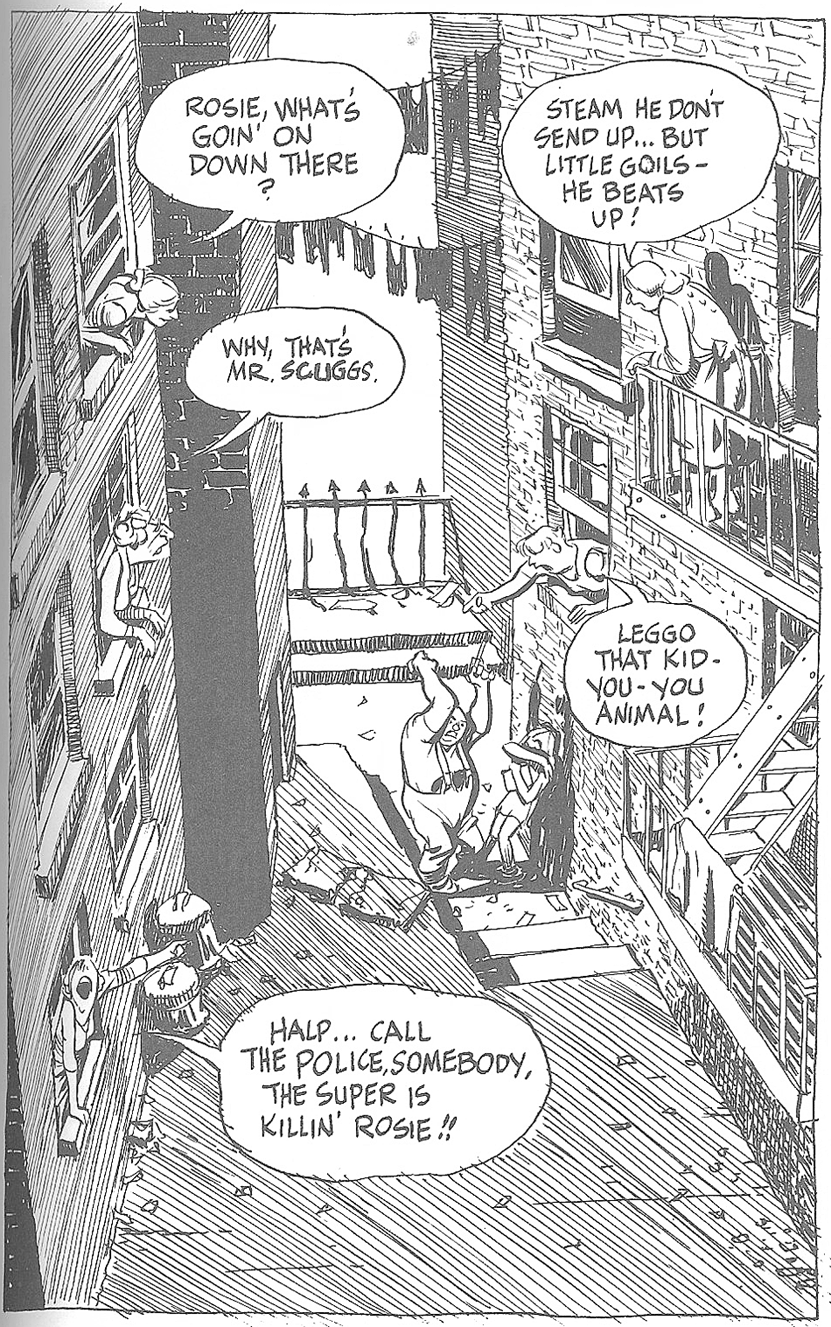
If the first story had a twist out of EC Comics’ horror stories, “The Super” has a twist out of EC’s crime stories. Telling the tale of 55 Dropsie’s alternatively hated and pitied superintendent, it’s a tightly wound, yet disturbing tale dealing with ambiguous victimhood centered around an accusation of pedophilia.

A page from "The Super"

Finally, “Cookalein” deals with the country jaunts from the city that Jewish families who could afford to do so often took in the 1930s. It also has by far the most characters to keep track of: a poor boy and poor girl both pretending they're rich, a teenage boy subjected to the advances of a married woman, small kids discovering the joys of “camping.” Plotwise, it includes portrayals of date rape, infidelity and true romance. This story was confusing at first with its myriad of characters, but developed into an interesting case study of how fish (repressed ones at that) deal with being out of water.

One of the few pages from "Cookalein" printable on a family blog.

The book deals with some heady topics for something written by a Depression-era kid in the ‘70s, and the art and storytelling are fine. But I had issues with the book. Eisner’s stories in the first volume aren’t much more than a series of vignettes centered around the same neighborhood — without much of a unifying thread. It’s a piece of Americana, but A Contract with God’s contents feel like they’d fit in a simple anthology, rather than a groundbreaking piece of comic literature.

But one of the biggest criticisms I have was made in other reviews as well: Eisner’s art is great for the pulps, but when dealing with serious subjects it seems a bit cartoony for the matter at hand. Not to say that simple art is bad for serious subjects — Craig Thompson’s Blankets is an example where simple art works well with adult themes — but Eisner’s characters almost look like caricatures in some places.

Still, A Contract with God was a good read and a great look into multiculturalism for the uninitiated. The next volume, A Life Force, is purported to be the best of the series. Expect a review of it soon.

Note: This is a review of the first book in Will Eisner’s Tenement Trilogy. The next two books, A Life Force, and Dropsie Avenue were later reviewed in November and December.