Sunday, July 15, 2012

Comic-Con 2012 wrapup

Comic-Con has gotten so big that it's almost impossible to give a sense of scale for the crowds.

The past four days I’ve been in San Diego at Comic-Con 2012. It’s been a good experience, and I was privileged to spend much of the weekend with my old friend Rob Roy.

After many hours of line waiting the last four days, I stand by the assertions I made in my last blog about the need for clearing rooms and panel reservations. But in general, I think the folks with Comic-Con and the San Diego Convention Center have done the best job they could with the massive crowds.

Comic-Con has taken over much of downtown San Diego, so much that even nearby supermarkets have set up junk food refueling stations (below) outside their shops for hungry geeks.


Arriving at the convention about mid-day on Thursday, I took a quick tour of the floor, where the always-impressive costumes encouraged me to make the following observation:


One of my first panels was an appreciation of the late Ray Bradbury. A number of prominent authors, including the esteemed Margaret Atwood outlined the impact Bradbury’s writing had on their work. As an example, Atwood noted that Bradbury’s “Fahrenheit 451” influenced her acclaimed novel “The Handmaid’s Tale” in regards to “who (is allowed) to read.”

Authors Margaret Atwood and Joe Hill talk about Ray Bradbury.

Following that, I stayed for a panel about 1982 -- called “the greatest geek year ever.” And with flicks such as Blade Runner, Star Trek II: The Wrath of Khan, Tron and E.T. released in 1982, it’s hard to argue. After a couple more panels, Rob and I got into Phil Plait’s roundtable about science in science fiction. Good discussion. I think the best point was about explosions in space: No, you really shouldn’t hear noise when they go off. But you don’t (usually) hear music during important moments in real life either, and music is prevalent in movies. Explosions, like music, are non-natural sound elements that accentuate drama. I think I can buy that.
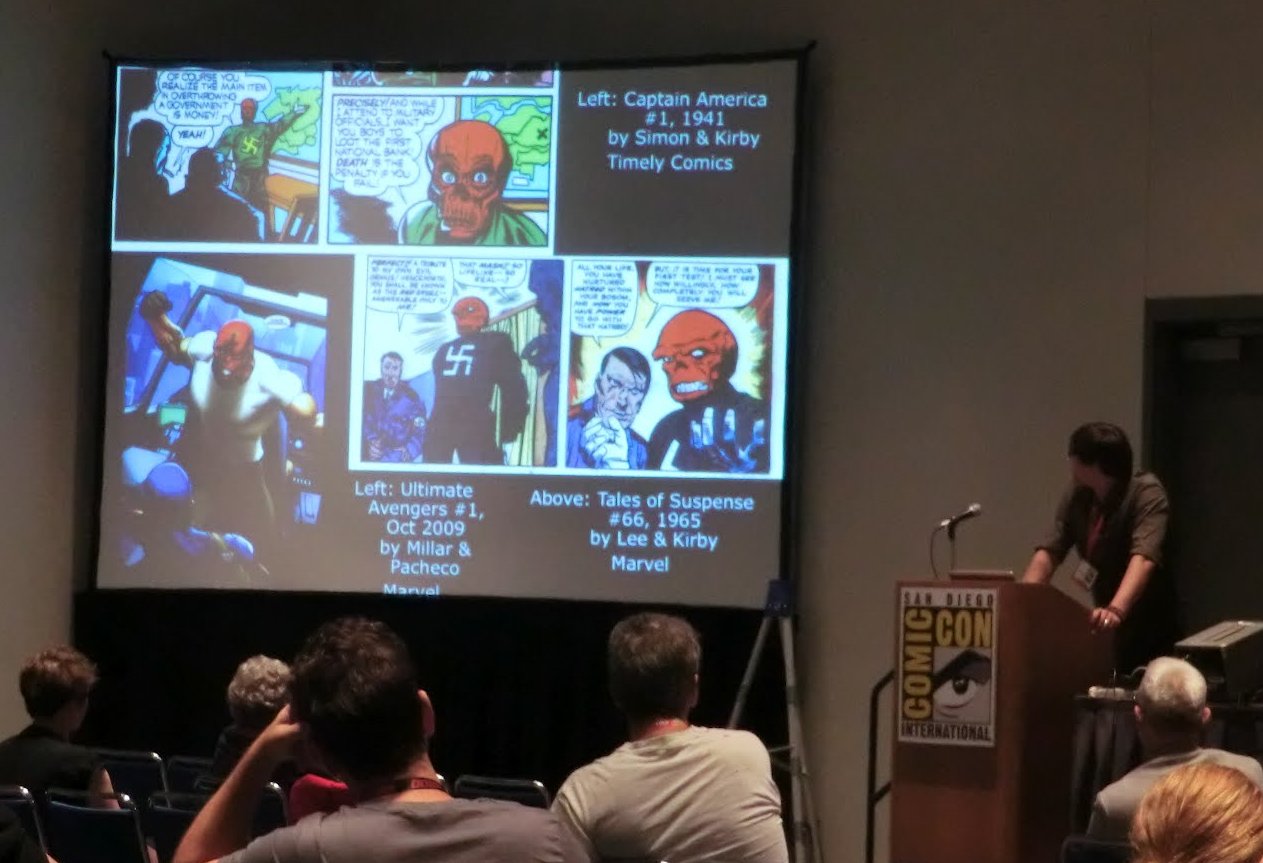
Matthias Harbeck, of Humboldt-Universität zu Berlin, discusses German stereotypes in comics since WWII.


On Friday, I eschewed the long lines for Firefly and Hobbit panels and spent most of my time at the Comics Art Conference, where serious academics present papers on serious comics topics. I sat through a series of lectures on how comics view nations (“Captain America: Court Jester or Patriotic Icon?” the portrayal of Germans in comics from World War II to the present day, etc.). I made an interesting point, I think, with one presenter whose paper was on Alpha Flight (the Canadian super team). Instead of most super teams, which are an assemblege of archetypes (tech hero, science experiment gone wrong, Norse god, etc.), I argued that Alpha Flight was composed instead of Canadian stereotypes: the angry Quebecois (Northstar), the noble First Nations (Shaman), the mysterious northern beast (Sasquatch) and the white Inuit (Snowbird). The presenter, from Carleton University in Ottawa, came up after the session and personally thanked me for my points.

Rob and I went to a strange panel for an Adult Swim-like Marvel cartoon called the “All Winners Squad,” hosted by Morgan Spurlock (of Super-size Me fame) for some reason:


That was weird.

Rob and I took advantage of the Comic-Con atmosphere later that night to watch The Amazing Spider-Man at a downtown San Diego theater. Rob was unhappy with the changes from the source material, although further conversation indicated to me that he was probably still upset with the reboot from the Toby Maguire series. I quite liked it. I thought the chemistry between Andrew Garfield’s Peter Parker and Emma Stone’s Gwen Stacy was well above that between Maguire and Kirsten Dunst. I liked Garfield’s performance, which brought some humor that Maguire had trouble portraying (at least in his first and third movies).

Saturday was a day lost in lines for me. I tried to get into the "Futurama" panel (right) by joining the Ballroom 20 line almost two hours before the noon panel, but didn’t get in until about 1:45, where I watched the Family Guy presentation. I then moseyed across the convention center to the Avengers vs. X-Men panel, which presented little new information about Marvel’s ongoing crossover.

But noticing that the same ballroom was to be used for the ever-popular “Mythbusters” panel a few hours later, I decided to stay in the room. As a result, I was subjected to the whims of TV marketers. First off, I watched the pilot of Fox’s new drama “The Following.” Kevin Bacon (below right) plays a retired FBI agent consulting on taking down the copycat followers of a serial killer he arrested. In this endeavor, he is being “assisted” by the manipulative serial killer himself. I actually enjoyed the pilot a lot. Good acting, good tension and some nice twists. I don’t see what the premise has to do with Comic-Con, however.

(On a side note, if there’s any panel video with me in the background, my Bacon Number has dropped to one!)

The other pilot, for NBC’s “Revolution,” was also promising, but less so than “The Following.” This series has a premise that some mysterious force knocked out all the power in the world 15 years previous. Setup was good, but execution was a bit clunky. It did bring up one sobering thought for me during the panel:


The “Mythbusters” panel itself, hosted by John Landis, was great. It featured some interesting back-stage stories. My favorite was one where the crew tried to test the myth where a drunk man asked a blind friend to drive him home with his guidance, under the assumption that a ticket for driving without a license was not as bad as one for a DUI. They found that a sober person, describing when to turn, brake, go, etc., could indeed guide a blind person quite well, but a drunk person made the blind person drive like a drunken driver!

The "Mythbusters" panel. From left: Director John Landis, Tory Belleci, Kari Byron, Jamie Hyneman, Grant Imahara and Adam Savage.

Sunday, I took no chances. I got up shortly after 6 a.m. and hopped an early train, getting into the massive Hall H line at about 7:05 a.m., hoping to get into the 12:30 p.m. “Doctor Who” panel. It didn’t look promising at first, as the linked snaked through the outdoor queueing area, long behind the convention center and around an artificial island/marina in the back. But I got into the hall about 10:30 and sat to enjoy the presentations.

While not a watcher of either "Fringe" or "Supernatural," the two panels I had to wait through, it was apparent those shows have an enthusiastic fanbase. But they had nothing on the love the audience showered on "Doctor Who" producer/writer Steven Moffett and stars Matt Smith, Karen Gillen and Arthur Darvill. We got to see some intriguing extended clips from the upcoming season, including one appropriately titled, "Dinosaurs in Space."

The "Doctor Who" panel. From left: Moderator Chris Hardwick, showrunner Steven Moffett, Matt Smith (The Doctor), Karen Gillan (Amy), Arthur Darvill (Rory) and producer Caroline Skinner.

After the "Who" panel broke up, I headed over to a panel featuring another beloved genre powerhouse, Buffy: The Vampire Slayer. Celebrating 20 years since the (poor compared to the almost-unrelated television series) Buffy movie started the franchise off and made Joss Whedon an entertainment powerhouse, the panel featured actors from the movie (although not the promised Kristy Swanson) and TV series and writers and artists from both the TV show and comic series. With the panel followed up by a sing-along showing of the musical episode "Once More, with Feeling," Whedonites left satiated.

At the "Buffy at 20" panel: actors Nicholan Brendon (Zander) and James Marsters (Spike) and writer Jane Espenson.

I did have a nice fan-interactive moment on Sunday, when I tweeted that I'd been right next to Plait while leaving a panel. Plait wrote back that I should have introduced myself, and I replied that I didn't want to interrupt his phone call. That brought on this reply:


That's what's great about what I still refer to as the "San Diego Comic Convention" -- despite the now-huge scale, fans can still have direct contact with celebrities.

My first Comic-Con was in 1992, a much-more restrained affair. It's gotten more crowded, more expensive and less about comics each year. But it's always (except for lines and frustration over not getting into certain panels) been a fun event overall. It's just taken a bit more adaptability on my part and forced me to lower my expectations over what I'm going to do in San Diego. For example, this was probably, save for a whistle stop in 2004, the convention in which I've spent the least time on the floor (less than 90 minutes over four days) and the Con where I bought the least -- one measly comic.

But where else can you take a picture with the Adam West-era Batmobile?


Just a note: I'm still trying to find the owner of the camera I found last year!

Tuesday, July 10, 2012

Lining up for San Diego Comic-Con

This week I will be attending my 17th San Diego Comic-Con (or just "Comic-Con" as the world is becoming to know it). I first went in 1992 and have both embraced and lamented the changes made as Hollywood took control.

(For the record, I've blogged about Comic-Con before: here, here and here. Plus, I'm still trying to find the owner of the camera I found last year.)

Hollywood has (much to the traditionalists' dismay) invigorated Comic-Con, but also made it much too crowded. Last year, I waited in the Hall H line for literally (and I am using "literally" in the correct, literal sense here) four hours at one point. My wait was in part due to camping-out fans going into the hall early for panels hours later than the panel currently happening(such as those depicted below, waiting for a "Lost" panel in 2009). This has been getting worse each year, for several years.


Comic-Con has got to cut down the waiting in line. It's unhealthy for the sun-averse (such as myself) and prevents me from enjoying as much of the show as I'd want.

So two things. One: Clear out the rooms between panels. (Hypothetical) Why is my Doctor Who panel full of Twilight fans waiting for good seats for their panel six hours from now (or vice-versa)? We could fit 4,000 more Doctor Who fans in here.

Second: How about online reservations for panels? Why should I have to wait in a six-hour line for Hall H and have no guarantee of even getting in? I could be going to the Roy Thomas panel in the meantime. Put aside a certain number of seats in each Hall/Ballroom/Conference room (say half) and let people make reservations for them online. Let registered badgeholders reserve one panel per badge per day. Let them print out a bar-coded ticket for the panel which means I just have to get into the short pass-holder line. Once that line clears, let in others until the room fills. Technology can do that these days.

Crowds (such as those in the picture above) will continue to overwhelm Comic-Con, there's not much that can be done about that without severely restricting ticket sales. But certain measures (such as having reservations for panels) can make the experience of wading through the crowds more enjoyable.

Sunday, May 27, 2012

My Wikipedian train of thought: Kuiper Belt to Oscar Wilde

What do beavers, Oscar Wilde and deep-space rocks have in common?
One of the worst, and best, things about Wikipedia is how it can become such a colossal time suck.

You go onto the site to look up one thing, and through a series of links and "Hmm, I'd like to know more about thats" you end up somewhere completely different.

Take this morning. I visited Wikipedia out of boredom and saw that the featured article was about the Kuiper Belt. Being an amateur astronomer, I began reading the article.

That took me to the article about Makemake (left), a plutoid with such a funny name that I had to visit.

When it was first discovered, close to a certain holiday, Makemake was given the code name "Easter Bunny," so I had to visit the Wikipedia article about that particular holiday icon.
I learned that easter bunnies were associated with colored eggs because of the abundance of eggs due to abstinence during the spring celebration of Lent, which led to that article.

Reading about Lent, I was astonished to discover that some churches allowed the consumption of beaver tails during the normally meat-free (except for seafood) period. So I read about beavers.


Finally, on the beaver page, there was a famous picture (left) of Oscar Wilde in a beaver fur coat. So I ended up reading a bit about the author of The Picture of Dorian Gray -- an article I somehow refrained from reading.

Friday, April 13, 2012

Interwoven destinies: A review of Richard Walker’s Country in the City

The Country in the City: The Greening of the San Francisco Bay AreaThe Country in the City: The Greening of the San Francisco Bay Area by Richard A. Walker

My rating: 2 of 5 stars

There is sometimes a perception that two things must be polar opposites: the poor preservationist and the well-off landowner; the city and the country; the rural and the urban. Richard Walker’s The Country in the City: the Greening of the San Francisco Bay Area (University of Washington Press, 2007), however, makes it a point to demonstrate that the presence of one of the above is not mutually exclusive to the other. In fact, Walker notes, the preservation of so much green space in the Bay Area was reliant upon an interweaving of factors that might otherwise seem oppositional. As examples, the efforts of well-to-do landowners trying to preserve the uniqueness of their exurban land were just as critical to keeping the Bay Area green as were the protests of poor urban minority families suffering the ill effects of pollution. For another, having so much “country in the city” — parks, beaches and open space in the immediate urban area — was critical in keeping the Bay Area from overflowing its current spatial limits. According to Walker, a juxtaposition of idealists and money, the country and the city, and accidents of geography all helped preserve some sense of nature in the Bay Area.

The Country in the City provides a detailed historical overview of more than 100 years of development in the Bay Area and the corresponding efforts to keep it in check. With more than a million protected acres of state parks, wilderness areas and other green space, compared with “only” about 750,000 acres developed, the Bay Area is unique in its mixing of the city and country. While some more-ardent preservationists may decry having a public seashore next to an airport, a mountaintop preserved but ringed by subdivisions, or a reservoir serving as an urban recreation area, the countryside woven into San Francisco’s urban landscaping may well be a model for the foundation of any future conservation movement (Kareiva, 2008). Walker’s premise from his own introduction — that as the Bay Area goes in terms of conservation, so eventually goes the nation — is dependent on establishing that local preservation projects have had national implications. For the most part, Walker succeeds. But while trying to put to rest the “myth of Bay Area exceptionalism” in terms of conservation, Walker also leads one to believe that the Bay Area is indeed unique thanks to its special geographical and social makeup.

Early on, Walker points out that Olmstead’s goal of having the “country in the city” meant much human intervention. Golden Gate Park (created by flattening of sand dunes and planting of tall non-native tree around the periphery), numerous recreational lakes (created artificially with dams), the pastoral hillsides (once covered with harvested redwoods) — all are taken for granted as “natural” by much of the population, yet are each as artificial as a freeway interchange. But this nearness of “nature” to the city helped inspire many environmental idealists. In some places, this might have led to a struggle between idealistic lower-income city dwellers and the moneyed classes on the outskirts. Yet, “all is not class harmony when the forces of capital storm the gates of landscape consumption. Many times the redoubts of the rich have been threatened by urban expansion, and many times the privileged have had to take on developers head to head,” (page 11).

Walker calls the mixed-social standings of the moneyed and the idealists who led calls to preserve open space “the two-headed nature of greening” (page 131). While each may have different inspirations on the surface for their work, deep down both the rich and the idealists have self-interest at heart — the rich want to preserve their property values and the idealists their principles. In reading Walker’s work, it is apparent that the author believes that the San Francisco Bay Area has a neo-liberal bent — the private sector is leading the charge, both in favor and against development. For every Maxxam (page 33) or similar company seeking to maximize profits for its shareholders, there is a well-off Samuel May (page 132) who helped a group of like-minded citizens found the East Bay Regional Parks District while a professor at UC Berkeley. The book abounds with such examples.

Such thoroughness in collecting the history of the Bay Area’s environmental movement sometimes works against The Country in the City. While Walker tries to avoid relying on “great man theory” in his history, sometimes he goes a little too much Howard Zinn-like in his talking about the “ordinary people” who contributed to the cause of preservation. “A critique of growth arose spontaneously from a thousand voices and a broad mobilization to protect the land and waters bubbled up from below,” he writes (page 83) before seemingly naming each voice. The author tends to occasionally get hung up on including names or organizations, many of which are only mentioned once in passing. This tendency to overly detail complicates the narrative.

A list of the giants of the conservation movement has always had a California lean: John Muir, Ansel Adams, and the like. Walker seems to suggest the names of such local environmentalists as Caroline Livermore, Dorothy Ward Erskine and Ralph Nobles (among many others) should be added to the list. While those names might lack the cachet of their predecessors, their efforts in promoting smaller projects (Livermore helped prevent Angel Island being bulldozed for a new transbay bridge, Erskine was instrumental in creating People for Open Space and Nobles preserved Bair Island from becoming a new Foster City) helped create a quilt of a green and nearly sustainable Bay Area from the patchwork of conservation efforts that have historically shaped the region.

Walker’s text is authoritative, but also opinionated and sometimes snarky. The death of a protester whose tree is cut down beneath him brings a comment of, “apparently, saving Redwoods is more fraught than the old conservationists ever imagined.” Calling the clear-cutting of the Bay Area’s redwood trees a “slaughter” is just one example of loaded language that Walker frequently uses, along with numerous unveiled slams at the planning process in the Los Angeles area. The text also occasionally suffers from inconsistencies in Walker’s message. For example, on page 142 he writes that peripheral suburbs “are generally ruled by a class alliance … looking to profit from growth and the machinery of government rests in the hands of city managers looking to expand their domains.” Not only is the latter part of the quote an insult to Wilsonian-inspired public administrators, but on the very next page, Walker cites the examples of Petaluma and Livermore as enacting early and influential anti-growth measures. In another passage he praises the planning that kept Walnut Creek’s downtown “thriving,” yet calls the same downtown “banal” on page 153. While a thriving downtown could still theoretically be banal, it is one of a number of mixed messages in the book.

On the positive side, the attention to detail in The Country and the City, while sometimes harming the book, is generally effective in showing how ideals developed over time. Walker succeeds in describing how “urban environmentalism,” usually recalled as a Bay Area invention associated with 1960s efforts to save the Bay (Davis, 1990), has spread nationally. There have been more failures in preserving the natural state of the Bay Area as there have been triumphs. To his credit, Walker is not afraid to address them. In fact, he does a good job at showing how cyclical the environmental process sometimes seems to be.

Indeed, the Bay Area seems to have reversed a national trend: as land use restrictions or environmental opposition in outlying cities make new housing construction difficult (for example, the current disputes over redevelopment of former Cargill salt ponds in Redwood City), residents are returning to redeveloped residential areas in the urban core. Observers note that San Francisco and Oakland seem to be fast becoming “bedroom communities” for Silicon Valley workers (Solnit, 2000). People are returning to the central city — and, as Walker would note, the interwoven country close at hand.
References

Davis, M. (1990). City of Quartz. New York: Verso.

Kareiva, P. (2008, February 26). Ominous trends in nature recreation. Procedings of the National Academy of the Sciences, 2757-2758.

Solnit, R. (2000). Hollow City: Gentrification and the Eviction of Urban Culture. New York: Verso.

Walker, R. (2007). The Country in the City: The Greening of the San Francisco Bay Area. Seattle: University of Washington Press.
View all my reviews

Sunday, April 8, 2012

Is this the worst protest song ever?


In 1999, the province of Kosovo, in what was then Yugoslavia, erupted in ethnic violence as Serbs and Kosovars battled over the small Balkan territory. Eventually drawing in NATO, the brief war over the region displaced thousands.

David Burchwell, an Ohio native studying at Cañada College (above) in the hills above Redwood City, was so moved by the carnage that he write a song called, “It’s a Troubled World.” The song was placed on an independent album designed to raise money to help relieve the refugee situation in the Balkans.

"(I) was watching the news and hearing about ethnic cleansing and ... Congress saying ‘We want an exit strategy before we commit anything.’ In the meantime, we’ve got people over there, our own young men and women, getting shot at," Burchwell told me when I interviewed him in April 1999. “Having been a soldier, the last thing you want is power brokers that are indecisive about supporting you when you’re over there fighting.”

Cañada College was also the site of a benefit concert for the refugees, thanks to Burchwell.

I wrote a story about Burchwell's efforts in a May 1999 issue of the Redwood City edition of The Independent. Besides an interview, Burchwell also helpfully gave me a home-burned CD with several versions of "It's a Troubled World," including a "dance mix" and "garage mix."

After I listened to the CD to get some perspective for my story, I struggled to continue writing because the song was just plain awful. I played it for my then-girlfriend and she also panned it. Horrified, I hid the CD in some files and rediscovered it recently while cleaning.

"It's a Troubled World" is at least as bad as I remember.

Maybe it's the insistence on repeating "It's a troubled world, yes it is" ad nauseum throughout the song. Perhaps it's Burchwell's singing like he's trying too hard, with an unnaturally strained voice. Alternatively, it's the distracting, off-pitch shouting of the background singers during the chorus.

Whatever the case, it's bad.

Judge for yourself. Here's the song, in all its glory:


It's no "Blowing in the Wind," is it? The "dance" and "garage" mixes are even worse, but I didn't want to torture my readers with them.

Still, the song was for a good cause -- and I admit that I could not do better. I never would have criticized the song like this at the time, but I think 13 years is enough time to get some distance from the events and put the awfulness in perspective.

Tuesday, March 27, 2012

My son writes to Buster Posey


Last year, my son's favorite baseball player -- San Francisco Giants catcher Buster Posey -- was injured in a horrific home plate collision and missed more than half the season.

This year, Posey is trying to make a comeback, so Ian wrote a letter to encourage him. There's nothing more heartfelt than an earnest letter from a second grader, so here you go:


The text reads:

Dear Buster Posey,

I hope your leg is better.

Besides, how is your wife(?)

On April 15th, I'm going to come in at 9:30 a.m.

From, Ian

P.S. Hope you play well.

(Ian is noting that we will be visiting the ballpark, with other members of South San Francisco Youth Baseball, for a 9:30 meet and greet with some yet-to-be-determined Giants before that day's game with the Pirates.)

I love the kid's idea of small talk! "Besides, how is your wife?" Priceless.

Saturday, March 3, 2012

El Camino falls, 71-53 in CCS championship game, but comes away with school pride

El Camino's Anthony Knight tries to drive past Sacred Heart Cathedral's Herman Pratt in the first quarter of the CIF-Central Coast Section Division III championship game Saturday at Santa Clara University. Photo by John Baker.
From CCS Chamipionship game

After opening its doors in 1961, it took 51 years for El Camino High School to earn its first league championship and get to its first Central Coast Section boys basketball championship game. After Saturday, the Colts are raring to get right back next season.

Despite being significant underdogs to top-seeded Sacred Heart Cathedral of San Francisco, who play in the powerful West Catholic Athletic League, El Camino came into Saturday night's Central Coast Section Division III championship game with high hopes.

Those hopes were dashed, as the Irish (ranked 14th in the state by Maxpreps.com) took advantage of a sluggish El Camino second quarter to win the championship, 71-53, at Santa Clara University.

Coach Archie Junio (right), who took over the program again this season after coaching the Colts in the early 2000s, will get serious consideration for CCS basketball coach of the year after leading El Camino -- which had never gotten past the quarterfinals -- to a championship game and state playoff berth.

"It was the (SHC) guards shooting lights out," Junio said. "We were banking on them missing some shots, but they weren't missing many shots, especially from the outside."

The Colts were handicapped by playing without starting point guard Elijah White, who was suspended for unrevealed reasons. El Camino could have used his nearly 16 points per game average and floor leadership.

"We didn't have the full force of our arsenal," Junio said. "And even with Elijah, who knows? We needed to be clicking on all cylinders and we weren't -- especially defensively."

Sacred Heart Cathedral coach Darrell Barbour, who had faced a weaker El Camino many times when he coached Woodside, said the El Camino players will always remember this year, regardless of the final result. Barbour should know, as his Irish have made the finals five straight years.

"It never gets old, it can't," he said. "It's just a blessing for these kids to have this experience. I tell them all the time to be humble about everything that happens to us because not every high school kid gets this opportunity."

Indeed it was a special year for El Camino's sports programs.

"We won our league in football, we won our league in basketball," Junio said. "It was just overall a great year thus far for the entire school and the population."

Colts football coach Mark Turner, who also assists Junio on the basketball squad, says more will come for El Camino.

"As far as I'm concerned, we've always been the best school in the city of South San Francisco," Turner said. "We haven't been the winning-ist program, but we're building. It's an everyday process."

For Sacred Heart, the win was the school's third CCS championship just on Saturday, as the Irish won titles in boys soccer and girls basketball earlier.

El Camino still has at least one more game in the State basketball tournament. Pairings will be released late Sunday on the California Interscholastic Federation's website.

Sunday, February 26, 2012

Best's best retort to a ref

Last night I covered the annual induction ceremony of the Pacifica Sports Hall of Fame for the Pacifica Tribune, where one of the inductees was retired NASL referee Klaus Kretschmer.

Kretschmer, a German immigrant and a Pacifica resident for almost five decades, related stories of his old refereeing days, including an encounter with soccer legend George Best (below). Kretschmer said the fiery Best, who like many aging European stars of the 1970s (e.g. Pelé*) was earning a past-his-prime paycheck in America, had a verbal issue.

George Best as a San Jose Earthquake.

“George Best had a problem with the English language — all he knew were the cuss words,” Kretschmer joked.

Best, then with a previous incarnation of the San Jose Earthquakes, had been previously carded by Kretschmer, who was about to book him again.

A cursing Best came running up to Kretschmer, and the referee said he’d pretend he didn’t hear Best’s verbal assault.

“You’re not just blind, you’re deaf too!” was Best’s reply.

* Or David Beckham and Thierry Henry these days.

Saturday, December 24, 2011

My Christmas playlist


Running right now on my iPhone's Christmas playlist as we prepare the house for tonight's Christmas Eve festivities (alphabetically by artist):

Do They Know It's Christmas: Band Aid (1984)

Overly sentimental, but a classic. One criticism: I know it was 1984, but did Simon LeBon really deserve the longest solo? Also, Sting and Bono have great harmony.

• Sleigh Ride: Debbie Gibson (1992)

OK, so I never got over my teenaged crush on Debbie Gibson. But Gibson also shows a little soul on this sassy take on a classic.

Oiche Chiun (Silent Night): Enya (1997)

Enya has always been haunting, and she gives a little dignity back to the holiday here.

She Won't Be Home: Erasure (1988)

I am absolutely flummoxed that this isn't considered a Christmas pop classic. Vince and Andy were never in finer form than this tale of a lonely Christmas.

Baby, It's Cold Outside: Glee Cast (2010)

Darren Criss is about the only thing watchable on "Glee" these days, and his character Blaine's duet with boyfriend Kurt is sweet and smooth.

Happy Xmas (War Is Over): John (Lennon) & Yoko And The Plastic Ono Band with the Harlem Community Choir (1971)

Hands down a classic. A very effective anti-war song wrapped up in a Christmas song. The kid's choir is sometimes overused in pop music, but has a great effect here.

Christmas Bells: Original Broadway Cast of "Rent" (1996)

Jonathan Larson's talent for writing overlapping harmonies and switching to multiple storylines within one song was never on better display than in this number. From the despair of Christmas among the poor in AIDS-ridden early '90s New York to Roger and Mimi's courtship to Angel and Benny's bonding, this is one of the most-critical songs in advancing the plot. Too bad the movie cut it.

Fairytale Of New York: The Pogues Featuring Kirsty MacColl (1987)

Talk about an epic storyline. When a song starts off "It was Christmas Eve in the drunk tank" and contains the most-unexpected line of "You scumbag, you maggot, you cheap lousy faggot, Happy Christmas your arse. I pray God it's our last" in an intentional attempt to make us loathe the characters, you know it's a good one.

Christmas In Hollis: Run-DMC (1987)

It seems 1987 was not only a good year for Christmas music, but it also taught us that hip-hop could cover the holidays as well as any other music genre with this diddy that was also featured in my all-time favorite Christmas movie: "Die Hard."

Merry Xmas Everybody: Slade (1973)

This hard-rocking, humorous song from the original creators of such hair-band classics as "Cum on Feel the Noise" has regained popularity in recent years from its inclusion in recent Doctor Who Christmas specials.

You're A Mean One, Mr. Grinch: Thurl Ravenscroft (1966)

Written by Dr. Seuss with every bit of the verbosity for which he's famous, this is a classic.

Christmas (Baby Please Come Home): U2 (1987)

Mostly on this list because MTV played it constantly in 1987, but also because it's a very good version of a longtime favorite.

Linus & Lucy: Vince Guaraldi Trio (1965)

Seriously, what North American child's Christmas tradition didn't have a viewing of "A Charlie Brown Christmas?" This song is not only a great jazz instrumental, but brings back fond memories in almost all who hear it.

Christmas Wrapping: The Waitresses (1981)

Talk about your "story songs." This one rivals "American Pie" in its proto-rapped narrative, about a busy young woman's missed connections with a certain gentleman from the previous Christmas. A happy climax at the A&P over a can of cranberry sauce is just one snippet from this tune I'm happy to hear any time of year.

Last Christmas: Wham (1984)

Stick it. This may be a guilty pleasure, but George Michael was never in truer vocal form than here, singing about the brevity of a holiday romance.

Monday, December 12, 2011

It takes more than five minutes to master social media


Infographics, by design, are supposed to make complicated matters appear simple. Sometimes, however, they oversimplify the topic.

One such over-simplifying graphic is at Mashable’s 5-Minute Guide to Getting a Job in Social Media. The infographic, originally published on Sept. 2, 2011, offers many good tips, but they might be either a little too vague or too generic to help those interested in getting paid for their social media use.

For example, while the first two tips (“establish an online presence” and “be proficient in all social channels”) might seem relevant to those interested in social media, the remaining topics (“be creative and relevant,” “be a professional,” “know the industry/company,” “network,” “know the lingo,” etc.) are good advice no matter the profession.

And how much demand is there for the profession? As a late-September article in the Los Angeles Times put it, “No one knows exactly how many social media jobs exist, but a quick scan of online recruitment sites shows a bounty of businesses looking to hire.”

So, in essence, no one can predict how long this social media hiring spree will last or how widespread it really is. Moreover, the tips given by Mashable are either common sense or rather vague.

The accuracy of the salary charts listed in the infographic is also up for debate. A salary of $80,000 to $100,000 annually for a social media manager sounds good, but as the number of avid social media users grow, corporations will no doubt realize that they can hire some fresh-out-of-college kid to Tweet and post to Facebook, and pay accordingly. Moreover, until the analytics come in as to how successful social media is in acquiring and nurturing customers, salaries might come down unless an increase in sales due to social media is affirmed.

One tip that I personally might find hard following is the advice to “be proficient on all channels.” I am an avid Twitter user, and have made a number of LinkedIn connections. But I was an early avoider of Facebook, initially thinking it too much like MySpace. When I finally had to open an account for a SFSU journalism class, it was under a pseudonym. I have made only four friends there (and befriended one only because she wanted it for her birthday present and another — a teenage cousin — only after she practically cried when I initially ignored her friend request). So I am obviously a latecomer to Mark Zuckerberg’s world. Maybe it’s time for me to upgrade. I’ve personally always felt superior in having an underutilized Facebook account.

Sadly, my life is boring enough that I don’t have any pictures of me getting drunk at parties, so “being professional” is not a problem of mine.

Sunday, December 4, 2011

Dropsie Avenue — Eisner's Tenement Trilogy, part III

Note: This is a review of the third book in Will Eisner’s Tenement Trilogy. The first two books, A Contract with God, and A Life Force, were previously reviewed in October and November.

Anyone who’s spent time in an old part of a big city can tell you that neighborhoods have personalities of their own. San Francisco’s Mission District or North Beach, for example, or New York’s Hells Kitchen, have long, storied histories that developed as time moved on.

In Dropsie Avenue: The Neighborhood, the third graphic novel in what I call Eisner’s “Tenement Trilogy” we learn the story of one fictional neighborhood in what is now the Bronx.

While A Contract with God was a series of short stories set in the Depression-era neighborhood and A Life Force essentially focused on an extended family through the 1930s, Dropsie Avenue focuses on the one character that is present through the series: the neighborhood itself.

The story begins in the 1870s on a farm owned by a Dutch family. A series of tragedies soon strikes the family and soon after, new folks, “The English” as they’re called in the story, move in.

In what will be a recurring motif, one of the characters laments the newcomers and feels the neighborhood (and property values) will suffer. Later, the Irish begin moving into the neighborhood and we see the same lament.


Then the same "they don't belong here" with the Germans.

The Italians.

The Jews.

The Puerto Ricans.

The “Negroes.”

In the 1910s, tenement housing goes up. Eisner shows us how corruption permeated every aspect of early 20th Century New York, down to the placement of subway stations and what organized crime would do to protect its investment.


Later on, as the story moves to the 1950s and 1960s, we see how the “old guard” in the neighborhood continues to be suspicious and hateful of newcomers — even when they once faced discrimination themselves.


By the era of the Vietnam War, the neighborhood becomes a run-down shell of what it once was. But we see that money is still to be made — if your morals are loose enough.

Of course, the building "mysteriously" burns down later.
Some say the "One Percent" are still doing stuff like this.

While the “Dropsie Avenue” neighborhood is fictional, the stories reflect some real-life history of New York. Obviously a composite neighborhood, Dropsie Avenue shows the struggles seen in many old cities as the United States grew.

Eisner’s storytelling in this book takes a little getting used too. Unlike the vignettes of A Contract with God or the clear, sometimes tense plotting of A Life Force, Dropsie Avenue reflects a continuing, ongoing history of the birth, life, death and rebirth of a neighborhood (with subtle hints that the cycle will continue). There’s 120 years of history to cover in a little more than 180 pages, so things seem condensed. We see couples meet, court, marry and have children in a few panels. Some characters last less than five pages before they move on – but we may see their children a decade or two later.

The pacing was hard to get used to, and somewhat confusing even for an experienced graphic novel reader such as myself. Eisner seems to eschew characterization and plotting at certain points because he was trying to say something important. Certainly Eisner has written one of the few graphic novels to tap into the controversial sociological theory of the neighborhood life cycle (joining last year’s ACT production of “Clybourne Park” as one of the few depictions of the phenomenon in the arts).

But Eisner also does something interesting in Dropsie Avenue. He makes a non-speaking, non-moving neighborhood into one of the most real characters ever seen in a graphic novel. You might not care much for the people walking on its streets, but by the end you care a lot about the neighborhood itself.