Showing posts with label Canada. Show all posts

Friday, March 28, 2014

Baseball back in Montréal; for two nights at least

Baseball, right back where it should be: Montréal.

Almost ten years ago, on Sept. 29, 2004, I was at the last Major League Baseball game in Montréal.

Or so I thought.

Tonight, the Toronto Blue Jays hosted the New York Mets for the first of two spring training games at Olympic Stadium, and the atmosphere was electric. The negativity that seemed to permeate media coverage of the Expos during their last days in the city was gone.

Instead, there was jealousy...
and appreciation of what the crowd meant ...

(A crowd of nearly 50,000 is expected on Saturday.)

Even casual baseball fans in Montreal's traditional rival of Toronto were happy with tonight's outcome:

The atmosphere was compared to a playoff game.
It was a far cry from when I was in Montréal for the last Expos game there. I had been an Expos fan for years, and an online advocate for their staying in Montréal. That day was an emotional experience, probably the last time I cried that was not connected to a relative's death. If anyone who doubted that Montréal could be a baseball city had been there, they would've changed their minds after seeing the heartfelt love the city showed their team that day.

Here's a short slideshow with some pictures I took before, during and after that final game:

Sunday, July 15, 2012

Comic-Con 2012 wrapup

Comic-Con has gotten so big that it's almost impossible to give a sense of scale for the crowds.

The past four days I’ve been in San Diego at Comic-Con 2012. It’s been a good experience, and I was privileged to spend much of the weekend with my old friend Rob Roy.

After many hours of line waiting the last four days, I stand by the assertions I made in my last blog about the need for clearing rooms and panel reservations. But in general, I think the folks with Comic-Con and the San Diego Convention Center have done the best job they could with the massive crowds.

Comic-Con has taken over much of downtown San Diego, so much that even nearby supermarkets have set up junk food refueling stations (below) outside their shops for hungry geeks.


Arriving at the convention about mid-day on Thursday, I took a quick tour of the floor, where the always-impressive costumes encouraged me to make the following observation:


One of my first panels was an appreciation of the late Ray Bradbury. A number of prominent authors, including the esteemed Margaret Atwood outlined the impact Bradbury’s writing had on their work. As an example, Atwood noted that Bradbury’s “Fahrenheit 451” influenced her acclaimed novel “The Handmaid’s Tale” in regards to “who (is allowed) to read.”

Authors Margaret Atwood and Joe Hill talk about Ray Bradbury.

Following that, I stayed for a panel about 1982 -- called “the greatest geek year ever.” And with flicks such as Blade Runner, Star Trek II: The Wrath of Khan, Tron and E.T. released in 1982, it’s hard to argue. After a couple more panels, Rob and I got into Phil Plait’s roundtable about science in science fiction. Good discussion. I think the best point was about explosions in space: No, you really shouldn’t hear noise when they go off. But you don’t (usually) hear music during important moments in real life either, and music is prevalent in movies. Explosions, like music, are non-natural sound elements that accentuate drama. I think I can buy that.

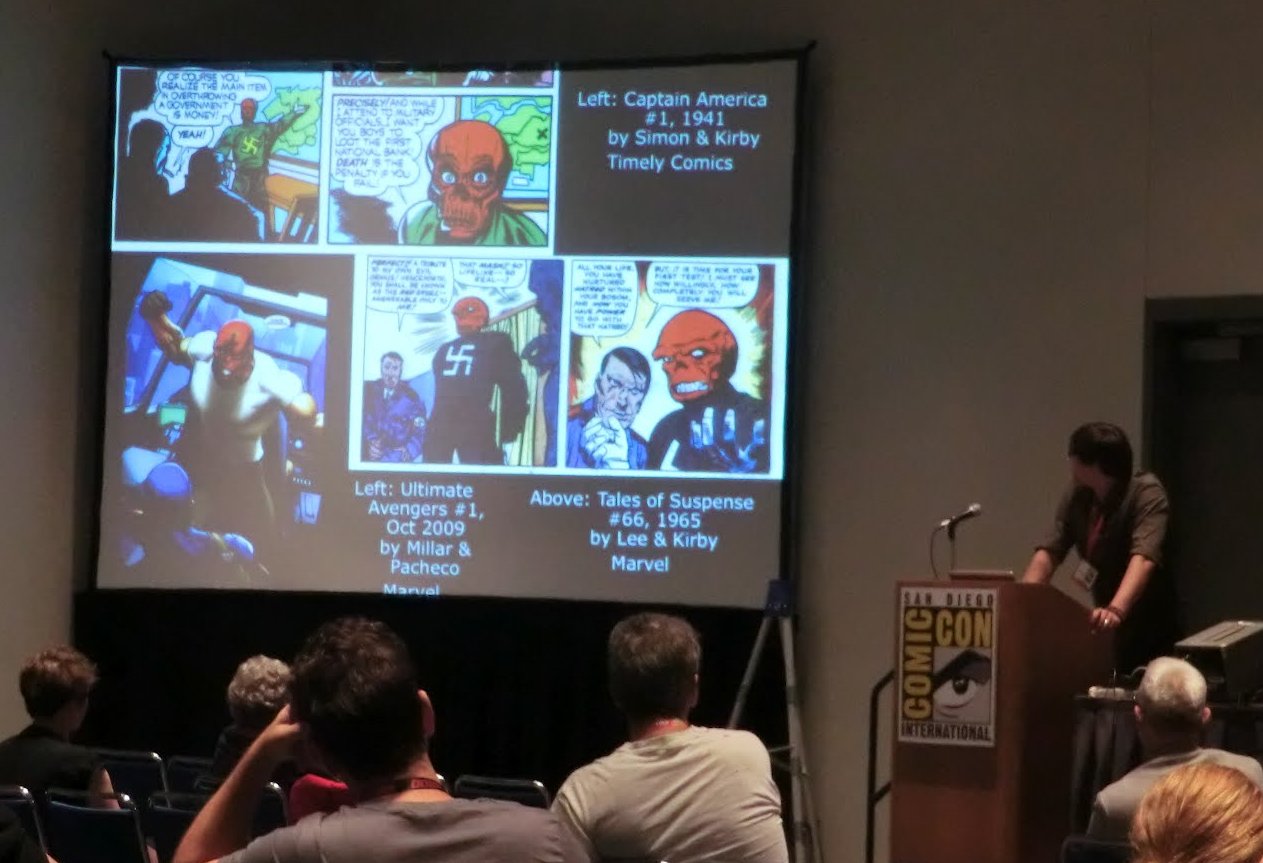
Matthias Harbeck, of Humboldt-Universität zu Berlin, discusses German stereotypes in comics since WWII.


On Friday, I eschewed the long lines for Firefly and Hobbit panels and spent most of my time at the Comics Art Conference, where serious academics present papers on serious comics topics. I sat through a series of lectures on how comics view nations (“Captain America: Court Jester or Patriotic Icon?” the portrayal of Germans in comics from World War II to the present day, etc.). I made an interesting point, I think, with one presenter whose paper was on Alpha Flight (the Canadian super team). Instead of most super teams, which are an assemblege of archetypes (tech hero, science experiment gone wrong, Norse god, etc.), I argued that Alpha Flight was composed instead of Canadian stereotypes: the angry Quebecois (Northstar), the noble First Nations (Shaman), the mysterious northern beast (Sasquatch) and the white Inuit (Snowbird). The presenter, from Carleton University in Ottawa, came up after the session and personally thanked me for my points.

Rob and I went to a strange panel for an Adult Swim-like Marvel cartoon called the “All Winners Squad,” hosted by Morgan Spurlock (of Super-size Me fame) for some reason:


That was weird.

Rob and I took advantage of the Comic-Con atmosphere later that night to watch The Amazing Spider-Man at a downtown San Diego theater. Rob was unhappy with the changes from the source material, although further conversation indicated to me that he was probably still upset with the reboot from the Toby Maguire series. I quite liked it. I thought the chemistry between Andrew Garfield’s Peter Parker and Emma Stone’s Gwen Stacy was well above that between Maguire and Kirsten Dunst. I liked Garfield’s performance, which brought some humor that Maguire had trouble portraying (at least in his first and third movies).

Saturday was a day lost in lines for me. I tried to get into the "Futurama" panel (right) by joining the Ballroom 20 line almost two hours before the noon panel, but didn’t get in until about 1:45, where I watched the Family Guy presentation. I then moseyed across the convention center to the Avengers vs. X-Men panel, which presented little new information about Marvel’s ongoing crossover.

But noticing that the same ballroom was to be used for the ever-popular “Mythbusters” panel a few hours later, I decided to stay in the room. As a result, I was subjected to the whims of TV marketers. First off, I watched the pilot of Fox’s new drama “The Following.” Kevin Bacon (below right) plays a retired FBI agent consulting on taking down the copycat followers of a serial killer he arrested. In this endeavor, he is being “assisted” by the manipulative serial killer himself. I actually enjoyed the pilot a lot. Good acting, good tension and some nice twists. I don’t see what the premise has to do with Comic-Con, however.

(On a side note, if there’s any panel video with me in the background, my Bacon Number has dropped to one!)

The other pilot, for NBC’s “Revolution,” was also promising, but less so than “The Following.” This series has a premise that some mysterious force knocked out all the power in the world 15 years previous. Setup was good, but execution was a bit clunky. It did bring up one sobering thought for me during the panel:


The “Mythbusters” panel itself, hosted by John Landis, was great. It featured some interesting back-stage stories. My favorite was one where the crew tried to test the myth where a drunk man asked a blind friend to drive him home with his guidance, under the assumption that a ticket for driving without a license was not as bad as one for a DUI. They found that a sober person, describing when to turn, brake, go, etc., could indeed guide a blind person quite well, but a drunk person made the blind person drive like a drunken driver!

The "Mythbusters" panel. From left: Director John Landis, Tory Belleci, Kari Byron, Jamie Hyneman, Grant Imahara and Adam Savage.

Sunday, I took no chances. I got up shortly after 6 a.m. and hopped an early train, getting into the massive Hall H line at about 7:05 a.m., hoping to get into the 12:30 p.m. “Doctor Who” panel. It didn’t look promising at first, as the linked snaked through the outdoor queueing area, long behind the convention center and around an artificial island/marina in the back. But I got into the hall about 10:30 and sat to enjoy the presentations.

While not a watcher of either "Fringe" or "Supernatural," the two panels I had to wait through, it was apparent those shows have an enthusiastic fanbase. But they had nothing on the love the audience showered on "Doctor Who" producer/writer Steven Moffett and stars Matt Smith, Karen Gillen and Arthur Darvill. We got to see some intriguing extended clips from the upcoming season, including one appropriately titled, "Dinosaurs in Space."

The "Doctor Who" panel. From left: Moderator Chris Hardwick, showrunner Steven Moffett, Matt Smith (The Doctor), Karen Gillan (Amy), Arthur Darvill (Rory) and producer Caroline Skinner.

After the "Who" panel broke up, I headed over to a panel featuring another beloved genre powerhouse, Buffy: The Vampire Slayer. Celebrating 20 years since the (poor compared to the almost-unrelated television series) Buffy movie started the franchise off and made Joss Whedon an entertainment powerhouse, the panel featured actors from the movie (although not the promised Kristy Swanson) and TV series and writers and artists from both the TV show and comic series. With the panel followed up by a sing-along showing of the musical episode "Once More, with Feeling," Whedonites left satiated.

At the "Buffy at 20" panel: actors Nicholan Brendon (Zander) and James Marsters (Spike) and writer Jane Espenson.

I did have a nice fan-interactive moment on Sunday, when I tweeted that I'd been right next to Plait while leaving a panel. Plait wrote back that I should have introduced myself, and I replied that I didn't want to interrupt his phone call. That brought on this reply:


That's what's great about what I still refer to as the "San Diego Comic Convention" -- despite the now-huge scale, fans can still have direct contact with celebrities.

My first Comic-Con was in 1992, a much-more restrained affair. It's gotten more crowded, more expensive and less about comics each year. But it's always (except for lines and frustration over not getting into certain panels) been a fun event overall. It's just taken a bit more adaptability on my part and forced me to lower my expectations over what I'm going to do in San Diego. For example, this was probably, save for a whistle stop in 2004, the convention in which I've spent the least time on the floor (less than 90 minutes over four days) and the Con where I bought the least -- one measly comic.

But where else can you take a picture with the Adam West-era Batmobile?


Just a note: I'm still trying to find the owner of the camera I found last year!

Thursday, October 13, 2011

The fog of war(planes)

Blue Angels: "We came, we saw, we flew off."

On Sunday I decided to brave the Embarcadero crowds and take one of the young'uns downtown to see the Blue Angels.

The Blue Angels, the US Navy's premier aerial acrobatics team have been a fixture of San Francisco's Fleet Week for decades. The have brought cheers and also jeers, mainly due to noise complaints, but also their symbolism in an area where the military can be unpopular.

The Snowbirds complete
a loop.
We exited BART at Embarcadero Station and walked about a mile-and-a-half up to Pier 37, where we set up a picnic about two hours prior to the scheduled start of the Blue Angels' demonstration. Luckily, there were a few opening acts.

First up were our neighbors from our north, the Snowbirds (left), representing Canada's Armed Forces. While their jets weren't quite as fast or powerful as the Blue Angels' F-18s, the Snowbirds made up for it by using their greater numbers (nine CT-114 jets). The numbers enabled the Snowbirds to pull off some pretty complicated tricks -- such as drawing a heart in the sky with smoke, then piercing it -- back-to-back-to-back as smaller groups broke off and performed along various parts of the waterfront.


Canada's Snowbirds fly in tight formation during their Oct. 9, 2011 show in San Francisco.


F-15 on afterburner.
Next up were a couple single-plane demonstrations, a Marine Corps F/A-18 and a US Air Force F-15, which delighted the crowd with very-low (and very loud), high-subsonic passes on afterburner (right). It also did a fairly good cobra maneuver and generously showed its high-thrust abilities with quick climbs from the deck to about 15,000 feet and back down again.

Another highlight was seeing a United Airlines 747 pass low and do some pretty tricky tight turns that you don't want done on your next flight to Chicago, but are pretty impressive at an air show. The big, lumbering jumbo jet was a surprisingly exciting part of the show.

(Click on the pictures to "embiggen." The photos are perfectly cromulent.)


A United Airlines 747-400 does some impressive low passes over the San Francisco waterfront.

My son and I had enjoyed the show, thus far, and its a good thing we did, too. When the Blue Angel's C-130 support craft, "Fat Albert," (below) appeared and did a few tricks, the crowd was led to believe the main show was about to start and got excited. As "Albert" left, the F-18s came into sight and began circling.

And circling.

And circling.

The Blue Angels' C-130 support plane, "Fat Albert," does low-level turns for the fans.

Turns out some fog had rolled in, and the Blue Angels didn't feel that conditions were safe to fly 18 inches apart 20 feet above the water. They eventually had to cancel the demonstration. Alas, while the crowd was disappointed, I think a majority understood. Certainly, we had been amused in the meantime.

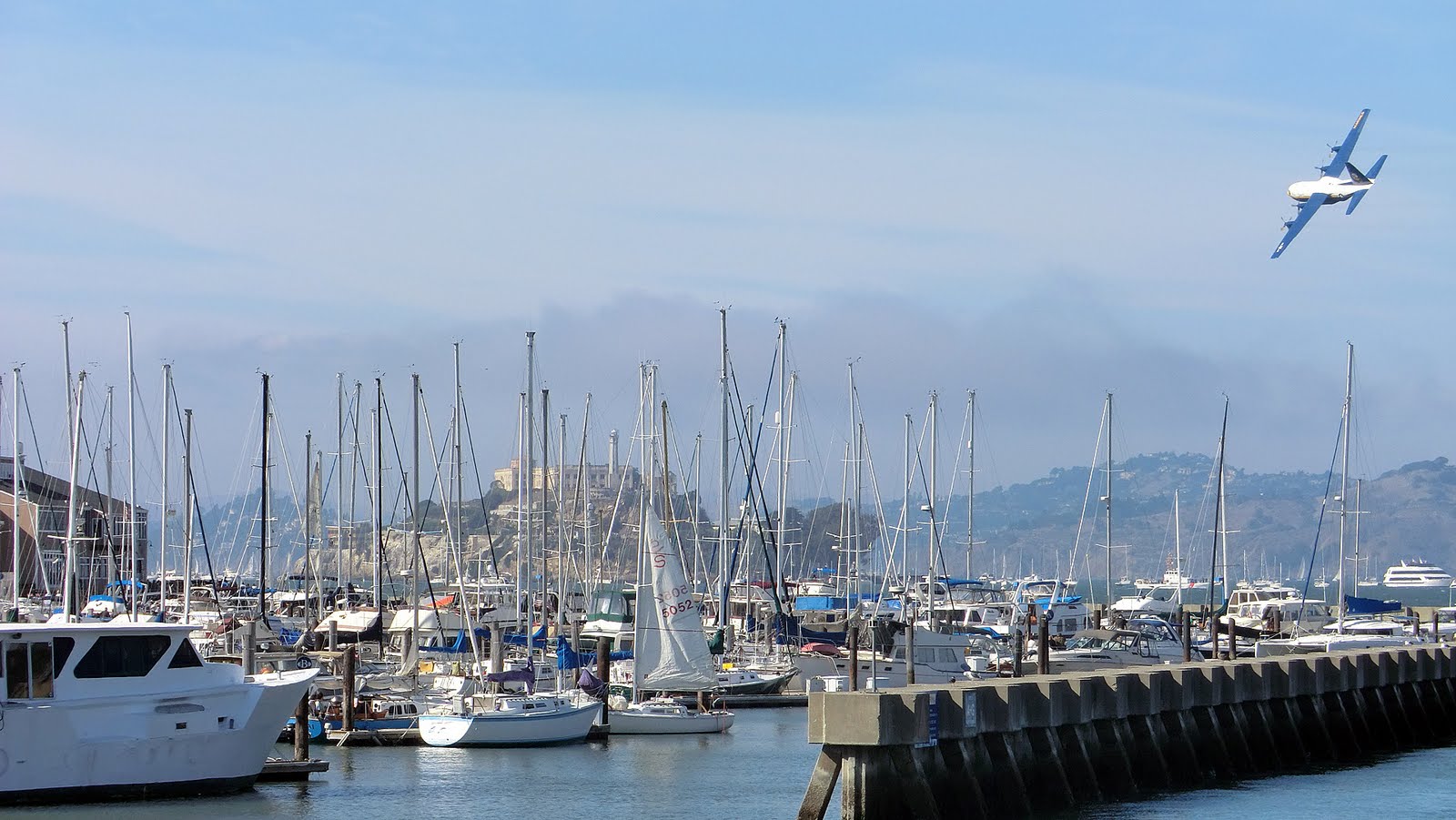
The fog, seen here over Alcatraz, which caused the Blue Angels to cancel  their Sunday performance.

Friday, September 23, 2011

GAO: Eliminate dollar bills in favor of dollar coins, save more than $5 billion

If not for gold dollars, Millard Fillmore would be under-representated on US currency.

I love my Congresswoman, Jackie Speier. She’s never backed down on a fight, despite having been shot five times for her political work. She’s been a strong representative for my community (including its transit issues) on the local, state and national level.

But I think she’s on the wrong side of one of the latest fights she’s taken on. Speier announced over the summer that she would introduce a bill to kill the dollar coin program.

Dollar coins? Yes, the United States has dollar coins. You don’t see them much, unless you actively seek them out or buy some straight from the mint, but they’re there.

And there should be more of them. The non-partisan Governmental Accounting Office recently issued a report that stated swapping dollar coins for bills could save the US Government $5.5 BILLION.

Annual savings to US government by replacing dollar bills with coins.

The United States recently got a few million more dollar coins into circulation by doing two things: starting the Presidential Dollar Coin Program, in which every dead president gets his own coin (hence my Millard Fillmore coin); and introducing a direct ship program to the public.

The problem with the latter deal was that frequent fliers got word of the program, buying literally nearly a billion dollars worth of coins in order to get miles or points, then depositing them right back into the bank. The government recently discontinued the direct-ship program because of “ongoing activity by individuals purchasing $1 coins with credit cards, accumulating frequent flyer miles, and then returning coins to local banks. Local banks, in turn, returned coins to the Federal Reserve. While not illegal, this activity was a clear abuse and misuse of the program.”

The result was more than $1 billion of dollar coins stuck in the Federal Reserve, raising the ire of Speier and resulting in her bill. (Disclaimer: I bought about $20,000 worth of dollar coins through the program, accumulating miles, but I also spent about $5,000. The coins are great for everything from bus fare to tips to Tooth Fairy Money for dentally challenged seven-year-olds.)

So let’s look at the numbers. The average cost to print a dollar bill was about 9.6 cents in 2010. The cost to make a dollar coin was about 30 cents – but as coins last about 20 times longer (40 years, versus two years for the “paper,” actually cotton/linen, dollar), the US would save millions in the medium-to-long term.

Let’s also look at some of the most-traded worldwide currencies. None of them print anything nearly as worthless as the US dollar:

Country/region -- Currency -- Lowest denom. bill -- Value in US $*
Europe -- Euro -- €5 -- $6.71
United Kingdom -- Pound -- £5 -- $7.70
Australia -- Aus. Dollar -- $AUD 5 -- $4.85
Canada -- Can. Dollar -- $CAD 5 -- $4.85
Mexico -- Peso -- Mex$20 -- $1.42
* As of Sept. 23, 2011

The U.S. government’s huge mistake, of course, is to continue printing $1 bills while producing dollar coins. Canada, Australia and the UK introduced coins of similar value into circulation by replacing the corresponding notes, eventually leaving the public with no alternative but the coin (the Euro has never had anything less than a €5 bill). That is what needs to happen here.

Freshman Congressman David Schweikert (R-Ariz.) has introduced what he calls the COINS Act, which would replace dollar bills with dollar coins. Is Schweikert’s bill going to go anywhere? Probably not, but it’s a start.

I love dollar coins, but with the direct ship over the Internet program ended, I’m running short on Tooth Fairy money. Luckily the kid says he doesn’t have any loose teeth.

Saturday, January 24, 2009

"Fictional History" (In other words, "History") -- Part Two: Louis Riel

A few years back, Claire and I were in a Montréal museum and she noticed me excitedly shooting photos of a hat in a display case. "It's Louis Riel's hat," I exclaimed. She drew a blank, as would most Americans.

Riel was a 19th Century revolutionary figure in Canada, who stood up for the rights of his people, the Métis, most of whom were of mixed French-"First Nations" ancestry. His activism helped form the province of Manitoba and advance the cause of French speakers outside of Québec. But his means -- including the support of armed insurrection -- caused him to be labled as a murderer in English-speaking Canada and his was hanged as a traitor (despite vehement protests in Québec) in 1885.

He was also just a little bit crazy. Either that or he actually was on a mission from God. Take your pick.

I first learned of Riel in my study of Canada a few years back. Both Ferguson's Canadian History for Dummies (actually a really good survey of our neighbors to the north) and Riendeau's dense A Brief History of Canada treat Riel rather roughly. A few years back at Comic-Con, I was at the Eisner awards and noticed a Riel biography was nominated for Best Graphic Album-Reprint. I decided to look for it and found it at a local library a couple weeks back.

Chester Brown's Louis Riel: A Comic-Strip Biography is a good read, but admittedly takes liberties with the facts. Historical figures are shown at gatherings where they were not present, several characters are composited into one for simplicity's sake, scenes are dialogue are dramatized. In other words, it's much like the movie "24 Hour Party People," which I reviewed earlier this week.

Below: Riel meets with Ulysses S. Grant, then goes nuts (because everyone knows there's no God in Washington D.C. ), in a two-page spread illustrating the typical six-panel layout of Brown's book. Click to enlarge.


Brown for the most part is sympathetic to Riel, showing him as being passionate about his cause, but indecisive and too willing to take bad advice. Despite the revisionism, the book is no hagiography. As stated, Riel is often shown to make bad decisions and despite the style shown in the "religious experience" above, its clear that Brown thinks Riel had a screw loose.

What conservative Canadians might get upset about is the treatment of John A. Macdonald, the Dominion's first prime minister. Now Macdonald is in no way as revered as, say, George Washington, he is certainly considered one of the greatest Canadians. In Brown's book Macdonald is presented as a conniving drunkard, willing to let the Métis suffer if it suits his political goals (right).

Brown offers an intriguing narrative, the simple line art is clean and easy to follow. The historical flow is easy to follow and the many, many characters are easy to keep straight. The story presents an intriguing political tragedy. But while I learned a lot about the North-West Rebellion and Riel's role in it, I don't know if I really learned much about Riel himself. There is nothing in the book before Riel's formation of Manitoba and virtually nothing about the nearly 15 years he was exiled in the United States. It stretches things to call this book a "biography" when it only concentrates on specific events.

History is indeed written not only by the victors, but by those who actually choose to write it. Brown's "Louis Riel: A Comic-Strip Biography" helps remind us of that fact, while at the same time helping us debate if a little historical wiggle room is acceptable over forgetting the whole deal.

Monday, November 17, 2008

Meeting old friends for the first time

Rundle Mall, Adelaide (my current location).

ADELAIDE, South Australia (Nov. 18, 2008) — A few years back, I joined a mailing list connected to a web camera focused on Charlottetown, Prince Edward Island, Canada. The list brought folks together from all over the world. Though the official mailing list is now off line, a group of us continue to talk frequently off list. Taking advantage of my unique geographical circumstances Monday (Australia time), I scratched another I-Cammer off my "To-Meet" list as I had dinner with Helen Potiris and her family in Adelaide.

Helen (with Chris and Amelia in the back) picked me up in front of my hostel in downtown Adelaide at 6:30 p.m. sharp (Helen was coming back after picking up Chris at work) and drove me to their home in the southwestern suburbs where I also met Helen's dad, Jim, and Chris' brother Adrian.

Amelia's third birthday is coming up in about two weeks so I took the liberty of buying her a kid's digital camera along with a Snow White card (what little girl doesn't like princesses?) and I made the card out as being "From John on behalf of Mom's I-Cam friends." No one on the list minded my adding that part I trust. Amelia (left) is a real sweetheart, and although she regarded me with a wary eye at first she warmed up later in the evening and regaled me with tales of flowers, ponds and how their cat, Musket, had been sick as she played with her new camera.

Helen was making pasta for us all (along with an ambitious anti-pasta side plate) when we were all surprised by the unexpected visit of Chris' sister Hazel and her husband Harry from Perth -- making their first visit in several years. Needless to say it was quite busy in the Potiris/Goodhall household, but Helen handled it with the grace of an air traffic controller and no one felt left out.

Me with the Potiris/Goodhall family.

After dinner, the bulk of us went to the shore at Glenelg and took a nice walk, culminating in a trip to the ice cream parlor. I had something called Jaffa Orange, basically a chocolate-orange mix. Quite tasty. We retired back to the house for tea, put Amelia to sleep and spoke about the US southwest (among other topics) before we called it a night and Helen drove me back downtown.

Thanks again Helen for dinner and an overall wonderful time.

(Part III of through the Centre will post later from Sydney. I'm off to catch the train now for a 24-hour ride.)

Wednesday, October 15, 2008

Westminster, Westschminster

Hier, l'élection fédérale canadienne a été juste une autre illustration des problèmes inhérents dans le système de Westminster.

Où d'autre, mais dans un système de Westminster une personne peut-elle voir comme un titre que j'ai vu sur le site de Radio-Canada ce matin: «Canadians 'voted to move our country forward,' Harper says of strong minority?» Qu'est-ce que l'enfer est une "forte minorité".

Le principal problème de Westminster, à mon avis, est que je pourrais comme la personne en cours d'exécution pour le député de ma circonscription mais la haineux chef de parti (ou vice-versa). Pourtant, si je décide de voter pour le politicien local, je suis également en vigueur de vote pour le chef du parti d'être PM. Non merci, je tiens à élire mon représentant local et le chef du pays séparément.

En fait, j'ai toujours été d'avis que le Président des États-Unis devrait être de la partie qui ne contrôle pas le Congrès. Je pense qu'il ya de meilleurs contrôles et des équilibres de cette façon.

Le système de Westminster bouleverser l'aile gauche, parce que quelqu'un comme Stephen Harper est susceptible de conduire au Canada avec une "forte" minorité. L'aile droite aux États-Unis peut être reconnaissants que il n'y a pas de système de Westminster ici, sinon, Nancy Pelosi serait en charge.


Pour cette question, seulement au Canada, peut faire un parti séparatiste, comme le Bloc québécois officiellement devenir "Her Majesty's Loyal Opposition".