Showing posts with label science. Show all posts

Sunday, July 15, 2012

Comic-Con 2012 wrapup

Comic-Con has gotten so big that it's almost impossible to give a sense of scale for the crowds.

The past four days I’ve been in San Diego at Comic-Con 2012. It’s been a good experience, and I was privileged to spend much of the weekend with my old friend Rob Roy.

After many hours of line waiting the last four days, I stand by the assertions I made in my last blog about the need for clearing rooms and panel reservations. But in general, I think the folks with Comic-Con and the San Diego Convention Center have done the best job they could with the massive crowds.

Comic-Con has taken over much of downtown San Diego, so much that even nearby supermarkets have set up junk food refueling stations (below) outside their shops for hungry geeks.


Arriving at the convention about mid-day on Thursday, I took a quick tour of the floor, where the always-impressive costumes encouraged me to make the following observation:


One of my first panels was an appreciation of the late Ray Bradbury. A number of prominent authors, including the esteemed Margaret Atwood outlined the impact Bradbury’s writing had on their work. As an example, Atwood noted that Bradbury’s “Fahrenheit 451” influenced her acclaimed novel “The Handmaid’s Tale” in regards to “who (is allowed) to read.”

Authors Margaret Atwood and Joe Hill talk about Ray Bradbury.

Following that, I stayed for a panel about 1982 -- called “the greatest geek year ever.” And with flicks such as Blade Runner, Star Trek II: The Wrath of Khan, Tron and E.T. released in 1982, it’s hard to argue. After a couple more panels, Rob and I got into Phil Plait’s roundtable about science in science fiction. Good discussion. I think the best point was about explosions in space: No, you really shouldn’t hear noise when they go off. But you don’t (usually) hear music during important moments in real life either, and music is prevalent in movies. Explosions, like music, are non-natural sound elements that accentuate drama. I think I can buy that.
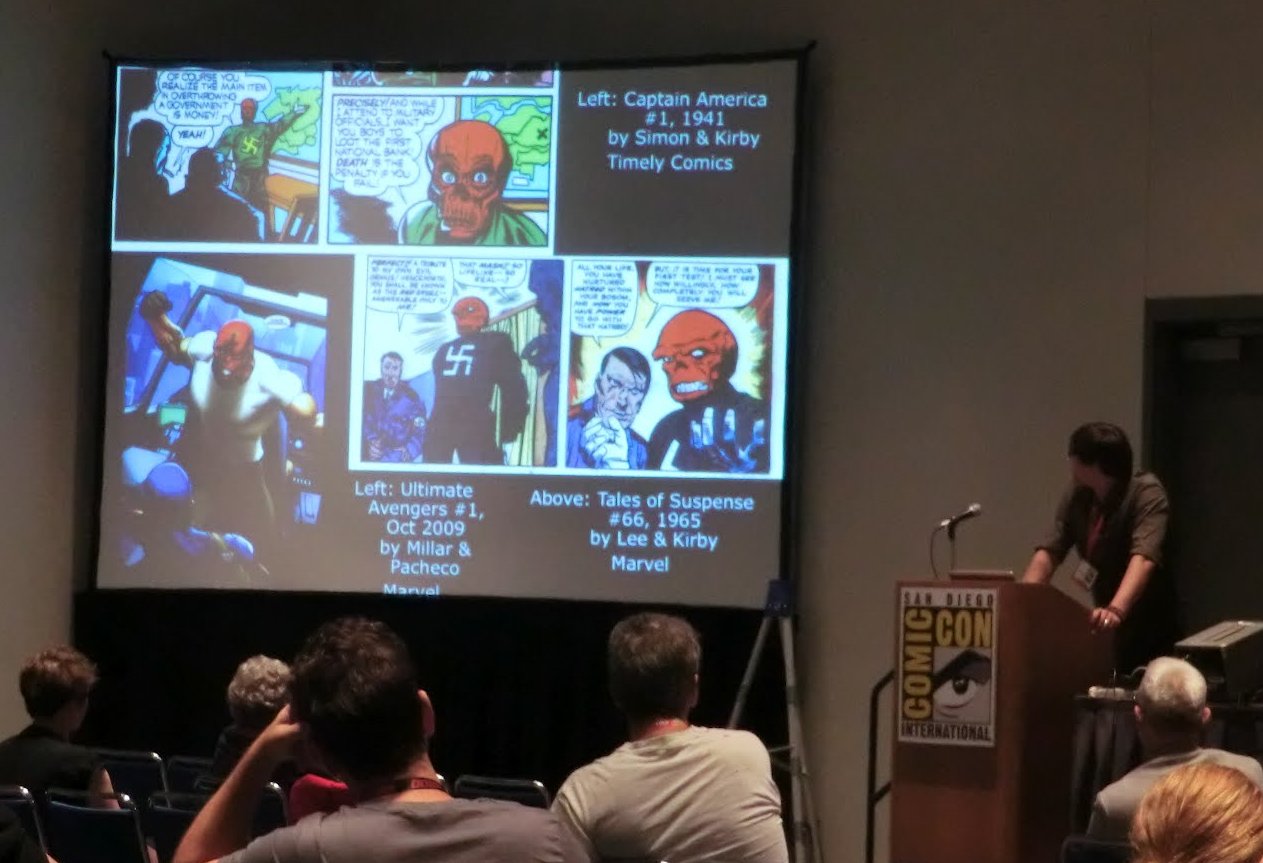
Matthias Harbeck, of Humboldt-Universität zu Berlin, discusses German stereotypes in comics since WWII.


On Friday, I eschewed the long lines for Firefly and Hobbit panels and spent most of my time at the Comics Art Conference, where serious academics present papers on serious comics topics. I sat through a series of lectures on how comics view nations (“Captain America: Court Jester or Patriotic Icon?” the portrayal of Germans in comics from World War II to the present day, etc.). I made an interesting point, I think, with one presenter whose paper was on Alpha Flight (the Canadian super team). Instead of most super teams, which are an assemblege of archetypes (tech hero, science experiment gone wrong, Norse god, etc.), I argued that Alpha Flight was composed instead of Canadian stereotypes: the angry Quebecois (Northstar), the noble First Nations (Shaman), the mysterious northern beast (Sasquatch) and the white Inuit (Snowbird). The presenter, from Carleton University in Ottawa, came up after the session and personally thanked me for my points.

Rob and I went to a strange panel for an Adult Swim-like Marvel cartoon called the “All Winners Squad,” hosted by Morgan Spurlock (of Super-size Me fame) for some reason:


That was weird.

Rob and I took advantage of the Comic-Con atmosphere later that night to watch The Amazing Spider-Man at a downtown San Diego theater. Rob was unhappy with the changes from the source material, although further conversation indicated to me that he was probably still upset with the reboot from the Toby Maguire series. I quite liked it. I thought the chemistry between Andrew Garfield’s Peter Parker and Emma Stone’s Gwen Stacy was well above that between Maguire and Kirsten Dunst. I liked Garfield’s performance, which brought some humor that Maguire had trouble portraying (at least in his first and third movies).

Saturday was a day lost in lines for me. I tried to get into the "Futurama" panel (right) by joining the Ballroom 20 line almost two hours before the noon panel, but didn’t get in until about 1:45, where I watched the Family Guy presentation. I then moseyed across the convention center to the Avengers vs. X-Men panel, which presented little new information about Marvel’s ongoing crossover.

But noticing that the same ballroom was to be used for the ever-popular “Mythbusters” panel a few hours later, I decided to stay in the room. As a result, I was subjected to the whims of TV marketers. First off, I watched the pilot of Fox’s new drama “The Following.” Kevin Bacon (below right) plays a retired FBI agent consulting on taking down the copycat followers of a serial killer he arrested. In this endeavor, he is being “assisted” by the manipulative serial killer himself. I actually enjoyed the pilot a lot. Good acting, good tension and some nice twists. I don’t see what the premise has to do with Comic-Con, however.

(On a side note, if there’s any panel video with me in the background, my Bacon Number has dropped to one!)

The other pilot, for NBC’s “Revolution,” was also promising, but less so than “The Following.” This series has a premise that some mysterious force knocked out all the power in the world 15 years previous. Setup was good, but execution was a bit clunky. It did bring up one sobering thought for me during the panel:


The “Mythbusters” panel itself, hosted by John Landis, was great. It featured some interesting back-stage stories. My favorite was one where the crew tried to test the myth where a drunk man asked a blind friend to drive him home with his guidance, under the assumption that a ticket for driving without a license was not as bad as one for a DUI. They found that a sober person, describing when to turn, brake, go, etc., could indeed guide a blind person quite well, but a drunk person made the blind person drive like a drunken driver!

The "Mythbusters" panel. From left: Director John Landis, Tory Belleci, Kari Byron, Jamie Hyneman, Grant Imahara and Adam Savage.

Sunday, I took no chances. I got up shortly after 6 a.m. and hopped an early train, getting into the massive Hall H line at about 7:05 a.m., hoping to get into the 12:30 p.m. “Doctor Who” panel. It didn’t look promising at first, as the linked snaked through the outdoor queueing area, long behind the convention center and around an artificial island/marina in the back. But I got into the hall about 10:30 and sat to enjoy the presentations.

While not a watcher of either "Fringe" or "Supernatural," the two panels I had to wait through, it was apparent those shows have an enthusiastic fanbase. But they had nothing on the love the audience showered on "Doctor Who" producer/writer Steven Moffett and stars Matt Smith, Karen Gillen and Arthur Darvill. We got to see some intriguing extended clips from the upcoming season, including one appropriately titled, "Dinosaurs in Space."

The "Doctor Who" panel. From left: Moderator Chris Hardwick, showrunner Steven Moffett, Matt Smith (The Doctor), Karen Gillan (Amy), Arthur Darvill (Rory) and producer Caroline Skinner.

After the "Who" panel broke up, I headed over to a panel featuring another beloved genre powerhouse, Buffy: The Vampire Slayer. Celebrating 20 years since the (poor compared to the almost-unrelated television series) Buffy movie started the franchise off and made Joss Whedon an entertainment powerhouse, the panel featured actors from the movie (although not the promised Kristy Swanson) and TV series and writers and artists from both the TV show and comic series. With the panel followed up by a sing-along showing of the musical episode "Once More, with Feeling," Whedonites left satiated.

At the "Buffy at 20" panel: actors Nicholan Brendon (Zander) and James Marsters (Spike) and writer Jane Espenson.

I did have a nice fan-interactive moment on Sunday, when I tweeted that I'd been right next to Plait while leaving a panel. Plait wrote back that I should have introduced myself, and I replied that I didn't want to interrupt his phone call. That brought on this reply:


That's what's great about what I still refer to as the "San Diego Comic Convention" -- despite the now-huge scale, fans can still have direct contact with celebrities.

My first Comic-Con was in 1992, a much-more restrained affair. It's gotten more crowded, more expensive and less about comics each year. But it's always (except for lines and frustration over not getting into certain panels) been a fun event overall. It's just taken a bit more adaptability on my part and forced me to lower my expectations over what I'm going to do in San Diego. For example, this was probably, save for a whistle stop in 2004, the convention in which I've spent the least time on the floor (less than 90 minutes over four days) and the Con where I bought the least -- one measly comic.

But where else can you take a picture with the Adam West-era Batmobile?


Just a note: I'm still trying to find the owner of the camera I found last year!

Thursday, December 1, 2011

Go ahead, put your bananas in the refrigerator

The United Fruit Company, may have overthrown Latin American governments, hired Columbian death squads and exacerbated economic and social divisions throughout the Americas. But, damn, could its adwriters write a good jingle.

Even the youngest among us have heard the Chiquita Banana song:


For those who missed it, here are the lyrics:

I'm Chiquita banana and I've come to say
Bananas have to ripen in a certain way
When they are fleck'd with brown and have a golden hue
Bananas taste the best and are best for you
You can put them in a salad
You can put them in a pie-aye
Any way you want to eat them
It's impossible to beat them
But, bananas like the climate of the very, very tropical equator
So you should never put bananas in the refrigerator

Don’t refrigerate the banana? Why not? What are the consequences?

I’m not the first to ask this question, nor will I be the last. Opinions suggest that refrigeration is fine, but ripening is slowed. But I needed to find out for myself.

Only one way to sort this out — experiment time!

Our experimental bunch of bananas. Click on photos to embiggen.

Day 1:
Step 1 — Got a pledge from my wife that she would make banana bread out of any rotten bananas.
Step 2 — Bought a small bunch of four barely-ripened bananas (above) from Safeway.
Step 3 — Lettered them from A to D, then left them to ripen in the four most-common fruit storage methods that I could think of:

• Banana A (the control) was simply put in my fruit basket with the other fruit;

• Banana B was put into the refrigerator to test the assessment in the song;

• Banana C was put on top of the refrigerator because that’s where my mom thought fruit best ripened;

• Banana D was kept in a paper bag, based on folk wisdom that keeping fruit in paper bags helps it ripen faster.

I then let nature take its course. The first few days, all the bananas looked the same, with the first brown splotches showing up on all four on day 3.

Sadly, tragedy struck on Day 6 when Banana C (on the top of the refrigerator) was eaten prematurely by an absent-minded housemate. The best I can say was that it looked little different on Day 5 from any of the other bananas.

Day 7: After one week, I compare my three remaining bananas (right).

Banana A is a bright yellow, with several round brown spots. Would still pick up and eat based on physical appearance.

Banana B is greener than its counterparts. Browning is more diffuse than other bananas (in blotches more than spots). Would eat this one last based on physical appearance.

Banana C: Missing.

Banana D: What do you know? It appears the paper bag method works. Appears to have gotten more ripe than other bananas. Even spotting. Would eat based on physical appearance.


Day 14: After two weeks, the experiment was over. I put all three bananas (below) on the counter, examined their appearance and resolved to take a couple bites from each.


Banana A: The best looking of the bunch and the only one I would pick to eat based on how it looks. Still fairly yellow, with high-contrast spots. After peeling, severe mushy spots apparent on top end. Bottom is still edible and appetizing, but upper half is a waste.

Banana B: This banana has a fairly even brown skin at this point. Based on appearance alone, would not choose to eat. But upon peeling, I am very surprised. The actual fruit is still firm and good-looking. Without a peel, this banana still looks fresh! Tastes good. Actually finish.

Banana C: Missing.

Banana D: Almost completely covered with splotches. Not very appetizing in appearance. Peeled skin. Interior was almost completely brown and mushy. Did not eat.

So the moral? If you need your bananas to ripen quickly, try a paper bag but don’t leave them in too long. If you want your bananas to last, refrigerate them, Chiquita Banana Song be damned. Just don't expect them to look good.


* Footnote: My wife notes that this was a bad experiment, as the third banana went missing. “It’s like Jonas Salk was about to cure polio and someone ate the moldy bread,” she said.

Monday, November 28, 2011

Klout and the Observer Effect


Rohn Jay Miller’s “Delete Your Klout Profile Now” (published Nov. 9, 2011 on SocialMediaToday.com) brings up a couple interesting points about measuring “influence” on social media. First, he brings up the fact that Klout is, in fact, a corporation seeking to leverage its subscribers into become influencers or advertisers for the company at little cost to itself. Secondly, Miller points out that Klout (and other SM measurement sites) are somewhat perverting the actual purpose of social media, making an immeasurable product into one that can be analyzed and sold. While Miller has valid points, he is missing the worst aspect of social media “influence” measurement — the fact that Klout’s measurement is affecting those it purports to monitor.

Physicists write about a phenomenon called “the observer effect” — referring to changes that the act of observation will make on the process being observed. Klout is similar. While there may be moral problems in Klout’s packaging its measurements — gained for free through the efforts of countless social media users — there is a bigger problem in that many users are changing their online behaviors in an effort to gain more “influence.” I have heard numerous social media users note that they are Tweeting at certain times of day or about certain topics, or even trading “+K” on Klout in an effort to improve their influence scores. Even if Klout’s scoring system is otherwise accurate, its propensity for being gamed (like Google search results) by users brings its credibility — and usefulness — into doubt.

Klout succeeds in that it meets a basic human need for recognition. This human desire makes Klout’s business model a successful one: some sample of people will alter their online behavior in order to improve their Klout score. And while there are philosophical issues as to whether Klout (or similar sites) is entitled to use its data in a business sense, there is a larger issue of credibility. If Klout’s measurement is affecting social media behavior, is it actually measuring accurately at all?

Friday, November 4, 2011

High-speed rail expensive, but worth it

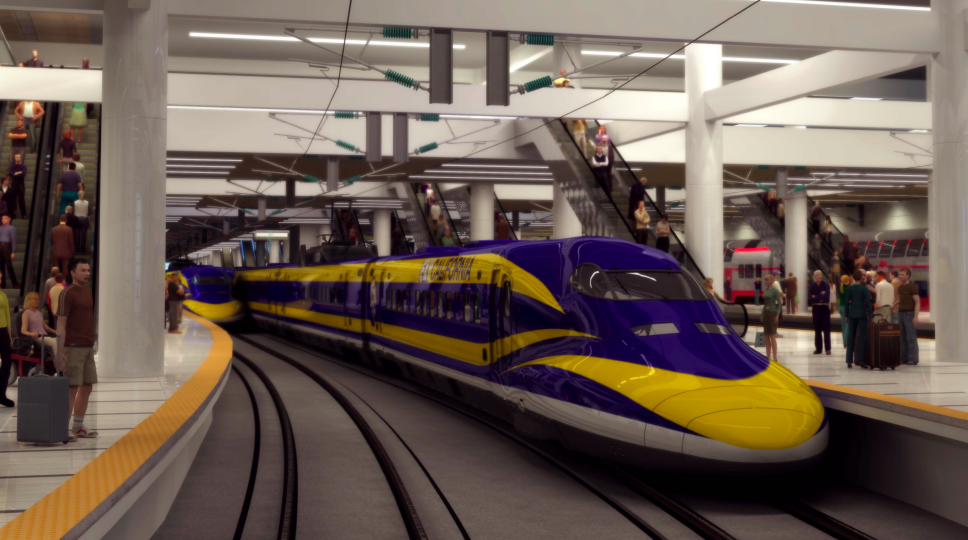
Artists' rendering of a high-speed train in San Francisco's new Transbay Terminal.

Three years ago tonight, I was in Perth, Western Australia, where I wrote stories on this blog about reactions to the US elections from Aussie college students and about the experiences of an American abroad on a historic election night.

Prior to leaving the country, I had voted by mail. Ever private in my politics, I only recommended people support one issue: Proposition 1A — the California High Speed Rail initiative.

California’s high-speed rail system is envisioned as an 800-mile system linking Southern California with Sacramento and the Bay Area at speeds up to 220 mph. The system is partially designed to compensate for a growing California population that Scientific American estimated in 2009 would otherwise require an extra 3,000 miles of highway lanes, five large airport runways and 91 airport gates by 2030 — improvements that were estimated to cost $100 billion.

In that regard, the California High-Speed Rail System integrates several principals of the Bay Area Metropolitan Transportation Commission’s 2035 plan, namely: Its downtown-to-downtown ideal serves the plan’s goals of primarily serving urban dwellers; It jibes with the ideal of “crisis brings opportunity,” — using the current economic upheaval to shift from over-reliance on cars and airplanes to more-sustainable alternatives, such as passenger rail; and, the system would have an effect on the MTC’s Regional Airport Systems plan by reducing intra-California flights.

Planning began with feasibility studies in the late 1990s, and a statewide initiative — initially based on an additional sales tax rather than a bond — was twice postponed while planners hoped for more-favorable economic conditions. When finally put on the ballot in 2008, the $9.95-billion bond proposition passed with 52.6 percent of the vote, a minor upset during an economic recession. It seemed like that high-speed rail would soon connect Northern and Southern California.

Flash-forward three years later, bad economic times and — especially — NIMBYs have stalled the project. While construction is still scheduled to begin sometime next year, opposition has increased. Joining the NIMBYs (covered in a previous post) are some financial conservatives who have balked at the anticipated costs of the project.

Last week, the financial news got even grimmer, as the California High Seed Rail Authority released a revised business plan. That plan estimated that — instead of the original $45 billion the entire plan would cost, the costs had climbed to an estimated $99 billion.

High-speed rail opponents and media critics went bananas, as might be expected. They criticized the more-than doubling of the original costs, continued to disbelieve projected ridership and questioned the need for the system altogether.

I beg to disagree.

What the media didn’t play up and the opponents have ignored are predictions that the HSR project will:

  • Be entirely self-sufficient operationally;
  • Generate 100,000 direct and indirect jobs over five years in the Central Valley alone during construction;
  • Generate 4,500 permanent jobs after construction is completed — compared to 100,000-400,000 in the rest of California by 2040;
  • Result in 8 billion fewer vehicle miles traveled;
  • Save 146 million hours;
  • Reduce CO2 emissions by 3 million tons.

Financially, a clarification should be made. The $98.5 million estimated cost includes a predicted three-percent inflation rate (which, off the top of my head means a cost “only” in the high $60 billion in today’s dollars). That out of the way, let's look at some of the real economic issues.

What if high-speed wasn’t built? Then, according to San José Mayor Chuck Reed, as quoted in the Silicon Valley Business Journal, California businesses and taxpayers would need $170 billion to add 2,300 lane-miles of freeway, four additional airport runways and 115 airline gates to accommodate the state’s increasing transportation needs (numbers slightly less than the ones above from Scientific American).

High-speed rail is expensive, but a bargain in comparison to the alternative. It needs to be built.

And locally, the opposition needs to settle down. As seen below, a very large percentage of San Mateo County voters supported Prop. 1A. Quoting wholesale from a previous post I made on this topic: “high-speed rail is an extremely positive project for San Mateo County as a whole, with great benefits from proposed stops at San Francisco International Airport and a possible stop in the South County. In addition, high-speed rail will be in a position to assist Caltrain with electrification and grade separation projects.”


I used to live in San Mateo on East 40th Avenue, one block from the tracks, so I understand the concerns of nearby residents. But there is a big picture and I hope that this post can remind Atherton and Menlo Park residents (and those in their respective city governments, which have filed suits against the project) of that big picture.

Tuesday, October 18, 2011

Omni predicts the distant future of 2010 -- Part II: Technology

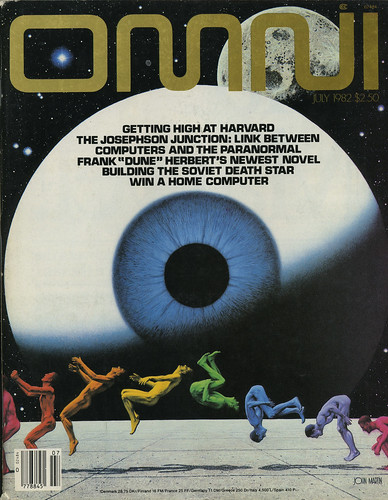
Omni Magazine, July 1982
Cover of Omni's July 1982 issue.

A while back, I outlined some of the wildly incorrect predicted 2010 prices from 1980's The Omni Future Almanac. Today, I want to point out some things the Omni editors got right.

And, because it's funnier, some more stuff they got wrong.

Successes
First, a couple slam dunks. On page 206, the editors wrote that video recording technology (initially the VCR) would not only let people watch what they want, when they wanted it, but that the practice would drive programmers and ad people crazy. They even got the terminology right:

The use of home video recorders for this type of "time shifting" will cause major problems for broadcasters who must predict to their advertisers which market will be watching which program at a specific time. Fans of daytime television programs, for example, will watch soap operas when their schedules permit — probably in prime time — utterly skewing ratings and confusing advertising plans.

Another swish -- e-mail would quickly become a communications medium to be reckoned with. While it sings the praises of the yet-to-come “paperless office” Omni's Almanac also (on page 181) talks about the amazing new technology of “electronic mail.” Apparently, in this miracle technology:

Messages are typed into the computer, which instantaneously sends the letter to its destination and files all requested copies. The recipient gets the message — either on his screen or through his printer — when he asks his computer for the mail.

E-mail was predicted to be common in interoffice business by 1990 and most correspondence would be e-mail (though that term wasn’t used by Omni) by the year 2000. The book also said the post office would struggle to compete. That much is true.

Mixed bags
On some matters, Omni had a mixed track record. Take health care costs. Omni predicted (on page 157) that an average familiy's health care costs would drop from 10.1 percent of a family's income in 1980 to about eight percent in 2000. Well, three failed decades of health care policy later, A middle-income family with individual coverage spends on average 22 percent of household income on health care -- and some spend up to 50 percent. A similar middle-income family with employer based coverage spends 8 percent percent of their income on health care costs.

In business, Omni suggested that General Motors would be profitable for many years thanks to fuel cell technology in its vehicles, ”but by 2010 the Detroit giant could vanish from the leading ranks of corporate conglomeration” (p. 178). Well, they got that last part right (still waiting on the fuel cells).

In the wishful thinking department, Omni's predicted the success of Genentech, still based on a sprawling South San Francisco campus but recently acquired by Roche. Of course, Omni also said that Genentech and or Cetus (another biotech company bought by Chiron in 1991 after staggering loses) “will create pharmaceuticals that will effectively cure diabetes and suppress the cancer tendencies in smokers.” Say what?

Just plain wrong
While Omni got some things right, or at least right to a degree, it was very off in other areas. Take basic economics. The magazine's editor thought that the average amount of their income spent by an American family on housing would drop from 21.3 percent in 1980 to about 19 percent in 2000. Well, in 2009, the average US family spent about 34 percent of their income on housing. (I blame the torrid San Francisco housing market!).

Of course, no discussion about the "future" is complete without a section on robots. On page 178, the Future Almanac predicts that the Soviet Union "will standardize the robots industry." Widespread use of robots would give the proletariat workers more free time and thus result in more political tension. Nothing about the Berlin Wall falling, however.

In the United States, Omni predicted, robots will be used extensively in office, service industries and manufacturing. Occupations which would become obsolete include bank tellers, supermarket cashiers, "movie ticket operators," car wash workers and stock clerks. "Factory assembly lines will be a nostalgic reminder of the past." Tell that to the population of Flint.

Another interesting area would be the use of robots in the restaurant business:

Short-order food preparation also appears likely to be overtaken by robotics. These firms could implement a robot food-serving system as early as 1985. Gas stations will also be totally serviced by robots. While the tank is being filled, a credit card will be put into the machine to register payment and complete the transaction.

That sounds like this:
Courtesy: The Fiscal Times

Omni predicted widespread use of robots only among the wealthy and upper middle class, however. That's probably why you don't have one. Except maybe a Roomba.

I was going to give Omni credit for its prescience in saying that robot space probes would be very successful -- until the book said that robot space probes would probe "other solar systems." No robot will make it to another solar system in the next 10,000 years, barring breakthrough in warp drive.

Still, we should be glad that robots aren't quite as widespread as Omni thought they would be:

Friday, September 30, 2011

Omni predicts the distant future of 2010 -- Part I: Inflation

Omni magazine predicted the future, or did it?

Omni was a strange combination of a science magazine and a science fiction journal that published from 1978 to 1996. It specialized in "gonzo" science journalism, as well as publishing cutting-edge sci-fi.

In 1980, the editors published The Omni Future Almanac, which aimed to predict the trends of the next 30 years or so. Some predictions, they got pretty close on -- I plan to look at their views on e-mail and the Internet later. Some predictions were not so good -- the geo-political ones, for example (who saw that darn Berlin Wall falling within the next ten years?).

One area that Omni tried to predict was consumer costs. As the chart below shows, and remember that these predictions were made during the stagflation of the late Carter Administration, they were not so accurate about 2010 prices:

From Omni predicts 2010 prices

Wow! Obviously the rate of inflation has gone down. My local Safeway wants $1.49 (club card price) for a head of iceberg lettuce, not $5. The most-recent Big Mac index I could find shows the sandwich goes for about $4.07 in the United States, making $22 for a pound of ground beef seem high. The average monthly rent for a three-bedroom apartment in the San Francisco market is $2,662, not $10,000 (although a million dollars for a home purchase is close!). Current New York MTA subway fare is $2.25, not $20. The average US car sold for $28,000 in 2009, not $70,000. $2.75 for a daily newspaper? What's a newspaper?

The price of gas mark is interesting. Omni thought that better fuel efficiency in cars would drive down demand and greater drilling in Alaska and elsewhere would increase supplies, making the costs of fuel DROP significantly after 1990 to about $2 per gallon in 2010. The average price of gas in California right now is $3.84 per gallon. Interesting to see how geopolitics (and SUVs) affected gas price predictions.

To be fair, Omni also predicted that secretaries would now be making $95,000 a year and the average public high school teacher would pull in $110,000, over-estimating current rates in both cases. Of course, Omni also said a Major League Baseball player with "average skills" would make $330,000 per year. In 2010, the mean salary for a MLB player was about $3.3 million!

So the next time you see an economist predict the rate of inflation, take it with a grain of salt.

Thursday, September 22, 2011

Neutrinos faster than light would have profound implications

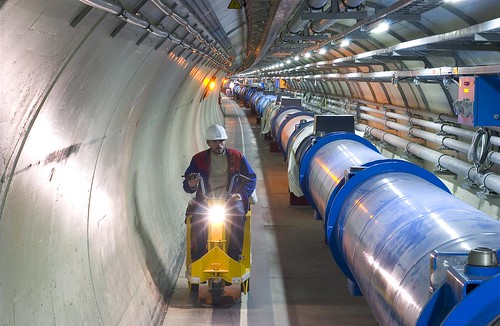
CERN / LHC tunnel
A small portion of the Large Hadron Collider at CERN, in Switzerland. Flickr photo by Ars Electronica.
A discovery was announced today that will either revolutionize science or be one of the biggest busts since the Fleischmann–Pons experiment in cold fusion, if not attempts to turn lead into gold.

Scientists at the European Organization for Nuclear Research (known by its French acronym, CERN), announced in a paper to be released soon that they had measured subatomic particles that seemed to travel faster than light. Essentially, scientists launched neutrinos from a source near Geneva, Switzerland, to a detector in Italy about 453 miles away. The neutrinos arrived 60 nanoseconds (0.00000006 seconds) faster than a photon (the particle [or wave] that makes up light) would have.

First, this discovery is somewhat shocking because it violates Einstein's theory of special relativity (you know, "e=mc squared"), which states nothing can travel faster than light. Relativity has been proven correct in experiment after experiment for more than 100 years. It's as if someone told Newton that there wasn't an equal but opposite reaction after every action.

CERN
Part of the CERN research center.
Flickr photo by dirtybronson.
The discovery is still doubted by other scientists, perhaps due to what would have been the sheer ludicrousness of proposing it before today. In fact, Occam's Razor (given multiple explanations, the simplest is the most likely) applies here. For example, "superluminal neutrinos are much much less likely than subtle systematic errors in a complex experiment the length of a country."

One might ask, "OK, but why is this important?" There are several reasons, although the ultimate effects -- if the experiment pans out -- might not be seen for years, if not centuries. Certainly, the everyday life of people alive today is unlikely to be affected. But the long-term effects may be enormous:

  • First, the implications for computing are significant. Think quantum computing will be fast? Then, what about computers that solve problems almost before they're entered?
  • What about astronomy? If neutrinos can go faster than light, one day we might have detectors that can almost literally see back in time to the beginning of the universe.
  • And not even finally, but perhaps most profoundly, neutrinos going faster than light means that information (although probably not objects) can also be sent faster than light. If mankind is not alone (and with billions of galaxies containing billions of stars, being alone is unlikely), then we might have the means to communicate with other beings in a reasonable time frame.

But the best part of this business is how it demonstrates the scientific method. These scientists came up with an idea, tested and experimented it into a hypothesis (that neutrinos can travel faster than light under some circumstances), and submitted their work to be peer reviewed for more experimentation en route to forming a theory. In fact, they basically pleaded with scientists from the United States, Japan and other scientifically advanced countries to try to replicate their experiment to make sure they didn't make a mistake.

The results may or may not pan out (probably not, I must admit). But the scientists' efforts at confirmation are a huge relief in times when those on both the left and the right often refuse to recognize the teachings of science because it doesn't fit their social or religious agenda.

Edit (Feb. 22, 2012): It appears that a faulty GPS reading caused the distances between the two sites to be overestimated, accounting for the unexpectedly short time it took for the neutrinos to hit the detector. Again, this shows the wonderfulness of the scientific method and its system of checks and balances.

Thursday, February 18, 2010

Woodrow Wilson and Newton's Laws of Motion

Future President Woodrow Wilson’s 1887 essay The Study of Administration is considered a classic of public administration, elements of which are still key tenets of public administration curriculums across the United States. In some regards, Wilson’s essay echoes previous revolutionary works like Issac Newton’s Principia Mathematica, published exactly 200 years earlier. That landmark tome presented Newton’s views on physics, gravity and scientific research methods that still resonate in today’s scientists. While Einstein, Heisenberg, Hawking and other later physicists tweaked Newton’s theories, Principia is still regarded as an essential starting point for the study of physics. So it is also with The Study of Administration and public administration.

The Study of Administration, like Principia, distilled a number of theories into one cohesive document. Like Principia, The Study of Administration has been studied, refined and had its concepts tweaked by succeeding generations of (political) scientists. And why not?; it is an influential scientific work. One reason is that it gave a clear definition for administrative duties. Wilson notes that “The object of administrative study is to rescue executive methods from the confusion and costliness of empirical experiment and set them upon foundations laid deep in stable principle.” (p. 22). Here, Newton (left) and Wilson (above, right) differ, as Sir Isaac was a firm believer in the scientific method. But just as Newton set the table for later experiments with his theoretical foundation, Wilson — the anti-experimenter — helped establish a firm base from which future public administration experiments jumped off.

With such similarities between the two mens’ manuscripts and their impacts, a compelling comparision can be made between a simplified version of Newton’s three laws of motion (introduced in Principia) with three main Wilsonian concepts introduced in The Study of Administration that still resonate with public administration scholars — and administrators — today.

Newton’s First Law: “A body persists in a state of rest or of uniform motion unless acted upon by an external force (aka the “inertia law”).” Public administration in Wilson’s time was fighting the inertia of the old spoils system that had recently been eliminated with the election of James Garfield and his “Half-Breeds,” whose advocacy of a merit system eventually cost Garfield his life at the hands of a disgruntled office seeker. Wilson recognized that, in order to be effective, politics and administration should be entirely separate fields. This was the framework of what would be expanded by Goodnow and later called the “Politics-Administration Dichotomy.” This separation of the political and operation is a trait of administrative government in the present day and few would argue with its necessity. Indeed, scholars such as Stivers (1990), take the tack that Wilson’s main thrust was that only apolitical administration was legitimate: it should be “taking its orders from the representative legislature and executing them according to dictates of rationality.” The concept of spoils or patronage is distasteful to most Americans now, but in 1887 the debate as to whether professional management would do a more-effective job was still open. Wilson helped send the political inertia in another direction.

Newton’s Second Law: “The net force on an object is equal to the mass of the object multiplied by its acceleration.” Wilson was among the first to promote the idea of public administrators treating government like a business. His call for efficiency and fixed responsibility quickly took over the field. “To be efficient,” Wilson wrote, “[Government] must discover the simplest arrangement by which responsibility can be unmistakably fixed upon officials; the best way of dividing authority without hampering it, and responsibility without obscuring it.” As adoption of the “businesslike” atmosphere accelerated, the substance of the idea eventually helped it gain a critical mass and predominate. Many public administration thinkers (e.g. Rosenbloom [1983] and Moe [1987]) think Wilson’s business idea is his greatest continuing legacy to the field. Indeed, Wilson’s businesslike preferences later saw a revival late in the 20th century with the market-like forces driving the New Public Management philosophy.

Newton’s Third Law: “To every action there is an equal and opposite reaction.” Wilson, like Newton, recognized that different systems will affect each other — if one pushes, one will be pushed back. To avoid this, Wilson recognized, a public administrator needs to cooperate with different levels of government, to embrace a federal system: “Our duty is to supply the best possible life to a federal organization, to systems within systems; to make town, city, county, state and federal governments live with a like strength and an equally assured healthfulness, keeping each unquestionably its own master and yet making all interdependent with mutual happiness.” That holistic approach to federalism, intergovernmental relations in today’s parlance, is a hallmark of local governments, which need far more help from other levels of government than was needed in Wilson’s era.

Who, then, is Einstein to Wilson’s Newton, proving that while the original theory is sufficient in most cases, it runs into difficulties as the pace gets faster and density increases? A good choice might be H. George Fredrickson, whose 1971 essay Toward a New Public Administration claimed that adminstrators need not be the neutral, operative stalwarts Wilson recommended they be. Fredrickson wrote: “[Administrators] should be committed to both good management and social equity as values, things to be achieved, or rationales” (Fredrickson, 1971, p. 297). Just as Einstein’s General Theory of Relativity essentially reaffirmed basic Newtonian concepts but showed there are cases where they simply did not hold true, Fredrickson’s calls for social equity influenced a generation of public administration scholars to be “short-haired radicals,” and stray from the narrow confines of Wilsonian stoicism.

But Wilson is still very much with us. Shafritz and Hyde (2007) note that Wilson attempted to do nothing less than refocus political science into concentrating on how governments are administered. They wrote, “Wilson was concerned with organizational efficiency and economy — that is productivity in its most simplistic function. What could be more current?” (emphasis added).

Two illustrious men, with their flaws: Wilson and Newton. Wilson’s social credit has eroded over the years due to his racism, Newton’s reputation as a scientific genius has had to co-exist with Sir Isaac’s occult beliefs. But both men wrote a great work whose impact continues to be felt centuries later. Newton’s Principia was the starting point of modern physics. As for Wilson, whatever specific organizational techniques the future president laid out, The Study of Administration is notable in and of itself for becoming the founding document of the science now known as “Public Administration.” These giants of science, political in Wilson’s case and physical in Newton’s, continue to have tremendous influence on their respective fields. Their similarities prove that great ideas can come to quickly be adopted and still be respected more than 100 years later.
References:
Fredrickson, H.G. (2007 (1971)). Toward a New Public Administration. In J. Shafritz, & A. Hyde (Eds.), Classics of Public Administration (6th Edition ed., pp. 296-307). Boston: Thomson Wadsworth.

Moe, R. (2007 (1987)). Exploring the Limits of Privatization. In J. Shafritz, & A. Hyde (Eds.), Classics of Public Administration (6th Edition ed., pp. 460-469). Boston: Thomson Wadsworth.

Rosenbloom, D. (2007 (1983)). Public Administration Theory and the Separation of Powers. In J. Shafritz, & A. Hyde (Eds.), Classics of Public Administration (6th Edition ed., pp. 434-444). Boston: Thomson Wadsworth.

Rosenbloom, D., Kravchuck, R., & Clerkin, R. (2009). Public administration: understanding management, politics, and law in the public sector (7th ed.). New York, NY, USA: McGraw-Hill.

Stivers, C. (2007 (1989)). Toward a Feminist Perspective in Public Administration. In J. Shafritz, & A. Hyde (Eds.), Classics of Public Administration (6th Edition ed., pp. 460-469). Boston: Thomson Wadsworth.

Wilson, W. (1887). The Study of Administration. Political Science Quarterly, 2, 197.

Sunday, January 17, 2010

Earthquake memories


Tuesday's earthquake in Haiti served as a reminder that today (Sunday) was the 16th anniversary of the 1994 Northridge Earthquake -- the largest I've ever been in (also, it was the 15th anniversary of the more-devastating Kobe Earthquake).

The Northridge quake offered me a fascinating insight of how both public safety and journalism react during a crisis. My experience:

I was living in with a roomate and two cats in a small house in Glendale, Calif., in January 1994. My roomate was in Santa Barbara with his then-girlfriend and I had stayed out until about midnight the evening before. I was sleeping at 4:31 a.m.when I heard a low rattling. The window above my bed was shaking and -- because we had had a very small temblor just a week or so before -- I immediately knew we were having an earthquake.

As soon as I was conscious enough to think "earthquake," I felt an acceleration upward then a quick drop down as the shaking began in earnest. I covered my head with my pillow, but not before seeing several blue flashes, no doubt caused by arcing powerlines touching. I think I said something to the effect of "Oh, crap, it's the Big One!" just before the earthquake stopped. I ran to the doorway of my room (much too late, of course) then into the living room, where I turned off the heater, worried about a gas leak. I then went to the bathroom and used the toilet, having drank about two liters of soda the evening prior.

I then flipped on my police scanner, which was kept next to my bed. I heard the Glendale Police conducting a unit roll call (all checked in OK) and heard the Verdugo Fire dispatch instruct its units to check their districts for damage. I heard about a collapsed parking garage behind the Glendale PD's station and began picking up LA County Fire radio traffic, including a discussion about the collapse of the intersection of the Interstate 5/Highway 14 intersection.

I decided a walk about the neighborhood would help calm my nerves, and of course the cats ran out the instant I opened the door. Going outside, I was surprised at how dark the sky was with power out across the Los Angeles Basin -- I could see the Milky Way for the first (and only) time in LA proper. I also noted a lot of my neighbors coming outside, crying and getting in their cars. I lived in a heavily Armenian neighborhood and many of my neighbors had either suffered through or lost family in the 1988 Armenian Earthquake and were justifiably traumatized.

After about a half-hour outside, I went back in and listened to the radio on the living room couch -- I even fell back asleep. I woke up when my mom called about 7 a.m. to say she was OK (I felt a little guilty later, because I think I told her something along the lines of "We should save the phone lines for emergencies."). The power came on shortly thereafter and I watched TV coverage of the disaster for a while before heading into the offices of the Glendale News-Press, where I worked at the time.

The newsroom was already in full swing, as you might imagine. The city editor, Steve Rosenberg, asked me to go with a photographer to a Luckys store in north Glendale, where I interviewed residents who were stocking up on canned food and bottled water ("A little late," I thought, and besides, the water system was fine). I also went over to the then-new Red Lion Hotel where I caught a couple out-of-town visitors and interviewed them about their first earthquake and a local restaurant, which was doing good business serving to rattled customers. I ended up having a couple bylines in the next day's paper, one under the headline of "Residents react with panic, panache."

I also did a few follow-up stories the next few days, dealing with the public transit situation (specifically the impacts on Metrolink) and the first day of classes two days later at Glendale College. I ended up getting a lot of extra work thanks to the disaster (much like after Sept. 11, 2001, where I earned a lot of extra money as a security guard at Candlestick Park).

As an aside, the one-year anniversary on Jan. 17, 1995, was also memorable for me. I was staying at a hotel in the Union Square area of San Francisco while I was house-hunting with my then-girlfriend in preparation for my upcoming move to the Bay Area. I had stayed up late the night before watching the pilot of "Star Trek: Voyager" on the hotel TV and woke up sleepily late that morning to see earthquake coverage. I initially thought it was a one-year retrospective until they made clear there had been a disaster in Japan that morning.

Friday, August 28, 2009

Skynet, here we come

David Mills, who hails from my hometown of Glendale, has an entertaining blog, "Undercover Black Man", where I found the video below. He asked the important question: "Shouldn’t we destroy all these Japanese robots now, instead of having to travel back in time and do it?"

And I have to say, the lady pushing the robot is probably why they will revolt in the first place.

The Terminator [Blu-ray]

Wednesday, May 13, 2009

Attack of the zombie ants

In the latest episode of "Science gone mad (but in a cool way):"

The Ft. Worth Star-Telegram reported Monday that a new strategy is being used to combat that all-too common Texas pest, the fire ant -- turning them into zombies whose heads fall off.

Apparently, fire ants are "The mean bastards of the ant world," and cause huge amounts of carnage. As stated in an Associated Press story, "The biting, territorial fire ants cost the Texas economy about $1 billion annually by damaging electrical equipment, according to a Texas A&M study. They can also threaten young calves."

Scientists are combating the six-legged red scourge by introducing phorid flies, natives of South America. Per the Star-Telegram: "The flies "dive-bomb" the fire ants and lay eggs. The maggot that hatches inside the ant eats away at the brain, and the ant starts exhibiting what some might say is zombie-like behavior."

With no brain, the ant wanders aimlessly for about two weeks, at which point the maggot emerges as a fly, then looks for new ants to lay eggs on.

Sounds good, but is anyone worried that this might take on echoes of The Simpsons episode "Bart the Mother," where some imported lizards, to the delight of the public, eliminate Springfield's pigeon problem, but then become a nuisance themselves? Principal Skinner comes up with a plan to then bring in lizard-eating snakes, then snake-eating gorillas to take care of them, and then "winter will take care of the rest."

Wednesday, February 18, 2009

Swimming on Cannery Row

We most certainly are ...

The family took advantage of an unusual three-way day off on Monday and headed down to Monterey, where we visited the world-famous Monterey Bay Aquarium.

We drove down Monday, stopping in Campbell for lunch (where Claire claims she was introduced to the wonders of Wienerschnitzel for the first time, although I swear she's been with me to one in Lancaster) before getting to the hotel in the late afternoon. Ian and I (amended to add "and Claire") had a great time in the heated indoor pool, then we went out for a nice family meal. (Though why Claire wanted to go to CPK when we had all the wonders of Cannery Row to choose from mystifies me.)

After breakfast and a brief swim (kid's gotta learn to hold his breath sooner or later), we drove down to the aquarium. Biggest hits were, by far, the otters. Between their antics ("That one's chasing his tail," Ian chuckled many times), the feeding we watched and the fact we all love Otter Pops, a good time was had.

Suddenly Ian wanted a peanut butter and jellyfish sandwich.

We also checked out the giant aquarium tanks, notable inhabitants of which included hammerhead sharks and a giant bluefin tuna that looked as if had swum through a meat grinder.

Dining at the cafeteria, we all eschewed the fish and chips and clam chowder in favor of more ... terrestrial fare. Didn't want to feel guilty about eating seafood.

We had a generally pleasant drive home, although Ian fell into the schtick of asking "How many minutes (until we get home)?" every five minutes. The boy was quite tired after the drive and went to bed relatively early.

After Ian was in bed, Claire and I watched the season 1 finale of Battlestar Galactica, "Kobol's Last Gleaming." She just became interested in the show and seems to be getting into it (although I don't think she can catch up by when the show ends in March).

How do I know she's getting into to it? She audibly gasped when (SPOILER!) ...

.
.
.
.
Sharon shot Adama.

Tuesday, November 18, 2008

Through the Red Centre, Part III

My Red Centre tour group.

The last time I arose at 4 a.m., it was 1989 and I was a poor student working at a McDonalds in La Crescenta, Calif., and needed to warm up the grill before the restaurant opened. Thus it was with some difficulty that I arose Saturday so we could see Uluru at sunrise. It was even more difficult as the rain had continued most of the night and I knew it was still cloudy.

An additional source of disappointment stemming from the clouds was the inability to see the stars. From the time I was 11 years old, I had always hoped to examine the southern skies, and seeing a whole new set of constellations that can’t be seen from the Northern Hemisphere (in fact, I had usually imagined seeing them from central Australia).

For example, I had hoped to see the Southern Cross — which features prominently in the Australian flag. I had also hoped to see the constellation Centaurus, which features Alpha Centauri, the closest star system to Earth.

But the clouds were being frustrating. Moreover, the moon was nearly full — spoiling the view in the few clear patches. Luckily, I had a clear night the week previous (although also partially spoiled by moonlight) on my drive from Albany and had seen the unseen-from-the-north bright star Canopus and had gotten a glimpse at the amusing site of seeing familiar constellations (specifically Orion and Taurus) upside-down.

While I never did get to see the Southern Cross, the clouds finally parted enough to give me a glimpse of Alpha Centauri — my favorite star since reading an old Isaac Asimov book in 1983.

After a quick brekky consisting of muesli flakes, we drove to the sunrise viewing area at Uluru and, thanks to the clouds, saw the sight of the dark blob of Uluru become the bright blob of Uluru. A bit deflated, we drove to the Rock itself, and began a foot trek halfway around.

As I wrote before, it’s difficult to gauge the enormity of Uluru from pictures. When you’re up close, the former Ayers Rock presents a much more massive profile than you might expect. While I hadn’t planned to climb Uluru, I was a bit gratified to see that the climb was closed that day because of the storms in the area (it apparently gets very slippy when wet), frustrating some of the rather insensitive European boys in the group who very much wanted to climb. Below: A detail of some of the cracks on Uluru.
There were a number of sites around Uluru’s perimeter where one could walk up to the rock and lay hands on it. A surprising number of gullies went down the side, but the rain had broken briefly and there was no water flowing down. We found some more Aboriginal art sites, a water hole and — in a rare concession to Aboriginal beliefs — a couple areas of the rock where photography was absolutely forbidden (left), and enforced by a $5,000 fine, because those areas were considered sacred by the Aborigines.

We spent a couple hours at Uluru, where the flies were taking advantage of the refreshing rain to jump on anything resembling a spring flower — such as my bright yellow shirt (below). The group then headed off to nearby Kata Tjuta, about a half-hour away.
Kata Tjuta, also known as “The Olgas,” is a group of ancient giant rocks that have been eroded over the past 300-plus million years into an undulating series of hikable canyons, valleys and gullies. My tour group took the five-mile hike into the famous “Valley of the Winds,” where a sudden crack just below the summits of adjoining peaks creates a wind tunnel, difficult hike and amazing views of the valley below.
Exhausted, we hiked back to the van, had a short lunch back at the campsite, then began the long haul home. Most everyone, worn down by the two hikes and early rising, slept on the drive. I only awoke when Natalie swerved the van to avoid a kangaroo nonchalantly hopping across the road and when we stopped at a roadhouse to refuel.

Knowing that our group mainly consisted of poor university-age students, Natalie suggested that the group dine for the night at Annies Place, a hostel in Alice Springs that had a built-in restaurant where the meals were only $5. Sounded good to us. Arriving back into town, we were dropped at our respective lodgings. I checked in at my hostel, showered then walked across town, figuring I didn’t know anyone else within hundreds of miles so I might as well join them.

The restaurant was cozy, but served good food for $5 (I had the fish and chips). The deco consisted mainly of classic Italian movie posters and front pages of newspapers (below), usually highlighting some misfortune that happened to a tourist in the area — shoes melting on Uluru, dying of horrible diseases and pleas to “Help Bring Back Virgin” (Virgin Blue Airlines). With beer and tequila flowing amply, I learned a bit about my fellow travelers.
For example, Kirsten, the Scottish girl, did her thesis on geese counting on the Isle of Islay. Patricio, the Italian, drove a big fast motorcycle back home, but had to sell it. Matteo (one of the Swiss boys) and “Heidi” (aka blonde German) were in the process of “hooking up” (if you know what I mean … but why was I the one who felt pressured to let her wear my Montréal Expos jacket because she had decided to wear a white tube top in the rain?), etc.

After finishing dinner, we walked up the street to Alice’s most hopping nightclub, Bojangles, which seemed to hold everyone in town between 18 and 35. After a brief misunderstanding at the bar (I ordered “a midi of VB [Victoria Bitter]” but somehow ended up with both a VB and a Carlton Mid), we settled in front of the dance floor for some conversation.

I found a pair of off-duty Aussie soldiers next to us and (no doubt sounding buzzed as I was) thanked them for “helping us with (stuff) we couldn’t finish ourselves.” “We’re all in it together, brother,” was the kind reply, accompanied by a number for a cab company.

Returning to my travelling companions (right, at Bojangles), I ended up spending a lot of time with the Irish contingent of our group and found out two things: they considered all non-Guinness brew inferior and apparently Irish people have a secret hand signal or something, because my new friends from Cork were briefly joined by an unknown fellow from Dublin.

With the hour getting late (almost 2 a.m.) and my needing to catch a train the next day, I excused myself and exchanged very friendly goodbyes with folks I had known for less than 72 hours and would likely never hear from again, despite the sharing of a couple e-mail addresses.

That led to the surreal moment I mentioned in Part I of this tale — walking home at 2 a.m. in a residential area of Alice Springs in a driving rainstorm after a night of clubbing (all parts of that being atypical behavior for me).

The next day, after taking pictures of the rain-swollen Todd River (bone dry for something like 360 days per year), I caught the train to Adelaide, met my Internet friend Helen and slept at another hostel before catching the train on Tuesday to Sydney, upon which conveyance I write this entry.Me at Kata Tjuta.

Thursday, November 6, 2008

A place where birds sound like cats

When one thinks of Australian wildlife, one generally thinks of kangaroos and koalas. I finally saw a few kangaroos -- from a great distance about 7:30 a.m. Tuesday as the train approached Perth. They were really far away, foraging in a field, and I couldn't get a picture of them. I've been much too far west and in the wrong type of surroundings (generally desert or urban) to see any koalas.

What I have noticed are the birds. They don't generally look all that exotic (although I have seen some sort of cockatoo-like bird flying around), but their cries are sure different. Except for the globally-ubiquitous pigeons, most Australian birds I've noticed are very loud, with strange (to my ears) cries. One even sounds like a cat in heat! (Check out an mp3 of the BirdCat.) Below, a poor-quality picture of the bird/cats.
My most intimate encounter with Aussie wildlife occurred in Adelaide the other day. I was walking by a cemetery trying to get some pretty pictures when I saw some huge ants and began to film them (turn sound up!):

I was fine, but I thought my unintentional comic timing was great!

Off to rent a car and risk driving on the left side of the road ...

(Wow, this was my 50th blog post!)