Showing posts with label high-speed rail. Show all posts

Friday, November 4, 2011

High-speed rail expensive, but worth it

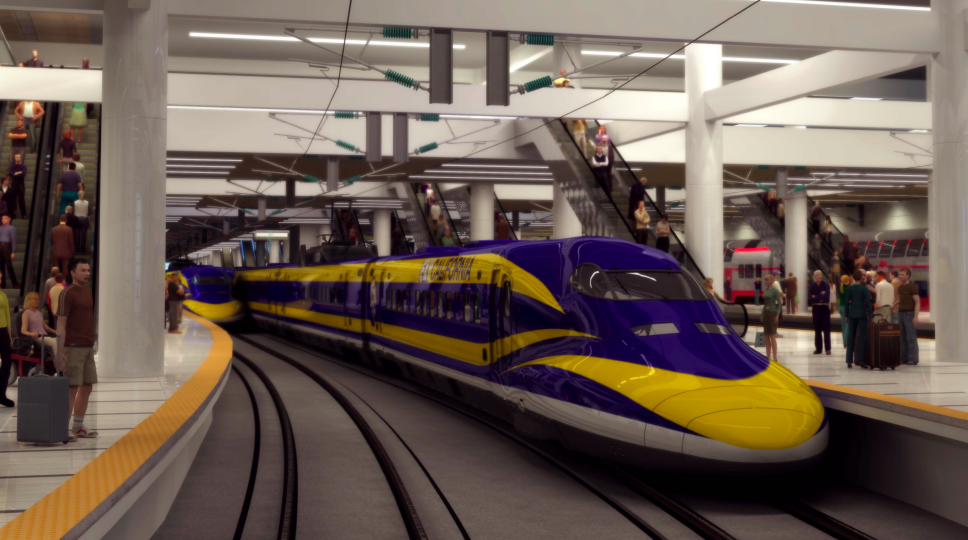
Artists' rendering of a high-speed train in San Francisco's new Transbay Terminal.

Three years ago tonight, I was in Perth, Western Australia, where I wrote stories on this blog about reactions to the US elections from Aussie college students and about the experiences of an American abroad on a historic election night.

Prior to leaving the country, I had voted by mail. Ever private in my politics, I only recommended people support one issue: Proposition 1A — the California High Speed Rail initiative.

California’s high-speed rail system is envisioned as an 800-mile system linking Southern California with Sacramento and the Bay Area at speeds up to 220 mph. The system is partially designed to compensate for a growing California population that Scientific American estimated in 2009 would otherwise require an extra 3,000 miles of highway lanes, five large airport runways and 91 airport gates by 2030 — improvements that were estimated to cost $100 billion.

In that regard, the California High-Speed Rail System integrates several principals of the Bay Area Metropolitan Transportation Commission’s 2035 plan, namely: Its downtown-to-downtown ideal serves the plan’s goals of primarily serving urban dwellers; It jibes with the ideal of “crisis brings opportunity,” — using the current economic upheaval to shift from over-reliance on cars and airplanes to more-sustainable alternatives, such as passenger rail; and, the system would have an effect on the MTC’s Regional Airport Systems plan by reducing intra-California flights.

Planning began with feasibility studies in the late 1990s, and a statewide initiative — initially based on an additional sales tax rather than a bond — was twice postponed while planners hoped for more-favorable economic conditions. When finally put on the ballot in 2008, the $9.95-billion bond proposition passed with 52.6 percent of the vote, a minor upset during an economic recession. It seemed like that high-speed rail would soon connect Northern and Southern California.

Flash-forward three years later, bad economic times and — especially — NIMBYs have stalled the project. While construction is still scheduled to begin sometime next year, opposition has increased. Joining the NIMBYs (covered in a previous post) are some financial conservatives who have balked at the anticipated costs of the project.

Last week, the financial news got even grimmer, as the California High Seed Rail Authority released a revised business plan. That plan estimated that — instead of the original $45 billion the entire plan would cost, the costs had climbed to an estimated $99 billion.

High-speed rail opponents and media critics went bananas, as might be expected. They criticized the more-than doubling of the original costs, continued to disbelieve projected ridership and questioned the need for the system altogether.

I beg to disagree.

What the media didn’t play up and the opponents have ignored are predictions that the HSR project will:

  • Be entirely self-sufficient operationally;
  • Generate 100,000 direct and indirect jobs over five years in the Central Valley alone during construction;
  • Generate 4,500 permanent jobs after construction is completed — compared to 100,000-400,000 in the rest of California by 2040;
  • Result in 8 billion fewer vehicle miles traveled;
  • Save 146 million hours;
  • Reduce CO2 emissions by 3 million tons.

Financially, a clarification should be made. The $98.5 million estimated cost includes a predicted three-percent inflation rate (which, off the top of my head means a cost “only” in the high $60 billion in today’s dollars). That out of the way, let's look at some of the real economic issues.

What if high-speed wasn’t built? Then, according to San José Mayor Chuck Reed, as quoted in the Silicon Valley Business Journal, California businesses and taxpayers would need $170 billion to add 2,300 lane-miles of freeway, four additional airport runways and 115 airline gates to accommodate the state’s increasing transportation needs (numbers slightly less than the ones above from Scientific American).

High-speed rail is expensive, but a bargain in comparison to the alternative. It needs to be built.

And locally, the opposition needs to settle down. As seen below, a very large percentage of San Mateo County voters supported Prop. 1A. Quoting wholesale from a previous post I made on this topic: “high-speed rail is an extremely positive project for San Mateo County as a whole, with great benefits from proposed stops at San Francisco International Airport and a possible stop in the South County. In addition, high-speed rail will be in a position to assist Caltrain with electrification and grade separation projects.”


I used to live in San Mateo on East 40th Avenue, one block from the tracks, so I understand the concerns of nearby residents. But there is a big picture and I hope that this post can remind Atherton and Menlo Park residents (and those in their respective city governments, which have filed suits against the project) of that big picture.

Thursday, October 6, 2011

Life goes on after people die, even Steve Jobs ... or my mom

Apple's webpage the night Steve Jobs died.

Today is a sad anniversary for me. Two years ago tonight, my mother lost her short battle with cancer.

Yesterday, another personal icon, Steve Jobs, lost his much longer fight against another form of the same scourge.

Death is a funny thing. For one person, it’s obviously the end, at least on this plane of existence. For those close to the deceased, depending how close, their lives can sometimes also be measured as “before” and “after.”

But last night, as I walked into my downtown San Francisco classroom after reading about Jobs’ death, I realized that for others, life goes on. My classmates were concerned about finishing their papers, discussing the ethics of California’s High-Speed Rail project (our assignment for the week), and curious about their colleagues' job prospects. Traffic along Market Street was as busy and frantic as ever. I couldn’t see the Apple Store a block away, but I’ll bet it was bustling, albeit with a sense of sadness.

But all in all, it looked rather normal, and I wondered, “is that fair?”

My mom and my son bond about three
months before her death.
It reminded me a bit of two years ago, after my mom died. I remember going out into the streets of Klamath Falls and seeing people moving along, doing their business. They read, laughed, ate, walked as if everything was the same as it ever was. I wanted to go up to people who seemed chipper and ask something along the lines of, “What the hell’s the matter with you? Don’t you know my mom died?”

But no, these people didn’t know my mother, nor did I know theirs. If their mothers were dead, even if I’d known it, I might feel sad for them, but I’d recognize the need to carry on – and I would, just like they did.

Those of us who’ve worked in the news business are familiar with the phrase, “One death is a tragedy, thousands of deaths is a statistic.” Yet, we’ve all seen how a single death can seemingly go unnoticed.

But do they really go unnoticed just because people haven’t changed their routines?

One of the best tributes to Steve Jobs is that so many people read about his death on devices he had a hand in creating, then went back to their business on another one of his devices. Jobs’ legacy lives on, just like I think that one of the best legacies of my mom is the love and understanding I give my own children.

We all incrementally contribute to the human race. One man might invent a better way to listen to music. Another woman might instill a sense of dedication to one’s family in her offspring. In the end, though, any single individual’s contribution – even an individual as famous as Steve Jobs – might seem negligible (heck, there are roughly seven billion of us).

But multiply the contributions, however small, of that individual by a few billion times and you can see that every life has a meaning and is important in its own way. My little contribution to society is important to its continuing development, and so is yours (whoever you may be). When a person dies, we may have lost their contribution, but they also did their part to build this society (no matter how screwed up it is).

In fact, it would be an insult to not carry on after they’re gone.

Wednesday, August 19, 2009

NIMBYs, NIMBYs, everywhere

I'm a firm believer that one should buy a home because of the neighbors, the local schools, a short commute to work, etc. Maybe because there's a nice view. Basically a place to live. I do not think, however, one should buy a home as an investment (at least it's low on my list).

So it upsets me when I see when I see articles in the paper like I did in today's Palo Alto Daily News (the recent redesign of which I'm digging, by the way). A five-column headline, "High-speed rail hit with lawsuit," outlines the complaint filed last week in a San Mateo County court by Menlo Park resident Russell Peterson.

Peterson contends that Caltrain and California High-Speed Rail authorities need the permission of Union Pacific Railroad to use the railroad right of way for high-speed rail. Peterson claims that Union Pacific has "the exclusive power to hire an operator to provide intercity passenger service" on the tracks.

First, the entire reason that Amtrak was founded almost 40 years ago is that the big railroads wanted to get out of passenger service. So I doubt that Union Pacific is in any way interested what passenger service is on the tracks, so long as it does not interfere with its freight operations.

Second, Paterson needs a new lawyer -- an informed one.

I'm sure attorney Michael Brady's contention that high-speed rail officials "need to obtain Union Pacific's consent (to run high-speed rail) because Caltrain isn't really the owner" of its tracks will be news to the Caltrain Joint Powers Board and the taxpayers who funded the purchase of the railroad right of way between San Francisco and San Jose from Union Pacific's predecessor, Southern Pacific, in 1991.

While Union Pacific, as noted later in the Daily News article, has an easement to run freight on Caltrain’s tracks north of San Jose, any "rights to inter-city passenger service" -- the bone of contention in Menlo Park resident Russell Peterson’s lawsuit -- would have been superseded when the Peninsula Corridor Joint Powers Board took over the tracks.

This is simply another meritless lawsuit by a NIMBY concerned about their property values. I think it's time for Peterson to take one for the team: the residents of the state of California.

I now quote wholesale from a previous post I made on this topic: high-speed rail is an extremely positive project for San Mateo County as a whole, with great benefits from proposed stops at San Francisco International Airport and a possible stop in the South County. In addition, high-speed rail will be in a position to assist Caltrain with electrification and grade separation projects.

I used to live in San Mateo on East 40th Avenue, one block from the tracks, so I understand the concerns of nearby residents. But there is a big picture and I hope that this post can remind Atherton and Menlo Park residents (and those in their respective city governments, which have filed suits against the project) of that big picture.

Wednesday, August 12, 2009

Public hearing on SamTrans cuts brings out crowd

Just a part of the crowd at Wednesday's SamTrans Board meeting regarding service cuts.

Note: This post was live-blogged from inside the SamTrans Board room as the meeting progressed. Apologies for it seeming disjointed.

SAN CARLOS, Calif. — A packed house offered their opinions about the proposed cuts to SamTrans service at the District’s Board of Directors meeting Wednesday afternoon.

The proposed cuts were blogged about in this post.

Comments from the numerous speakers at the meeting will be added to 1,436 comments made at community forums, CAC meetings and mailed, e-mailed and telephoned comments to District officials over the past two months. The Board will make its decision on the level of cuts at its September meeting.

The relatively limited capacity of the Bacciocco Auditorium was quickly reached, with a line of standees along the back of the room. There was an announcement that the nearby SamTrans cafeteria was wired to carry the sound as well, and about 40 people took up the offer.

SamTrans Chief Operating Officer Chuck Harvey said, "The agency is in an financial crisis," noting that the district is facing a $28.4 million deficit. Thus far, prior to any service cuts, SamTrans has saived: $750,000 with a freeze on administrative raises; $250,000 by reorganizing; $1.75 million with a hiring freeze; and $1 million in fuel hedging.

Harvey noted that there had been many calls to raise fares to entirely cover the deficit, but such a measure would not be enough. "The problem is we’d have to raise the fares to four times what they are today, because we only get 20 percent of our operating costs through fares."

Fifty-one speakers addressed the board over the two-hour open comment section of the meeting. Highlights included:
* “SamTrans is the best part of my life,” said one elderly woman who asked that the eligible discount fare not be raised and that line 391 be allowed to continue to downtown San Francisco.
* One rider said she lives in San Jose and works at a Redwood City school and begged that line 270 be retained. Besides Caltrain passes, she also buys VTA and SamTrans passes (perhaps unaware that a two-zone Caltrain pass is taken as local fare on both VTA and SamTrans).
* Half Moon Bay’s interim City Manager, Michael Dolder, stated that SamTrans did not properly take into account greenhouse gas emissions as mandated by the California Environmental Quality Act.
* Howard Cohen, superintendent of the South San Francisco Unified School District, pleaded for the directors to not cut youth service: "Young people do not leave their constitutional rights at the school gates. I believe they do not leave them at the public bus doors as well."
* CAC chair Wayne Kingsford-Smith outlined CAC opinions outlined at last week's meeting. (My thoughts from last week are presented below).
* Dave Taylor, who claimed he “represents labor and working class” argued against a fare increase: "Handicapped and seniors have no increases coming up in their paychecks." (Well neither do the rest of us right now, I reply.)
* One lady, arguing for the retention of line 17 on the San Mateo County Coast, noted through a Spanish translator that, “It’s better for seniors to take the bus than have seniors driving.”
* “For the love of God, what is Schwarzengger doing to us?” said an angry supporter of the 295, drawing approvals akin to a revival meeting from several members of the audience. The California governor cut state transit subsidies for the next three to five years after a number of budget initiatives failed in May's special election.
* Menlo Park councilmember Andrew Cohen said that cutting bus service at the same time large infrastructure programs are planned to take place on the Caltrain/California High-Speed Rail tracks 300 feet from his home is like “telling the poorest members of our community to eat cake.”
* SamTrans bus operator Pat Ketcham cautioned against wholesale cuts, stating that his bus is packed after 10 p.m. He said operators are concerned for the low-income riders who utilize the service and that operations staff is aware of the gravity of the financial situation. “The strength of a country is in how it treats its poor,” Ketcham said. “Our drivers are open, we understand reason. We are not closed-minded.”

After closing the hearing, the Board went into a brief recess prior to its regular meeting. As is typical at public hearings, board members were not permitted to discuss the issues related to the public hearing. Redwood City Councilman Jim Hartnett, a member of the SamTrans Board, did make one point in the regular session -- the Board does not have the technical skills to handpick which routes to save and will probably need to pick from the tiered alternatives.

"It's not what choices we have, it's what level we pick," Hartnett said. "From a financial point of view, we could easily justify a 15-percent cut or more. The real change that has to occur is a structural change. We don't have the money in the best of times to provide the level of service we do."

My opinions, as I expressed them at last week’s Citizen’s Advisory Committee meeting:

• Agree with (others) that a centralized, consolidated express bus from Belmont with an additional stop at Hillsdale/101 would be a good cost-saving idea. Though I must state for the record that I do not agree with proposals for having KX skip the airport and have those riders take BART (I have a long-standing disapproval of plans where a higher-priced alternative to SamTrans is promoted until and unless those routes [Caltrain or BART] accept SamTrans fare media).

• I have long favored reducing frequency over absolute cuts, back to the 193 and 282 eliminations a few years ago and the first time the 17 was slated to be eliminated. In particular as relates to the Pescadero to Moss Beach route 17, we cannot cut off our poorest, most-needy customers on the coast.

• I believe that 10 p.m. is absolutely much too early to stop El Camino Real service, even on weekends. Too many of our traditional demographic riders must work unconventional hours. Our downtowns and SFO are open well past midnight. When I was a dispatcher, I know we kept a lot of potentially unfit drivers off the road by suggesting a convenient SamTrans bus.

• I do believe route consolidation might be able to get us some of the savings we need. I do, however, worry that longer routes will mean more fatigue for our operators and want to confirm that they would get appropriate rest for both their safety and ours.

• Symbolism is important – to the public, the operators and mechanics, and to me. If SamTrans administration is going to get any wage concessions from its employees and/or lay them off, it would be a bold, affirmative step if there was an equivalent cut in administrative costs, either through wage cuts or redundancies.

• Finally, this process seems to have moved along haphazardly. To say the district needs to cut costs by an undetermined point and then leave it up to the board to make decisions has, I believe, left the public a bit befuddled and made it more difficult for transit advocates to respond. If we had had a definite plan to respond to, rather than a series of “what ifs,” it would have been easier for community groups to come up with a workable alternative. The issues have been too diffuse for my tastes. It almost feels like a cynical attempt by the administration to pick, say, a middle proposal and then have them be able to go to the public looking for congratulations by saying “Hey, we didn’t cut it as much as we could have.”

Tuesday, October 28, 2008

I'm voting tomorrow -- Yes on Prop. 1A

Since I'll be out of the country next week, I have to vote this week and will fill out my mail-in ballot tomorrow.

Between my right to a secret ballot, some remaining indecision on my part and my previously expressed desire to appear neutral, I'm not going to burden the reader with most of my political decisions. But there is one measure I support wholeheartedly: California's Proposition 1A -- the High Speed Rail initiative.

The Proposition would set aside about $9 billion dollars to serve as seed money for a "bullet train" between Los Angeles and San Francisco. The bond money would be supplemented with promised federal and private funds to begin operations. The train will take passengers from city center to city center in about 2.5 hours (less time than in air travel once security and travel to-and-from the airport is taken into account) for the same price as plane fare. Eventually, proponents hope, the system would be extended to Sacramento and San Diego as well.

The Los Angeles Times, the San Francisco Chronicle and other local papers have advocated its passing -- as has Gov. Arnold Schwarzenegger and the San Mateo County Transit District, whose board I addressed prior to its endorsement.

Some opponents question the wisdom of increasing the state's bond indebtedness in a time of such fiscal trouble. Under most situations, I'd concur. But this proposition is the rare exception because it will directly address the current economic concerns. Analysts estimate that high-speed rail's construction will result in 162,000 construction jobs while the system is built and several thousand permanent operations job will follow. It's like a mini-WPA!

What's even more important, in my view, is the fact that high-speed rail will -- thanks to its electrified line -- prevent thousands of tons of greenhouse exhaust gasses from entering the atmosphere annually. On a more provincial level, the line will benefit San Mateo County substantially, as the California High-Speed Rail Authority will use the Caltrain right-of-way. This means the CHSRA will be the one paying for sorely needed local grade separations and electrification projects.

Several years back (2001-2002) I had the privilege of serving with the chairman of the California High-Speed Rail Authority, the Hon. Quentin Kopp ( right) while I was a member of the San Mateo County Civil Grand Jury and he was its advising judge. Judge Kopp impressed me with his vast knowledge, friendly, no-nonsense manner and interest in transportation. Later, I had further contact with him while as a public safety dispatcher for the County of San Mateo, wherein I would need to contact him to help officers set up emergency protective orders and the like.

During that time, Kopp struck me as a man of integrity. I can't think of a better man to see the system through its founding stages. Kopp is as fiscally conservative as they come in the Bay Area, is very knowledgeable about transit (his overestimation of SFO BART ridership aside) and won't let this project become a fiscal boondoggle. I don't think anyone else involved in its planning will either. So, "Yes" on 1A.

Wednesday, September 10, 2008

Statement in support of California High-Speed Rail

At today's meeting of the SamTrans Board of Directors, the board expressed a resolution in support of Proposition 1A (the High-Speed Rail bond measure). A couple of NIMBY cities in the county, Menlo Park and Atherton, have joined a lawsuit seeking to dismiss the project's environmental impact report. No doubt they're concerned that a year of construction related to the project will lower their average home value from $2.7 million to $2.4 million. Sigh.

Before the vote, I gave the Board the following testimony:

"I hate pitting constituency against constituency, city against city. But I hope that this Board and the JPB (Caltrain Joint Powers Board) at some point find an appropriate time to decry the lawsuit joined by the cities of Menlo Park and Atherton opposing High Speed Rail.

"This is an extremely positive project for San Mateo County as a whole, with great benefits from proposed stops at San Francisco International Airport and a possible stop in the South County. In addition, this project can assist Caltrain with electrification and grade separation projects.

"I used to live in San Mateo on East 40th Avenue, one block from the tracks, so I understand their concerns. But there is a big picture and I hope that this Board can remind Atherton and Menlo Park of that big picture."


I had at least three Board members (to remain nameless because I can say things they can't) thank me for my support at the end of the meeting, as well as a couple SamTrans/JPB employees.