 |
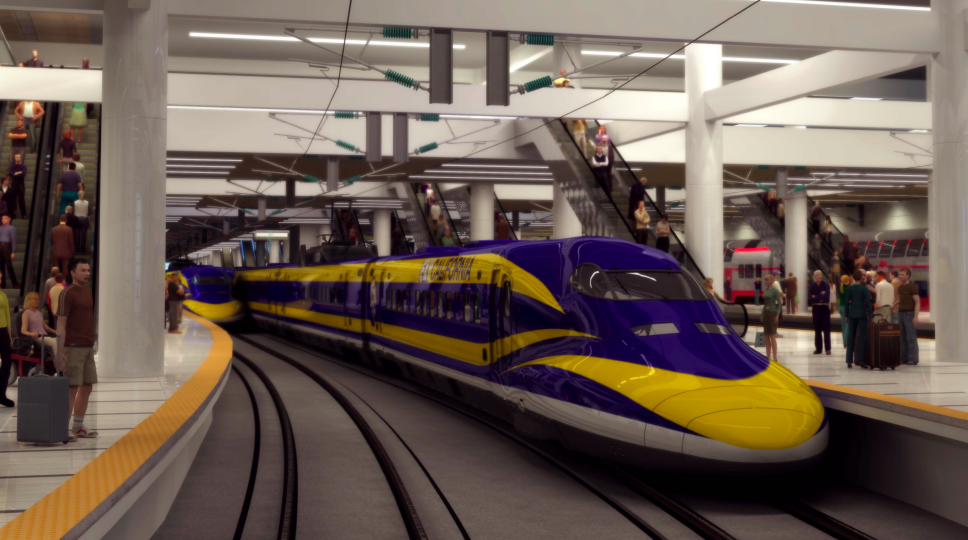
| Artists' rendering of a high-speed train in San Francisco's new Transbay Terminal. |
Three years ago tonight, I was in Perth, Western Australia, where I wrote stories on this blog about reactions to the US elections from Aussie college students and about the experiences of an American abroad on a historic election night.
Prior to leaving the country, I had voted by mail. Ever private in my politics, I only recommended people support one issue: Proposition 1A — the California High Speed Rail initiative.
California’s high-speed rail system is envisioned as an 800-mile system linking Southern California with Sacramento and the Bay Area at speeds up to 220 mph. The system is partially designed to compensate for a growing California population that Scientific American estimated in 2009 would otherwise require an extra 3,000 miles of highway lanes, five large airport runways and 91 airport gates by 2030 — improvements that were estimated to cost $100 billion.
In that regard, the California High-Speed Rail System integrates several principals of the Bay Area Metropolitan Transportation Commission’s 2035 plan, namely: Its downtown-to-downtown ideal serves the plan’s goals of primarily serving urban dwellers; It jibes with the ideal of “crisis brings opportunity,” — using the current economic upheaval to shift from over-reliance on cars and airplanes to more-sustainable alternatives, such as passenger rail; and, the system would have an effect on the MTC’s Regional Airport Systems plan by reducing intra-California flights.
Planning began with feasibility studies in the late 1990s, and a statewide initiative — initially based on an additional sales tax rather than a bond — was twice postponed while planners hoped for more-favorable economic conditions. When finally put on the ballot in 2008, the $9.95-billion bond proposition passed with 52.6 percent of the vote, a minor upset during an economic recession. It seemed like that high-speed rail would soon connect Northern and Southern California.
Flash-forward three years later, bad economic times and — especially — NIMBYs have stalled the project. While construction is still scheduled to begin sometime next year, opposition has increased. Joining the NIMBYs (covered in a previous post) are some financial conservatives who have balked at the anticipated costs of the project.
Last week, the financial news got even grimmer, as the California High Seed Rail Authority released a revised business plan. That plan estimated that — instead of the original $45 billion the entire plan would cost, the costs had climbed to an estimated $99 billion.
High-speed rail opponents and media critics went bananas, as might be expected. They criticized the more-than doubling of the original costs, continued to disbelieve projected ridership and questioned the need for the system altogether.
I beg to disagree.
What the media didn’t play up and the opponents have ignored are predictions that the HSR project will:
- Be entirely self-sufficient operationally;
- Generate 100,000 direct and indirect jobs over five years in the Central Valley alone during construction;
- Generate 4,500 permanent jobs after construction is completed — compared to 100,000-400,000 in the rest of California by 2040;
- Result in 8 billion fewer vehicle miles traveled;
- Save 146 million hours;
- Reduce CO2 emissions by 3 million tons.
Financially, a clarification should be made. The $98.5 million estimated cost includes a predicted three-percent inflation rate (which, off the top of my head means a cost “only” in the high $60 billion in today’s dollars). That out of the way, let's look at some of the real economic issues.
What if high-speed wasn’t built? Then, according to San José Mayor Chuck Reed, as quoted in the Silicon Valley Business Journal, California businesses and taxpayers would need $170 billion to add 2,300 lane-miles of freeway, four additional airport runways and 115 airline gates to accommodate the state’s increasing transportation needs (numbers slightly less than the ones above from Scientific American).
High-speed rail is expensive, but a bargain in comparison to the alternative. It needs to be built.
And locally, the opposition needs to settle down. As seen below, a very large percentage of San Mateo County voters supported Prop. 1A. Quoting wholesale from a previous post I made on this topic: “high-speed rail is an extremely positive project for San Mateo County as a whole, with great benefits from proposed stops at San Francisco International Airport and a possible stop in the South County. In addition, high-speed rail will be in a position to assist Caltrain with electrification and grade separation projects.”

I used to live in San Mateo on East 40th Avenue, one block from the tracks, so I understand the concerns of nearby residents. But there is a big picture and I hope that this post can remind Atherton and Menlo Park residents (and those in their respective city governments, which have filed suits against the project) of that big picture.


