Showing posts with label technology. Show all posts

Wednesday, January 29, 2014

Whether it's broadband or telegraph, it's too expensive (a century apart)

The front page of the Jan. 29, 1914, edition of the Bemidji Daily Pioneer.

It’s not a secret that Internet prices in the United States are out of line with those in other developed countries. In fact, Americans pay more per megabyte than anyone else in the world with access to broadband.

This is on top of having our Netflix stream slower than elsewhere; in 2012 the average download speed for American connections was just 12th in the world.

(It should be noted here that the United States' speed problem is one of having some areas with great speeds, but low performers dragging the rest of the country down.  For example, if Vermont and New Hampshire were countries, they would have the second and third-highest average download speeds in the world. California, home of Silicon Valley, also suffers from this diffusion on a micro scale, having fast service in urban cores while most of the state’s land area remains unserved or underserved.)

Wow. It must be completely unprecedented that the country where a revolutionary new telecommunications technology was invented trails the rest of the world in terms of costs and efficiency. Right?

Nope. A century ago, people were complaining that US telephone and telegraph rates were too high. It seems that the more things change, the more they stay the same.

One-hundred years ago today, the Bemidji Daily Pioneer in Minnesota ran a column one article by Illinois Congressman Clyde Tavenner noting several areas where the United States trailed significantly in terms of costs compared to what was then the "developed" world.

As examples, the United States ranked:

  • Last of 16 countries in average cost to send a telegram (44 cents vs. 9 cents in top-ranked Luxembourg);
  • Only 14th lowest in terms of costs per local phone call (2.1 cents vs. 0.4 cents in Norway);
  • Last in average costs of a long-distance call (60 cents vs. 8 cents in Sweden for a call to a place 100 miles distant [in 15th place was Hungary, with 39 cents for that same call]).

The whole screed was apparently a call from the Congressman to nationalize the home phone service, then (as now -- what breakup?) dominated by American Telephone & Telegraph. Apparently, per Tavenner, Ma Bell was engaged in an "evident attempt to stave off government ownership by its willingness to submit to every government demand" (wire-tapping included?).

Tavenner was obviously a proponent of government ownership of the telephone system, noting that the one place where American service was superior than most of its contemporaries (other than Japan) was in its government-owned postal service.

"Our privately owner telegraphs and telephones fall far below the standard of efficiency and cheapness set by the European government service," Tavenner wrote.

The government never did buy AT&T, although it did cause it to break up in the 1980s -- before the telecommunications giant reformed like a melted T-1000.

Wednesday, February 27, 2013

Has Marvel given up in the fight against piracy?

Comics website Bleeding Cool pointed out an unusual ad on online piracy site Pirate Bay this evening. Look at this banner ad in the comics section:

A screenshot of the Pirate Bay website with what appears to be an ad for a Marvel Comics game

Now, Marvel: Avengers Alliance is just a licensed product, but the fact that a company even loosely affiliated with Marvel is advertising on a website which practically advocates the theft of comics (or movies, music, books, etc.) is cause for a head smack.

I'll bet Marvel's lawyers contact Playdom (the game's publisher) pretty darn quick and ask it to change its advertising strategy.

So, has Marvel given up in the fight against online piracy? Nope. But its affiliates seem to know to advertise where people go to find cheap comics-related stuff.

Wednesday, October 24, 2012

How I listen to local announcers during the World Series

This gentleman shows the sentiment of many Giants fans regarding Joe Buck.  Source: Facebook.

San Francisco Giants fans love their hometown broadcasters, and with a team containing Jon Miller, Dave Fleming, Duane Kuiper and Mike Krukow, who can blame them?

With the Giants in the World Series this week, however, San Francisco fans have had to stomach Fox broadcasters Joe Buck and Tim McCarver as national TV broadcasts bump out local ones. Buck in particular has had to face criticism for his style, including his perceived bias against West Coast teams and for the St. Louis Cardinals (the team for which his father broadcast for decades and the Giants' opponent in the NLCS). Such criticism includes:

and,
and,
Never fear, because the Giants' regular broadcasting team are on the radio! Alas, because the TV broadcasts need time to encode, go up to the satellite, come back down and be transmitted, the radio feed is a few seconds ahead. Not easy to watch that way. So what to do?

When the Giants made their 2010 World Series run, I came up with the following method and have continued it this season. You do need a DVR and a smartphone with the MLB At Bat app to make it work.

First, turn on the TV, mute it, load the At Bat app and start the audio (right) for the team you wish to hear (yes, you could even listen to the Tigers if you want). You'll notice that the audio (thanks to the encoding and download process) is now about 30 seconds behind the TV broadcast.

Now, use your DVR to pause the video (as seen below) and press play when the radio broadcast over the app starts. This easiest way to do this in my experience is to wait until a player hits the ball and pause the video. When you hear the crack of the bat on the radio broadcast, press play.

You should then be more-or-less in synch. While I have Airplay for my iPhone and stream the audio through my stereo system, probably any speaker system will work. Heck, even a little tinny phone speaker sure beats listening to Fox!


The City's sure supporting the Giants, as I saw downtown last night:

San Francisco City Hall decked out in Giants orange the night of Oct. 23, 2012. Photo: John Baker

Sunday, May 27, 2012

My Wikipedian train of thought: Kuiper Belt to Oscar Wilde

What do beavers, Oscar Wilde and deep-space rocks have in common?
One of the worst, and best, things about Wikipedia is how it can become such a colossal time suck.

You go onto the site to look up one thing, and through a series of links and "Hmm, I'd like to know more about thats" you end up somewhere completely different.

Take this morning. I visited Wikipedia out of boredom and saw that the featured article was about the Kuiper Belt. Being an amateur astronomer, I began reading the article.

That took me to the article about Makemake (left), a plutoid with such a funny name that I had to visit.

When it was first discovered, close to a certain holiday, Makemake was given the code name "Easter Bunny," so I had to visit the Wikipedia article about that particular holiday icon.
I learned that easter bunnies were associated with colored eggs because of the abundance of eggs due to abstinence during the spring celebration of Lent, which led to that article.

Reading about Lent, I was astonished to discover that some churches allowed the consumption of beaver tails during the normally meat-free (except for seafood) period. So I read about beavers.


Finally, on the beaver page, there was a famous picture (left) of Oscar Wilde in a beaver fur coat. So I ended up reading a bit about the author of The Picture of Dorian Gray -- an article I somehow refrained from reading.

Monday, December 12, 2011

It takes more than five minutes to master social media


Infographics, by design, are supposed to make complicated matters appear simple. Sometimes, however, they oversimplify the topic.

One such over-simplifying graphic is at Mashable’s 5-Minute Guide to Getting a Job in Social Media. The infographic, originally published on Sept. 2, 2011, offers many good tips, but they might be either a little too vague or too generic to help those interested in getting paid for their social media use.

For example, while the first two tips (“establish an online presence” and “be proficient in all social channels”) might seem relevant to those interested in social media, the remaining topics (“be creative and relevant,” “be a professional,” “know the industry/company,” “network,” “know the lingo,” etc.) are good advice no matter the profession.

And how much demand is there for the profession? As a late-September article in the Los Angeles Times put it, “No one knows exactly how many social media jobs exist, but a quick scan of online recruitment sites shows a bounty of businesses looking to hire.”

So, in essence, no one can predict how long this social media hiring spree will last or how widespread it really is. Moreover, the tips given by Mashable are either common sense or rather vague.

The accuracy of the salary charts listed in the infographic is also up for debate. A salary of $80,000 to $100,000 annually for a social media manager sounds good, but as the number of avid social media users grow, corporations will no doubt realize that they can hire some fresh-out-of-college kid to Tweet and post to Facebook, and pay accordingly. Moreover, until the analytics come in as to how successful social media is in acquiring and nurturing customers, salaries might come down unless an increase in sales due to social media is affirmed.

One tip that I personally might find hard following is the advice to “be proficient on all channels.” I am an avid Twitter user, and have made a number of LinkedIn connections. But I was an early avoider of Facebook, initially thinking it too much like MySpace. When I finally had to open an account for a SFSU journalism class, it was under a pseudonym. I have made only four friends there (and befriended one only because she wanted it for her birthday present and another — a teenage cousin — only after she practically cried when I initially ignored her friend request). So I am obviously a latecomer to Mark Zuckerberg’s world. Maybe it’s time for me to upgrade. I’ve personally always felt superior in having an underutilized Facebook account.

Sadly, my life is boring enough that I don’t have any pictures of me getting drunk at parties, so “being professional” is not a problem of mine.

Monday, October 24, 2011

FCC responds to complaint over BART phone service disruption

A few weeks ago, I filed a complaint with the Federal Communications Commission against the Bay Area Rapid Transit agency after it shut down cell repeaters in its tunnels in an apparent attempt to stifle a protest.

It turns out, I was one of many who complained to the FCC about the disruption. Today, I got a mailed response from the FCC about the situation. Here it is:


It's a form letter. In fact, other people got the exact same letter a month ago. But it's a bit heartening to see that the matter wasn't dismissed out of hand. Will the FCC come down on BART for its disruption?

Perhaps to peremptorily address the issue, the BART Board of Directors will be discussing a cell phone disruption policy at its Thursday (Oct. 27) meeting. This policy, said to include input from the ACLU and BART's Citizen's Review Board, would enable BART to disrupt cell service "only when [the District] determines that there is strong evidence of imminent unlawful activity that threatens the safety of District passengers, employees and other members of the public, the destruction of District property, or the substantial disruption of public transit services."

I'm a bit troubled by the ambiguity of the statement. Under the policy above, the previous disruption -- of which I seriously disapprove -- would still have been possible had BART's general manager approved of it beforehand.

While the draft policy does include a few examples of the "extraordinary circumstances" in which a disruption is possible, the list is still ambiguous. Listed among those special circumstances are when phones are used: as explosive detonators; to facilitate "violent criminal activity ... such as hostage situations"; in specific plans to destroy BART property; and when there are plans to "substantially disrupt public transit services." If, for example, a few members of OpBART plan to briefly prevent a train from moving (as happened at an earlier protest), is that a "substantial" disruption of public transit services?

As it is, without an exception for non-violent civil disobedience, I don't see how this policy would result in any difference than the phone service disruption we saw in August.

Tuesday, October 18, 2011

Omni predicts the distant future of 2010 -- Part II: Technology

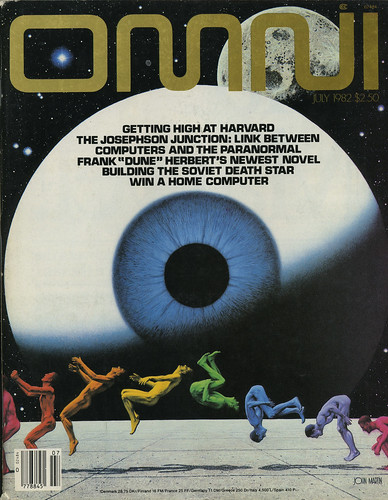
Omni Magazine, July 1982
Cover of Omni's July 1982 issue.

A while back, I outlined some of the wildly incorrect predicted 2010 prices from 1980's The Omni Future Almanac. Today, I want to point out some things the Omni editors got right.

And, because it's funnier, some more stuff they got wrong.

Successes
First, a couple slam dunks. On page 206, the editors wrote that video recording technology (initially the VCR) would not only let people watch what they want, when they wanted it, but that the practice would drive programmers and ad people crazy. They even got the terminology right:

The use of home video recorders for this type of "time shifting" will cause major problems for broadcasters who must predict to their advertisers which market will be watching which program at a specific time. Fans of daytime television programs, for example, will watch soap operas when their schedules permit — probably in prime time — utterly skewing ratings and confusing advertising plans.

Another swish -- e-mail would quickly become a communications medium to be reckoned with. While it sings the praises of the yet-to-come “paperless office” Omni's Almanac also (on page 181) talks about the amazing new technology of “electronic mail.” Apparently, in this miracle technology:

Messages are typed into the computer, which instantaneously sends the letter to its destination and files all requested copies. The recipient gets the message — either on his screen or through his printer — when he asks his computer for the mail.

E-mail was predicted to be common in interoffice business by 1990 and most correspondence would be e-mail (though that term wasn’t used by Omni) by the year 2000. The book also said the post office would struggle to compete. That much is true.

Mixed bags
On some matters, Omni had a mixed track record. Take health care costs. Omni predicted (on page 157) that an average familiy's health care costs would drop from 10.1 percent of a family's income in 1980 to about eight percent in 2000. Well, three failed decades of health care policy later, A middle-income family with individual coverage spends on average 22 percent of household income on health care -- and some spend up to 50 percent. A similar middle-income family with employer based coverage spends 8 percent percent of their income on health care costs.

In business, Omni suggested that General Motors would be profitable for many years thanks to fuel cell technology in its vehicles, ”but by 2010 the Detroit giant could vanish from the leading ranks of corporate conglomeration” (p. 178). Well, they got that last part right (still waiting on the fuel cells).

In the wishful thinking department, Omni's predicted the success of Genentech, still based on a sprawling South San Francisco campus but recently acquired by Roche. Of course, Omni also said that Genentech and or Cetus (another biotech company bought by Chiron in 1991 after staggering loses) “will create pharmaceuticals that will effectively cure diabetes and suppress the cancer tendencies in smokers.” Say what?

Just plain wrong
While Omni got some things right, or at least right to a degree, it was very off in other areas. Take basic economics. The magazine's editor thought that the average amount of their income spent by an American family on housing would drop from 21.3 percent in 1980 to about 19 percent in 2000. Well, in 2009, the average US family spent about 34 percent of their income on housing. (I blame the torrid San Francisco housing market!).

Of course, no discussion about the "future" is complete without a section on robots. On page 178, the Future Almanac predicts that the Soviet Union "will standardize the robots industry." Widespread use of robots would give the proletariat workers more free time and thus result in more political tension. Nothing about the Berlin Wall falling, however.

In the United States, Omni predicted, robots will be used extensively in office, service industries and manufacturing. Occupations which would become obsolete include bank tellers, supermarket cashiers, "movie ticket operators," car wash workers and stock clerks. "Factory assembly lines will be a nostalgic reminder of the past." Tell that to the population of Flint.

Another interesting area would be the use of robots in the restaurant business:

Short-order food preparation also appears likely to be overtaken by robotics. These firms could implement a robot food-serving system as early as 1985. Gas stations will also be totally serviced by robots. While the tank is being filled, a credit card will be put into the machine to register payment and complete the transaction.

That sounds like this:
Courtesy: The Fiscal Times

Omni predicted widespread use of robots only among the wealthy and upper middle class, however. That's probably why you don't have one. Except maybe a Roomba.

I was going to give Omni credit for its prescience in saying that robot space probes would be very successful -- until the book said that robot space probes would probe "other solar systems." No robot will make it to another solar system in the next 10,000 years, barring breakthrough in warp drive.

Still, we should be glad that robots aren't quite as widespread as Omni thought they would be:

Thursday, October 13, 2011

Your brand is more than just a label, it's what people think you are


Every Facebook post, every Tweet and every blog a writer uploads contribute to the formation of an online identity, but what contributes to the writer's "brand?"

That key question was addressed this week by a guest lecturer to a San Francisco State University journalism class.

According to Pueng Vongs, the San Francisco Bay editor for Yahoo! Local (and the class instructor), one of a journalist's most-important tools is their "brand." A good brand can open doors, bring (or push away) credibility on a subject and drive readership.

To that end, Vongs arranged for Sherbeam Wright, founder of AndaCommunications, to address students at SFSU's "Social Media for Journalists" seminar on Wednesday. Wright's bio states she has developed and driven communications programs and supported the sales efforts of market-leading high tech companies.

Sherbeam Wright addresses a class at SFSU.
A journalist's brand is "a personal identity that stimulates precise, meaningful perceptions in an audience about the values and qualities of the person," Wright said. That statement means that a brand is not necessarily who you actually are, but what the public thinks you are from the content you produce.

According to Wright, before the advent of the Internet, a journalist's "brand" was actually that of the organization for which they worked. There was little opportunity for the general public to actually engage with a working journalist, or vice-versa.

Now, however, the trend is for news to be a "conversation," rather than simply a broadcast. Aspiring journalists (or public bloggers at large) are expected to have their own brand, be it through blogging, Twitter or some other form of social media.

So how does one build a brand? First, one has to decide ahead of time what they want their brand to be. Wright said that if you want to cultivate a business brand, get involved with LinkedIn. If one has a desire to be a breaking news source, invest heavily in Twitter. Facebook will generate fans, but a personal blog illustrates personality and builds readership.

Wright pointed out a couple examples of people she thinks have been successful in promoting an outstanding online brand. One was Derrick Ashong, who Wright said turns social media into "socially meaningful" media. Another was MSNBC commentator Rachel Maddow, who "blew up" past her radio roots due to social media.

While many online media promoters suggest one specializes in a few topics (vertical integration) in order to become a "go-to guy," Wright said covering a wide-range of topics can also pay off, but you "have to know how to package it." In other words, be consistent. You can address many subjects if you, for example, put your own consistent spin on it -- tie it into your locality, put your own humorous take on it, or analyze everything in one certain way.

That revelation prompted Vongs to concede, after some debate, that "horizontal is the new vertical."

Great news for me ... this blog goes all over the place!

Thursday, September 22, 2011

Neutrinos faster than light would have profound implications

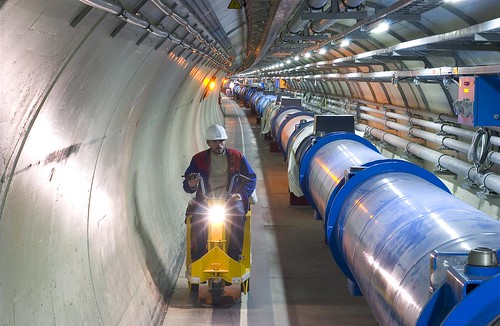
CERN / LHC tunnel
A small portion of the Large Hadron Collider at CERN, in Switzerland. Flickr photo by Ars Electronica.
A discovery was announced today that will either revolutionize science or be one of the biggest busts since the Fleischmann–Pons experiment in cold fusion, if not attempts to turn lead into gold.

Scientists at the European Organization for Nuclear Research (known by its French acronym, CERN), announced in a paper to be released soon that they had measured subatomic particles that seemed to travel faster than light. Essentially, scientists launched neutrinos from a source near Geneva, Switzerland, to a detector in Italy about 453 miles away. The neutrinos arrived 60 nanoseconds (0.00000006 seconds) faster than a photon (the particle [or wave] that makes up light) would have.

First, this discovery is somewhat shocking because it violates Einstein's theory of special relativity (you know, "e=mc squared"), which states nothing can travel faster than light. Relativity has been proven correct in experiment after experiment for more than 100 years. It's as if someone told Newton that there wasn't an equal but opposite reaction after every action.

CERN
Part of the CERN research center.
Flickr photo by dirtybronson.
The discovery is still doubted by other scientists, perhaps due to what would have been the sheer ludicrousness of proposing it before today. In fact, Occam's Razor (given multiple explanations, the simplest is the most likely) applies here. For example, "superluminal neutrinos are much much less likely than subtle systematic errors in a complex experiment the length of a country."

One might ask, "OK, but why is this important?" There are several reasons, although the ultimate effects -- if the experiment pans out -- might not be seen for years, if not centuries. Certainly, the everyday life of people alive today is unlikely to be affected. But the long-term effects may be enormous:

  • First, the implications for computing are significant. Think quantum computing will be fast? Then, what about computers that solve problems almost before they're entered?
  • What about astronomy? If neutrinos can go faster than light, one day we might have detectors that can almost literally see back in time to the beginning of the universe.
  • And not even finally, but perhaps most profoundly, neutrinos going faster than light means that information (although probably not objects) can also be sent faster than light. If mankind is not alone (and with billions of galaxies containing billions of stars, being alone is unlikely), then we might have the means to communicate with other beings in a reasonable time frame.

But the best part of this business is how it demonstrates the scientific method. These scientists came up with an idea, tested and experimented it into a hypothesis (that neutrinos can travel faster than light under some circumstances), and submitted their work to be peer reviewed for more experimentation en route to forming a theory. In fact, they basically pleaded with scientists from the United States, Japan and other scientifically advanced countries to try to replicate their experiment to make sure they didn't make a mistake.

The results may or may not pan out (probably not, I must admit). But the scientists' efforts at confirmation are a huge relief in times when those on both the left and the right often refuse to recognize the teachings of science because it doesn't fit their social or religious agenda.

Edit (Feb. 22, 2012): It appears that a faulty GPS reading caused the distances between the two sites to be overestimated, accounting for the unexpectedly short time it took for the neutrinos to hit the detector. Again, this shows the wonderfulness of the scientific method and its system of checks and balances.

Friday, July 1, 2011

Streetview cars are everywhere, even on TV

It seems Google is becoming ubiquitous in our lives (this blog you're reading is on a service owned by Google, for example), to the point where "Google" has become a verb.

Google's Streetview service has become a godsend to wandering travelers and armchair explorers (I used it prior to my 2008 Australia trip to plan walking routes around the neighborhoods I'd be visiting). It has also brought protests from those who say the service violates privacy, even though it does no such thing.

It's no surprise, then, that Google's Streetview cars have been constantly going through neighborhoods to update photos. A car was seen in my neighborhood in March, for example.

Still I was surprised that while watching "Burn Notice," about 54 minutes into last night's episode (counting commercials), I saw a Google Streetview car go by in the background (below).


The chances of a TV show shooting at the exact same time a Streetview car goes by might seem low, but -- as I wrote above -- the cars are all over the place now. It's probably for that reason that the editors of Burn Notice left the shot with the very-noticeable Streetview car in the show instead of using another take -- it's more realistic that way!

Thursday, February 3, 2011

Yes, I CAN take pictures here ...

A racist jerk in my neighborhood, right as he rushed me.

I live in a nice neighborhood, Winston Manor in South San Francisco. It's clean, well-maintained, ethnically heterogeneous, and -- other than having to suffer the occasional annoyance of lazy neighbors parking on the opposite side of the street (i.e., facing the wrong direction) -- it's never bugged me in the eight-plus years I've lived here. Until today.

We have a friend renting out our "library" for a few months as he's just re-located to the Bay Area and needs to get settled. He's enjoyed the town thus far, and has taken walks to the nearby park the last several days. He came back this evening and showed me the following entry he had just put on his Facebook page:


Say what? My friend just wanted to shoot some snaps of our neighborhood for out-of-town friends on the Internet when some idjit tried to shut him down, called him an "Ay-rab" and warned that he could get "shot" if he continued (you know, the "threat that's not an outright threat" game). I was a bit irritated as you can imagine. So what did I do? See if it could happen to me, of course.

Having both a journalism degree (which included courses in media law) and three years dispatching for the police, I know I can take pictures in public with hardly any restrictions. Even a quick Google search will show multiple websites that say taking pictures of houses from the sidewalk is permissible. While it is courteous to ask permission, it is not required for personal, non-commercial purposes like those of my friend.

After asking my friend to stay behind (in order to see if a white person would get the same reception), I began walking down Arlington Drive, in the direction where my friend said the confrontation happened. I occasionally pointed my camera at houses as I walked down the sidewalk at a steady, brisk pace. I rarely actually took a picture. To be perfectly clear, not once did I take any pictures of people or through open windows. And just to prove my point, that we were doing no more than what is already on the Internet, here's a link to the Google Streetview of the area.

About a third of the way down the block, someone on the opposite side of the street stepped out on their porch, yelled "Turn around!" then "Smile!" as they took my picture. I complied -- hey, I was in public and fair game. I thought, "OK, that was probably where (my friend) had his problem," and figured they weren't giving me as many problems because I was white. I kept walking, to finish my loop of the neighborhood.

But about 200 feet down the street, at about the point on the Streetview map above, a burly white man in his late 30s/early 40s, wearing an unflattering sweatsuit combo, approached me and asked what I was doing. I flipped on voice memo on my iPhone and recorded the following:

John (J): "I'm just taking pictures."
Burly Racist Ass (BRA): "Why?"
J: "Frankly my friend, that's not your business."
BRA: "You can't take pictures of houses, that's violating people's privacy."
J: "No sir, it's not. I'm on public property."

At this point I began walking away, in the same direction I was originally heading. All of a sudden, the man gently swiped my foot with his foot and then did it again when I kept walking. It was after that second time that I warned him that I was recording the whole conversation and that was the second time he had kicked me.

BRA (realizing his situation): "I didn't kick you. You need to ask people if you can take pictures."
J: "May I take your picture, my friend?"
BRA: "Yes."

As soon as I pulled out my camera and pointed it, the man pounced. He rushed me, tried to grab my camera (which I protected in my hand) and managed to break the strap (right). I was a bit surprised at how well I kept my temper, and our conversation continued.

J: "You just assaulted me."
BRA: "I didn't assault you."
J: "I've got it on tape." (Actually on flash memory.)
BRA: "All you have is us talking."

I asked his name (to which he offered a colorful non-sequitor), asked him to pay $10 for the broken camera strap (he refused) then told him I didn't appreciate him calling my friend an "Ay-rab," (double wrong because my friend isn't of Middle-Eastern descent). "We don't have room for racists in this neighborhood," I said, then walked off.

The man then mumbled something about talking to another neighbor, who he said was a cop, and stormed off. "Whatever," I said, knowing I was in the right, and continued on my walk. I got to the bottom of the hill, then walked back up to my house on the other side of the street. All my interactions with people on the other side of the street were congenial.

I never saw the burly guy again, and my friend later confirmed (via description and blurry picture) that my confrontation was with the same person as was his.

What it comes down to is this: I have the right to take pictures on a public street. If you want to be suspicious of some otherwise nondescript people taking pictures in a public place, fine -- call the cops. Let them make sure the person isn't up to no good. Don't come roaring out of your house calling people racist names and try to grab their camera. I've half a mind to make this a weekly project, or organize a flash mob to go up and down the street taking pictures.

Oh, and if anyone still thinks I was violating privacy by taking pictures, here's a sample of the (now all-deleted) pictures I did take. It's my own house, and you can see the resolution was quite low.

Monday, December 6, 2010

What goes through a kid's mind at dinner

While I was in class tonight, the missus took the opportunity to take Ian out to dinner with a couple friends. If you ever wondered what a kid thinks while he's at a restaurant, just give him an iPhone and tell him to take notes.

My six-year-old wrote the following:

6:06 p.m. -- We are almost at the restaurant
6:44 p.m. -- We are now at the restaurant
6:45 p.m. -- We're at Outback Steakhouse
6:46 p.m. -- I like Outback Steakhouse
6:47 p.m. -- My food is not here yet
6:47 p.m. -- I am getting Chicken
6:48 p.m. -- Bread is here
6:48 p.m. -- But my food is not
6:49 p.m. -- I got Root Beer
6:51 p.m. -- They are getting my food
6:52 p.m. -- Outback Steakhouse is good
6:55 p.m. -- My Food is still not here
6:56 p.m. -- I like songs
(food comes, they eat, Ian resumes taking notes)
8:13 p.m. -- We we're at Outback Steakhouse
8:14 p.m. -- Sharkboy and Lavagirl are cool
8:15 p.m. -- Fireboy and Watergirl are cool also
8:17 p.m. -- I made up Sharkgirl and Lavaboy and Firegirl and Waterboy

Grammar and spelling as by the author. And "Sharkboy and Lavagirl" was horrible.

Friday, August 28, 2009

Skynet, here we come

David Mills, who hails from my hometown of Glendale, has an entertaining blog, "Undercover Black Man", where I found the video below. He asked the important question: "Shouldn’t we destroy all these Japanese robots now, instead of having to travel back in time and do it?"

And I have to say, the lady pushing the robot is probably why they will revolt in the first place.

The Terminator [Blu-ray]

Saturday, July 18, 2009

Why the Internet is good for television

There has been much discussion as to whether the Internet is killing traditional television shows. Bit Torrent, etc., has hurt a lot of studios who are losing out on revenue (both advertising and DVD revenue). But online commercial-supported streaming may change that. For example, the multi-network/studio venture Hulu has led to a bunch of new TV viewing by me. To wit:

Ongoing TV shows I've started -- watching both online and on TV -- because of Hulu: Burn Notice, Parks and Recreation, My Name is Earl (OK, this has since been canceled, but the point remains -- they are getting an ad-viewing audience they would not have received otherwise).

Old, archive shows shows I've started watching because of Hulu: Dead Like Me (I love this show!), Firefly. I likely would never have watched these shows without Hulu and certainly wouldn't have bought the DVDs. So it's free money for the studios.

On the flip side, shows that I started watching on television, but now catch (or caught if since-ended) thanks to Hulu: Battlestar Galactica (2004 series), ER, King of the Hill, The Simpsons, American Dad, House. (In fairness, I will buy the BSG Blu-Ray when it comes out and I likely would NOT have watched ER if it had not been available online.)

(On the flip side of the Internet/television argument, I must admit to watching last week's BBC sensation "Torchwood: Children of Earth" through, shall we say, illicit means. I found it fantastic, good, thinking science fiction. It doesn't air until next week on BBC America, a channel I do not have. To make up for it, the Blu-Ray is on pre-order from Amazon.)

Wednesday, April 1, 2009

An economic casualty

While biding my time until my education can advance, I'm working in corporate security at a bio-tech firm (which I will keep nameless for obvious reasons). The company, shall we say, isn't doing so well, having laid off more than 50 percent of its workforce in the past year.

Yesterday word came down (not wholly unexpectedly) that they were cutting one full-time equivalent position from the security staff. I'm proud to say, however, rather than cost someone a job, our department was able to spread the harm out by cutting hours among various people. Not necessarily a good thing, but not nearly as bad as it could have been.

Therefore, I am now working just four days a week. It won't be great for the pocketbook, but it could be worse. I have decided to not think of it as 20 percent less pay, but rather 50 percent more free time.

Sunday, March 15, 2009

I am such a Twit

I never got a MySpace page, because I'm not a 13-year-old girl. I never got a Facebook page, because I'm not a 19-year-old college student. But I am on Twitter (check me out at http://twitter.com/jcb10).

The blogging bug may have faded for me a bit lately (especially since my Australia trip -- the reason I started this blog -- ended), but it's less hassle to put my thoughts into 140 characters or less and post them.

Some recent "tweets" of mine:
As convoluted as the NCAA basketball selection is, it still beats the socks off of its football selection "process."
32 minutes ago from web

I just watched the new "Star Trek" trailer for the fourth time today. Awe-freakin-some!
11:16 AM Mar 6th from web

For some reason, I have the sudden desire to watch "Tron.".
2:03 PM Mar 5th from twitterrific

Why don't downtown SF BART stations take credit cards? Probably to avoid money laundering of stolen cards via BART tickets.
8:21 PM Feb 11th from twitterrific

Is it bad that when I heard of a terrible storm in the Midwest today with gusts of 88 mph that I thought "Now it can travel through time?"
7:36 AM Feb 11th from twitterrific

Don't pour cherry coke into a cup you immediately previous used for iced tea. It's am unholy combination of two holy drinks.
1:02 PM Jan 31st from twitterrific

I'm wondering why my neighborhood has such a strong smell of jet fuel. Wind must be coming from SFO direction.
1:01 AM Jan 12th from web
As you can see, nothing major, just random thoughts. Mostly me bitching about my morning commute.

Friday, March 6, 2009

Fuel cell bus coming to SamTrans, but don't expect to ride it

A Santa Clara County VTA fuel cell bus similar to ones local transit agencies will evaluate this year.

SAN CARLOS, Calif. -- While SamTrans may soon be getting a hydrogen-fueled bus, don't expect a fleet of the fuel cell buses taking passengers around the streets of San Mateo County anytime soon.

David Olmeda, SamTrans' director of maintenance, updated the district's Citizens Advisory Committee (of which your blogger is a member) on Wednesday about a pilot program that will see 12 of the so-called "zero emissions vehicles" go to Bay Area transit districts this calendar year. One will go to Samtrans, which will run road tests on it.

"Do we know if the vehicle works? Yes, it does." Olmeda told the CAC. "Is it ready to replace diesel vehicles now? No, it is not."

Hydrogen fuel-cell engines, at least in the type envisioned by SamTrans, use a chemical reaction between hydrogen (the most plentiful element in the universe) and zinc to produce electricity and power the bus. While these vehicles are touted as "zero emissions," they do indeed emit significant amounts of water vapor -- also a greenhouse gas, although nowhere near as potent in climate change as carbon dioxide.

The 12 examples, purchased by the Metropolitan Transportation Commission from Gillig at a per-bus cost of $2.1 million each (more than five times the cost of a typical diesel bus), will be leased to a variety of transit agencies, including AC Transit, San Francisco Muni and Santa Clara County's VTA, as well as a single example for SamTrans. AC Transit, which has a hydrogen-fueling facility in Emeryville, will get the bulk of the order and test the buses in revenue services. [Clarification (March 15, 2:08 p.m.) -- reader Chris Peeples points out in a comment below that these buses are actually being purchased on an AC Transit contract (MTC was involved in the planning) and are not being built by Gillig. I believe he fact sheet I got at the meeting stated Gillig, but I have recycled it and can not verify in what context Gillig was mentioned. I apologize for the error.]

SamTrans, however, would not have the benefit of fueling facilities and would have to get its hydrogen either from Emeryville or VTA -- burning off a significant portion of the bus' range before it even gets into San Mateo County. Short of expensively trucking in a hydrogen fuel truck, it is therefore unlikely that everyday SamTrans riders will get a lift in a hydrogen bus soon.

Vancouver, which has ordered 21 of the hydrogen buses in preparation for the 2010 Winter Olympics, will be the biggest road tester of Gillig's hydrogen bus and will be looked upon to provide feedback for transit agencies across the continent.

"If performance from zero-emission buses is not what we're expecting, we may pursue other alternatives," Olmeda said. Such alternatives may include a wider use of bio-diesel. "It's a little more mature technology and can offer some benefits to us until we decide where technology takes us."

Olmeda did note that a combination of new, lower-polluting buses and the re-engineering of some older vehicles has more than halved SamTrans' pollution since 2002.

Wednesday, January 7, 2009

Excuse me while I Google myself in the corner

These days, it is fashionable to "Google" a person (i.e., run them through an Internet search engine -- to discover information about potential boyfriends, babysitters, neighbors, etc. You can often get a good notion of a person's hobbies and interests via the Internet (although nothing of the sort I could potentially get when I was a police dispatcher a few years back -- but couldn't due to privacy laws). Someone trying to track me down might have a more difficult time.

You see, I have a pretty darn common name. If you run "John Baker" through Google, you'd have a hard time finding me. You'd see entries on a British photographer, three baseball players (including John Frank "Home Run" Baker, who led the American League in home runs four times in the deadball era without ever hitting more than 12 in a season)* and numerous others before finally getting a hit on my old, neglected school website in 65th place. Note: This search was conducted in late December. not only do search results change over time, but they've already changed by the time I posted this.

So let's try to nail it down by adding my middle intial. Searching Google with "John C. Baker" doesn't find anything related to me until the 22nd entry (my Amazon.com profile). Even more interesting is that on the second page of the "John C. Baker" results is an old New York Times article about the 38-year-old head of a newspaper's art department committing suicide -- potentially disconcerting for those who know both my age and original career choice who miss the tiny dateline of 1906.

Only if one already knows something about me will they make headway on Google. Searching "John Baker" and adding "Glendale" (my old home town) will get my old webpage third, a story I wrote in 1993 about Rosa Parks 11th, and an old blog entry in 16th.

Adding my name to my current town of "South San Francisco" is productive, getting my website third again, with the 13th result a link to a bunch of old stories I wrote for the San Mateo Times (most with a "South San Francisco" dateline). I used to score higher on this search, but took my resume offline after getting a lot of spam.

If you're a high school chum looking for me, try searching for "John Baker Crescenta," for my old high school, Crescenta Valley High School in La Crescenta, Calif. The first three results are actually related to me: 1. A comment I made on an LA Times blog entry; 2. My link on the Alumni listings; 3. Something related to Classmates.com. I was also the subject of the ninth result (a story I wrote about taking public transit from Glendale to San Diego) and the 15th.

If you narrow down the search to "John Baker San Mateo," the first three results referred to me and if you try "John Baker Humboldt," the first two did.

The long and short of it? If you know a lot about with me to begin with, you can find out a lot more with Google. If you know squat about me, Google won't be much help.

* The other baseball John Bakers include former San Francisco Giants (and current Cincinatti Reds) manager John "Dusty" Baker," who sent me a personalized post card when he played for the Dodgers in the late 1970s addressed to the "other" John Baker.

Tuesday, December 9, 2008

Needless to say, I'm pleased

Say hello to my little friend!

If there was any doubt that I had readers of this blog, it was erased when today -- back at work for the first time in more than a month -- the first words from my co-workers (after a salutatory greeting) were "Did you get your iPhone back yet?"

And, thankfully, I could say "YES!"

The DHL deliveryman came to my door at about 2:30 p.m. on Monday with a package from Sydney. Inside was the little piece of technology that has led to such pain and joy the last two weeks, none the worse for wear. I had briefly, and perhaps insanely, worried that it wasn't my iPhone that was found in the Air New Zealand lounge, but rather some other unlucky traveler's. But as I opened the package and found my leather-covered iPhone with a picture of Ian and his cousin Ellie on the home page, I was ecstatic.

So special thanks to Linda Falardeau of Sydney, who -- based only on the recommendation that I was a friend of a friend -- trekked out to Kingsford-Smith International Airport*, found the United Airlines office, then took the time to go to a courier and ship my phone. And what reward did she want? Nothing, other than the costs of shipping the phone. Well, she's getting a shout out in this blog as well.

I thought foundly of her as I was checking my e-mail and watching an episode of Doctor Who on the bus ride home tonight.

* Speaking of Kingsford-Smith airport, I found out the other day that Charles Kingsford-Smith, the Australian aviation pioneer for whom the airport is named, was a great-uncle of Wayne Kingsford-Smith -- who was re-elected chair of SamTran's Citizen's Advisory Committee last week (over me).