Showing posts with label San Francisco. Show all posts

Friday, January 4, 2019

A school board position comes with great power; it must also come with great responsibility

SSF City Clerk Rosa Govea Acosta (left) swears me in for my first full term as a Trustee for the South San Francisco Unified School District Board on Dec. 13, 2018.

On Nov. 6, voters re-elected me to a new term on the South San Francisco Unified School District's Board of Trustees after I had spent the previous 2.5 years filling out the term of the late Rick Ochsenhirt. I had been elected to a two-year term in 2016 after being appointed earlier that year, and this election netted me a full four-year term -- as well as the most votes among eight candidates (thanks everyone!).

Last month, former Trustee (and current South San Francisco City Clerk) Rosa Govea Acosta ceremoniously swore me in (above) and I got down to work with my new colleagues. They honored me with their votes and elected me to the presidency of the Board for 2019.

Being president gives one a soapbox, and in my Dec. 13 inaugural address, after a page of thanking voters, my colleagues, and my family, I drew upon the inspiration of the recently-departed Stan Lee, and reminded my colleagues on the Board that while student learning is our primary responsibility, we can’t other ignore situations in which we can help, because the costs down the line of not doing so will be great:

I enter this new role, and I’m sure trustees Flores and Richardson enter their new positions with similar feelings, mindful of the words of a great author who recently left us: “With great power, there must also come great responsibility.”

When Stan Lee wrote those words in 1962, he may not have had school boards on his mind, but the lessons apply to them just as well – there is possibly no greater power in our society than that of those who shape the minds of our next generation, and certainly there is no greater responsibility than that next generation’s care and safety.

Think of what happened in that famous issue of Amazing Fantasy where the phrase was first used and think how it applies to our role: Peter Parker, high on his own hubris after gaining great power and focusing on his own wants, refuses to help a security guard stop a robber despite being in a prime position to do so. That decision later results in tragedy for Peter’s family, as that robber later killed Peter’s uncle Ben.

So it is with the school board. We must not revel in our roles and become insensible to the needs of others. Our authority is narrow, but influential. We need to be aware of what our staff, our families, and, above all, our students, require, and we need to work together as a team to get it to them.

We all enter this position with our own expertise, passions, and ideas for the future. But ultimately, we as a Board must work as a unit, with our guiding principles directed by our LCAP, which was put together in consultation with our community, and is continues to be updated in consultation with all our stakeholders.

As a District and Board, we have made great strides over the years, but there remain challenges. For example, we have a teacher shortage. We have an achievement gap. We have seen complaints in the community about test scores at certain schools. But what do those test scores really measure? They don’t necessarily measure a teacher’s ability to teach or a student’s ability to learn. But test scores are  good measures of poverty and socio-economics -- especially in a District such as ours that is de facto segregated by income.

If you measure our students to like students in similar districts, however, the South San Francisco Unified School District acquits itself very well. As Dr. Moore wrote in the San Mateo Daily Journal yesterday, we are committed to offer the support students need to achieve equal outcomes, and that’s why our Board’s key focus has been – and must continue to be – equity, not necessarily equality. We need to get the most help to those students who most need it, and, as this District transitions to a neighborhood-based election system, we need to ensure equity remains a concrete part of our District’s culture going forward.

Our challenges are exacerbated by the high costs of housing in our region, which affects everything in our District: teachers and classified staff, who find it difficult to stay in our District or sometimes even in education as a profession altogether with what we can pay; Our students, who sometime have parents who can’t help with homework because they work multiple jobs and are either out working or too fatigues, and; families worried about housing security, resulting in instability that affects their students’ performance.

Our job is to educate those kids, but I think it is also our imperative as a District and a Board to advocate for our families. And by that, I mean both the families of our students and the families of our teachers and staff – two groups, by the way, that are often one and the same.

Unlike Peter Parker, who refused to stop the robber because it was “not his job,” we can’t ignore situations in which we can help, because the costs down the line of not doing so will be great. So, I challenge our cabinet and my fellow Board members: remember that while student learning is our priority, we must be able to help our families if we have the means to do so.

Some examples of what we can do:

•        We can discover what additional financial resources we can offer to help those we employ, funded by school finance reform measures such as efforts to close commercial loopholes in Prop. 13.
•        We can advocate for our school families before local planning officials to convince them to allow sufficient affordable units in northern San Mateo County in order to blunt rent prices.
•        We can continue and expand parent education programs, such as English classes for parents at Los Cerritos
•        We can expand after-school care options at our high-demand campuses

Finally, whatever one's opinion is on the development in our community, everyone agrees that the schools need to be ready for a changing, growing population. This means we need to ensure we have the capacity, both in terms of staff and structures to accommodate those new students.

If we can implement strategies such as those I just mentioned, more parents can help with homework, fewer students will feel insecure, and more teachers will stay with our district and become even more effective in the profession. Those positives will result in better outcomes for our students.

Because when you come down to it, this job comes down to doing what is right for Ian, Charlotte, and the more than 8,000 other students in our District.

We have the great power, now let’s show that great responsibility.

For video of the meeting, click here.

Wednesday, October 24, 2012

How I listen to local announcers during the World Series

This gentleman shows the sentiment of many Giants fans regarding Joe Buck.  Source: Facebook.

San Francisco Giants fans love their hometown broadcasters, and with a team containing Jon Miller, Dave Fleming, Duane Kuiper and Mike Krukow, who can blame them?

With the Giants in the World Series this week, however, San Francisco fans have had to stomach Fox broadcasters Joe Buck and Tim McCarver as national TV broadcasts bump out local ones. Buck in particular has had to face criticism for his style, including his perceived bias against West Coast teams and for the St. Louis Cardinals (the team for which his father broadcast for decades and the Giants' opponent in the NLCS). Such criticism includes:

and,
and,
Never fear, because the Giants' regular broadcasting team are on the radio! Alas, because the TV broadcasts need time to encode, go up to the satellite, come back down and be transmitted, the radio feed is a few seconds ahead. Not easy to watch that way. So what to do?

When the Giants made their 2010 World Series run, I came up with the following method and have continued it this season. You do need a DVR and a smartphone with the MLB At Bat app to make it work.

First, turn on the TV, mute it, load the At Bat app and start the audio (right) for the team you wish to hear (yes, you could even listen to the Tigers if you want). You'll notice that the audio (thanks to the encoding and download process) is now about 30 seconds behind the TV broadcast.

Now, use your DVR to pause the video (as seen below) and press play when the radio broadcast over the app starts. This easiest way to do this in my experience is to wait until a player hits the ball and pause the video. When you hear the crack of the bat on the radio broadcast, press play.

You should then be more-or-less in synch. While I have Airplay for my iPhone and stream the audio through my stereo system, probably any speaker system will work. Heck, even a little tinny phone speaker sure beats listening to Fox!


The City's sure supporting the Giants, as I saw downtown last night:

San Francisco City Hall decked out in Giants orange the night of Oct. 23, 2012. Photo: John Baker

Friday, April 13, 2012

Interwoven destinies: A review of Richard Walker’s Country in the City

The Country in the City: The Greening of the San Francisco Bay AreaThe Country in the City: The Greening of the San Francisco Bay Area by Richard A. Walker

My rating: 2 of 5 stars

There is sometimes a perception that two things must be polar opposites: the poor preservationist and the well-off landowner; the city and the country; the rural and the urban. Richard Walker’s The Country in the City: the Greening of the San Francisco Bay Area (University of Washington Press, 2007), however, makes it a point to demonstrate that the presence of one of the above is not mutually exclusive to the other. In fact, Walker notes, the preservation of so much green space in the Bay Area was reliant upon an interweaving of factors that might otherwise seem oppositional. As examples, the efforts of well-to-do landowners trying to preserve the uniqueness of their exurban land were just as critical to keeping the Bay Area green as were the protests of poor urban minority families suffering the ill effects of pollution. For another, having so much “country in the city” — parks, beaches and open space in the immediate urban area — was critical in keeping the Bay Area from overflowing its current spatial limits. According to Walker, a juxtaposition of idealists and money, the country and the city, and accidents of geography all helped preserve some sense of nature in the Bay Area.

The Country in the City provides a detailed historical overview of more than 100 years of development in the Bay Area and the corresponding efforts to keep it in check. With more than a million protected acres of state parks, wilderness areas and other green space, compared with “only” about 750,000 acres developed, the Bay Area is unique in its mixing of the city and country. While some more-ardent preservationists may decry having a public seashore next to an airport, a mountaintop preserved but ringed by subdivisions, or a reservoir serving as an urban recreation area, the countryside woven into San Francisco’s urban landscaping may well be a model for the foundation of any future conservation movement (Kareiva, 2008). Walker’s premise from his own introduction — that as the Bay Area goes in terms of conservation, so eventually goes the nation — is dependent on establishing that local preservation projects have had national implications. For the most part, Walker succeeds. But while trying to put to rest the “myth of Bay Area exceptionalism” in terms of conservation, Walker also leads one to believe that the Bay Area is indeed unique thanks to its special geographical and social makeup.

Early on, Walker points out that Olmstead’s goal of having the “country in the city” meant much human intervention. Golden Gate Park (created by flattening of sand dunes and planting of tall non-native tree around the periphery), numerous recreational lakes (created artificially with dams), the pastoral hillsides (once covered with harvested redwoods) — all are taken for granted as “natural” by much of the population, yet are each as artificial as a freeway interchange. But this nearness of “nature” to the city helped inspire many environmental idealists. In some places, this might have led to a struggle between idealistic lower-income city dwellers and the moneyed classes on the outskirts. Yet, “all is not class harmony when the forces of capital storm the gates of landscape consumption. Many times the redoubts of the rich have been threatened by urban expansion, and many times the privileged have had to take on developers head to head,” (page 11).

Walker calls the mixed-social standings of the moneyed and the idealists who led calls to preserve open space “the two-headed nature of greening” (page 131). While each may have different inspirations on the surface for their work, deep down both the rich and the idealists have self-interest at heart — the rich want to preserve their property values and the idealists their principles. In reading Walker’s work, it is apparent that the author believes that the San Francisco Bay Area has a neo-liberal bent — the private sector is leading the charge, both in favor and against development. For every Maxxam (page 33) or similar company seeking to maximize profits for its shareholders, there is a well-off Samuel May (page 132) who helped a group of like-minded citizens found the East Bay Regional Parks District while a professor at UC Berkeley. The book abounds with such examples.

Such thoroughness in collecting the history of the Bay Area’s environmental movement sometimes works against The Country in the City. While Walker tries to avoid relying on “great man theory” in his history, sometimes he goes a little too much Howard Zinn-like in his talking about the “ordinary people” who contributed to the cause of preservation. “A critique of growth arose spontaneously from a thousand voices and a broad mobilization to protect the land and waters bubbled up from below,” he writes (page 83) before seemingly naming each voice. The author tends to occasionally get hung up on including names or organizations, many of which are only mentioned once in passing. This tendency to overly detail complicates the narrative.

A list of the giants of the conservation movement has always had a California lean: John Muir, Ansel Adams, and the like. Walker seems to suggest the names of such local environmentalists as Caroline Livermore, Dorothy Ward Erskine and Ralph Nobles (among many others) should be added to the list. While those names might lack the cachet of their predecessors, their efforts in promoting smaller projects (Livermore helped prevent Angel Island being bulldozed for a new transbay bridge, Erskine was instrumental in creating People for Open Space and Nobles preserved Bair Island from becoming a new Foster City) helped create a quilt of a green and nearly sustainable Bay Area from the patchwork of conservation efforts that have historically shaped the region.

Walker’s text is authoritative, but also opinionated and sometimes snarky. The death of a protester whose tree is cut down beneath him brings a comment of, “apparently, saving Redwoods is more fraught than the old conservationists ever imagined.” Calling the clear-cutting of the Bay Area’s redwood trees a “slaughter” is just one example of loaded language that Walker frequently uses, along with numerous unveiled slams at the planning process in the Los Angeles area. The text also occasionally suffers from inconsistencies in Walker’s message. For example, on page 142 he writes that peripheral suburbs “are generally ruled by a class alliance … looking to profit from growth and the machinery of government rests in the hands of city managers looking to expand their domains.” Not only is the latter part of the quote an insult to Wilsonian-inspired public administrators, but on the very next page, Walker cites the examples of Petaluma and Livermore as enacting early and influential anti-growth measures. In another passage he praises the planning that kept Walnut Creek’s downtown “thriving,” yet calls the same downtown “banal” on page 153. While a thriving downtown could still theoretically be banal, it is one of a number of mixed messages in the book.

On the positive side, the attention to detail in The Country and the City, while sometimes harming the book, is generally effective in showing how ideals developed over time. Walker succeeds in describing how “urban environmentalism,” usually recalled as a Bay Area invention associated with 1960s efforts to save the Bay (Davis, 1990), has spread nationally. There have been more failures in preserving the natural state of the Bay Area as there have been triumphs. To his credit, Walker is not afraid to address them. In fact, he does a good job at showing how cyclical the environmental process sometimes seems to be.

Indeed, the Bay Area seems to have reversed a national trend: as land use restrictions or environmental opposition in outlying cities make new housing construction difficult (for example, the current disputes over redevelopment of former Cargill salt ponds in Redwood City), residents are returning to redeveloped residential areas in the urban core. Observers note that San Francisco and Oakland seem to be fast becoming “bedroom communities” for Silicon Valley workers (Solnit, 2000). People are returning to the central city — and, as Walker would note, the interwoven country close at hand.
References

Davis, M. (1990). City of Quartz. New York: Verso.

Kareiva, P. (2008, February 26). Ominous trends in nature recreation. Procedings of the National Academy of the Sciences, 2757-2758.

Solnit, R. (2000). Hollow City: Gentrification and the Eviction of Urban Culture. New York: Verso.

Walker, R. (2007). The Country in the City: The Greening of the San Francisco Bay Area. Seattle: University of Washington Press.
View all my reviews

Tuesday, March 27, 2012

My son writes to Buster Posey


Last year, my son's favorite baseball player -- San Francisco Giants catcher Buster Posey -- was injured in a horrific home plate collision and missed more than half the season.

This year, Posey is trying to make a comeback, so Ian wrote a letter to encourage him. There's nothing more heartfelt than an earnest letter from a second grader, so here you go:


The text reads:

Dear Buster Posey,

I hope your leg is better.

Besides, how is your wife(?)

On April 15th, I'm going to come in at 9:30 a.m.

From, Ian

P.S. Hope you play well.

(Ian is noting that we will be visiting the ballpark, with other members of South San Francisco Youth Baseball, for a 9:30 meet and greet with some yet-to-be-determined Giants before that day's game with the Pirates.)

I love the kid's idea of small talk! "Besides, how is your wife?" Priceless.

Saturday, November 5, 2011

SF Mayor finances: Lee, Chiu and Yee

The San Francisco Mayoral election is coming up Tuesday and the outcome is fuzzy amid swirling rumors of ethics violations and questions of just who can win in the City’s first major test of ranked-choice voting. One thing is clear, however: it’s an expensive race.

An analysis of several major mayoral candidates’ finances this weekend shows that millions of dollars have been both collected and spent by candidates for a position that pays $252,000 per year.

Using campaign finance links from the California Secretary of State’s office and the San Francisco Ethics Commission, I examined the complicated process of filing finance reports for several mayoral campaigns.

In the interests of time, I selected the three candidates (out of the 16 declared) who seem to get the most attention in the press or on social media: the incumbent, Ed Lee, and challengers David Chiu and Leland Yee. If someone chooses to go to the relevant part of the California Secretary of State’s website and analyze the other candidates, I’d be happy to provide a link to that analysis.

I realize this list is neither fair nor exhaustive, and the selection process was rather arbitrary. I also spent a great deal more time analyzing Lee’s finances, both because he is the incumbent and seemed to have more donors than the other candidates. But there is no ulterior motive behind which three candidates were selected, other than I thought they’d be the most interesting. I do not have a favored candidate in the race — in fact, I do not live in San Francisco.

The following was largely based on each candidate’s “Form 460” (a document filed with the California Fair Political Practices Commission listing contributions and expenses) for the period covering Sept. 25 to Oct. 22, 2011, the most-recent filing period.
______

Ed Lee, the incumbent.
First, Edwin Lee, the current mayor. According to documents filed with the San Francisco Ethics Commission, Lee (as of Oct. 31, 2011) has taken in $1,334,576.67 in contributions, loans and public funds and spent $1,722,713.93. Lee still had $136,472.48 in his campaign war chest.

Unlike Chiu and Yee, whose Form 460s for the time period ran 96 and 97 pages, respectively, Lee’s Form 460 was a staggering 455 pages long. Some of Lee’s notable donors include: John Fair, manager of Lefty O’Doul’s ($500 on Sept. 30); the Rev. A. Cecil Williams of Glide Memorial Church ($250 on Sept. 29); and Matthew Janopaul, former COO of Fender Musical Instruments (of Fender Guitar fame) and current co-owner of Pasta Pomodoro restaurants ($500).

Lee gets some cross-Bay love, collecting donations from Joseph Yew, Oakland’s Finance Director ($250 on Oct. 17), and embattled Oakland Mayor Jean Quan ($500 on Oct. 20).

Interestingly, Lee collected numerous donations from several individuals who directly owe their jobs to San Francisco’s “interim” mayor. These include: Lisa Ang, Lee’s deputy communications director ($340 on Sept. 25); Lily Madjus, another deputy communications director ($150 a few days later); Craig Dziedzic, acting general manager of the SF Department of Emergency Management ($500 on Oct. 6); and Jacalyn Fong, acting director of contract administration ($100 on Oct. 18).

One of the more controversial donations Lee accepted might be from Mohammed Nuru, San Francisco’s director of public works, who gave $500 on Sept. 29. Nuru was appointed to his current post by Lee when Ed Reiskin was appointed SF's new Director of Transportation, despite allegations against Nuru of sexism and racism.

Lee is a golf fan, and continues to benefit from the largess of the Professional Golfers Association. Remember his 2009 gift from the PGA of two tickets for the President’s Cup at Harding Park? Well, Tom Clark, the PGA Tour's executive director of the Presidents Cup, gave Lee $500 on Oct. 4, and Brian Goin, a director of the PGA tour, also gave $500.

The business community likes Lee. October gifts of $500 to Lee’s campaign came from Carl Guardino, President of the Silicon Valley Leadership Group; former state Assemblyman and current transportation consultant Richard Katz; Yelp CEO Jeremy Stoppelman (seeking good reviews, Ed?); and Zynga founder Mark Pincus. Twitter chief financial officer Ali Rowghani gave Lee a $500 contribution on Oct. 10 — six months after Lee pushed to give the social media firm payroll tax breaks to keep Twitter’s HQ in San Francisco.

So what’s the money been used for? For one thing, those yard and window signs you see all over the city aren’t cheap. Lee’s campaign paid the Wilmes Company, Inc., $27,887.21 for signage. Lee’s campaign also reimbursed staffer Thomas Li $2 for a Muni ride — what, he doesn’t have a Clipper Card?

But much of the campaign work is contracted out. “Ed Lee for Mayor, 2011” paid Phil Giarrizzo Campaigns multiple payments totalling more than $125,000 in the four-week period, and listed that it still owes the consulting firm $50,000.

The campaign also paid more than $110,000 to Sadler Strategic Media, Inc. for “professional services.” Sadler, in turn, paid SCN Strategies, a political firm known for dirt digging, almost $23,000 during the period.

Sadler also bought more than $50,000 worth of TV air time from stations KTVU, KRON, KPIX and KTSF, as well as $19,528.75 worth of local cable ads from National Cable Communications.
______

David Chiu.
The documents of Board of Supervisors President David Chiu were fairly simple, compared to Lee’s. According to documents filed with the San Francisco Ethics Commission, Chiu (as of Oct. 22, 2011) has taken in $623,138 in contributions, loans and public funds and spent $839,442.21. Chiu still had a healthy $321,511.99 in his campaign war chest.

Chiu’s most-recent four-week donor/expenses tally shows he took in $72,607.51 between Sept. 25 and Oct. 22 from individual contributors and businesses. There were fewer marquee donors on Chiu’s list, the most-notable being donations of $500 each from concert promoter Gregg Perloff, founder of Another Planet Entertainment, and his wife. Chiu collected $500 from a number of contributors, including Jessica Garcia-Kohl, director of development of the Housing Trust of Santa Clara County and Brown and Toland CEO Richard Fish. Fish, whose doctor's group operates at several Bay Area hospitals, seems to be hedging his bets, because he also gave $500 to Ed Lee the same date.

Expenditures for Chiu’s campaign seem heavily media-oriented. Chiu paid about $88,000 to JPM&M political consultants to handle most buys. Chiu, whose supervisorial district includes Chinatown, has invested heavily in Chinese over-the-air media, including $17,995 to Chinese TV station KTSF and $7,875 to Sing-Tao Chinese radio. In English, Chiu has been putting a lot of money into print ads — including $24,352.06 to the San Francisco Chronicle, which endorsed him. Payback, or simply advertising to the readers of a newspaper known to be friendly to you?

Chiu also took out ads in the San Francisco Bay Guardian ($5,174) and its competitor, San Francisco Weekly ($3,000), as well as a $7,000 buy in the San Francisco Examiner.

Being in a mayoral campaign involves a lot of traveling, and the carless Chiu (who usually bikes or takes Muni) owes Hertz $578.36, according to its unpaid debt sheet.
______

Leland Yee.
State Senator Leland Yee’s documents also were simpler than those from Lee. According to documents filed with the San Francisco Ethics Commission, Yee (as of Nov. 3, 2011) has taken in $1,311,759 in contributions, loans and public funds and spent $1,313,301.37. Yee still had $56,310.60 in his campaign war chest.

Yee’s most-recent four-week donor/expenses tally shows he took in $70,969 between Sept. 25 and Oct. 22 from individual contributors and businesses, including $100 from Fattoush, a Middle Eastern restaurant at 1361 Church Street, and a $500 contribution to himself. But Yee also returned several donations, including $500 on Oct. 14 to hedge fund manager David Corriea, president of Parnas Holdings.

Yee is popular with fellow politicians, collecting $100 from Redwood City Planning Commissioner Jeff Gee and $500 from the re-election campaign fund of Los Angeles-area State Senator Alex Padilla.

Yee’s campaign made 16 separate payments between Sept. 25 and Oct. 22 to Stearns Consulting, a campaign management firm which also claims Chiu as a client (although I could not find any payments from Chiu to Stearns). The payments totaled $128,758.20, with the largest single payment for $50,000. According to Yee’s records, most of these payments were passed on to various television stations for commercial airtime. The documents also show that Yee still owed Stearns about $22,000 as of late October.

Friday, November 4, 2011

High-speed rail expensive, but worth it

Artists' rendering of a high-speed train in San Francisco's new Transbay Terminal.

Three years ago tonight, I was in Perth, Western Australia, where I wrote stories on this blog about reactions to the US elections from Aussie college students and about the experiences of an American abroad on a historic election night.

Prior to leaving the country, I had voted by mail. Ever private in my politics, I only recommended people support one issue: Proposition 1A — the California High Speed Rail initiative.

California’s high-speed rail system is envisioned as an 800-mile system linking Southern California with Sacramento and the Bay Area at speeds up to 220 mph. The system is partially designed to compensate for a growing California population that Scientific American estimated in 2009 would otherwise require an extra 3,000 miles of highway lanes, five large airport runways and 91 airport gates by 2030 — improvements that were estimated to cost $100 billion.

In that regard, the California High-Speed Rail System integrates several principals of the Bay Area Metropolitan Transportation Commission’s 2035 plan, namely: Its downtown-to-downtown ideal serves the plan’s goals of primarily serving urban dwellers; It jibes with the ideal of “crisis brings opportunity,” — using the current economic upheaval to shift from over-reliance on cars and airplanes to more-sustainable alternatives, such as passenger rail; and, the system would have an effect on the MTC’s Regional Airport Systems plan by reducing intra-California flights.

Planning began with feasibility studies in the late 1990s, and a statewide initiative — initially based on an additional sales tax rather than a bond — was twice postponed while planners hoped for more-favorable economic conditions. When finally put on the ballot in 2008, the $9.95-billion bond proposition passed with 52.6 percent of the vote, a minor upset during an economic recession. It seemed like that high-speed rail would soon connect Northern and Southern California.

Flash-forward three years later, bad economic times and — especially — NIMBYs have stalled the project. While construction is still scheduled to begin sometime next year, opposition has increased. Joining the NIMBYs (covered in a previous post) are some financial conservatives who have balked at the anticipated costs of the project.

Last week, the financial news got even grimmer, as the California High Seed Rail Authority released a revised business plan. That plan estimated that — instead of the original $45 billion the entire plan would cost, the costs had climbed to an estimated $99 billion.

High-speed rail opponents and media critics went bananas, as might be expected. They criticized the more-than doubling of the original costs, continued to disbelieve projected ridership and questioned the need for the system altogether.

I beg to disagree.

What the media didn’t play up and the opponents have ignored are predictions that the HSR project will:

  • Be entirely self-sufficient operationally;
  • Generate 100,000 direct and indirect jobs over five years in the Central Valley alone during construction;
  • Generate 4,500 permanent jobs after construction is completed — compared to 100,000-400,000 in the rest of California by 2040;
  • Result in 8 billion fewer vehicle miles traveled;
  • Save 146 million hours;
  • Reduce CO2 emissions by 3 million tons.

Financially, a clarification should be made. The $98.5 million estimated cost includes a predicted three-percent inflation rate (which, off the top of my head means a cost “only” in the high $60 billion in today’s dollars). That out of the way, let's look at some of the real economic issues.

What if high-speed wasn’t built? Then, according to San José Mayor Chuck Reed, as quoted in the Silicon Valley Business Journal, California businesses and taxpayers would need $170 billion to add 2,300 lane-miles of freeway, four additional airport runways and 115 airline gates to accommodate the state’s increasing transportation needs (numbers slightly less than the ones above from Scientific American).

High-speed rail is expensive, but a bargain in comparison to the alternative. It needs to be built.

And locally, the opposition needs to settle down. As seen below, a very large percentage of San Mateo County voters supported Prop. 1A. Quoting wholesale from a previous post I made on this topic: “high-speed rail is an extremely positive project for San Mateo County as a whole, with great benefits from proposed stops at San Francisco International Airport and a possible stop in the South County. In addition, high-speed rail will be in a position to assist Caltrain with electrification and grade separation projects.”


I used to live in San Mateo on East 40th Avenue, one block from the tracks, so I understand the concerns of nearby residents. But there is a big picture and I hope that this post can remind Atherton and Menlo Park residents (and those in their respective city governments, which have filed suits against the project) of that big picture.

Tuesday, November 1, 2011

San Francisco mayoral candidates and the gifts they receive

San Francisco City Hall.

People generally like to eat, listen to music and watch football, and when it comes to politicians, they really like receiving opportunities to do those things as gifts.

A review of public forms designed to reveal potential conflicts of interest showed that San Francisco Mayoral candidates have a propensity for accepting everything from toy trucks to 49ers tickets to — above all else — meals.

Every person elected or appointed to an official political position in California is required to annually file “Form 700” with the Fair Political Practices Commission. (I had to fill out a Form 700 for my service on the South San Francisco Housing Authority, for example.) These state-mandated forms include information about the sources of an official's income, investments, business positions, real property holdings and gifts from the previous year (i.e., the form for 2010 would be filed in 2011).

Forms for those who hold local government office are available at City Hall. But as a service, the FPPC has put online Form 700s filed by state legislators, elected city council members and county boards of supervisors. This week, I’ve been reviewing the online forms of the top candidates for San Francisco Mayor.

(Public Defender Jeff Adachi, City Attorney Dennis Herrera and Assessor-Recorder Phil Ting theoretically have their forms available for perusal at San Francisco City Hall. Candidate Tony Hall has been out of his former supervisorship for several years and Joanna Rees has never before held political office, therefore they apparently do not have recent Form 700s for perusal.)

Several other candidates did have their Form 700s available online, however. Alphabetically:

Michela Alioto-Pier didn’t file a Form 700 for 2010, probably because she left her office as Supervisor this past January, before it was due. Alioto-Pier’s 2009 form only reported one gift: a $100 flower arrangement from the Drew School, a small private prep school on California Avenue in San Francisco. (She did have to list her more than $100,000 stock holdings in Exxon-Mobil and two real estate holdings worth more than $1 million each: a home in Santa Helena and a condo on Vallejo Street in San Francisco.)

Ed Lee, the incumbent.
John Avalos, curiously, seems to be the only member of the Board of Supervisors running for mayor to not receive a gift, own any property or stock. His Form 700 was limited to a single page declaring he had no reportable assets.

Current Mayor Ed Lee does, however. In his form covering 2009, while he was city administrator, Lee writes he received a total of $290 in gifts — symphony tickets in July from the City Arts Commission worth $140, and two tickets from the PGA in October for the President’s Cup at Harding Park worth $150.

Lee did not seem to have a 2010 form available online, despite being City Administrator the whole calendar year.

David Chiu.
The bicycle industry-sponsored Bikes Belong Foundation gave supervisor David Chiu his largest gift: a $3,400 trip in August 2010 to the Netherlands to observe “urban transportation and biking practices … with other Bay Area officials.” Does this gift — the largest revealed by any candidate in their filings — make Chiu a puppet of corporate interests? Chiu’s acceptance of the gift from the Bike Belongs Foundation is interesting, because he doesn’t even seem to be the favored candidate of San Francisco bicyclists. That would be Avalos, who was endorsed by the San Francisco Bicycle Coalition (the SFBC ranked the carless Chiu second). Chiu was endorsed by the Chronicle, which may be some consolation.

Chiu's form shows he also got more than $700 from Harvard University for speaking engagements, tickets (worth $258) from the San Francisco Symphony in September 2010 and two tickets (worth $228) from the San Francisco 49ers the next month.

(It should be noted that the largest gift that public officials can generally accept tops out at $420. Chiu's trips seem to fall under an exemption for travel outside of California provided by non-profit entities.)

Bevan Dufty, who like Alioto-Pier left his SF Supervisor’s office in early 2011, also doesn’t have a Form 700 online for 2010. However, his 2009 filing indicates that he likes a show. He received theater tickets worth $250 in February 2009 from the Shorenstein Theater for the opening night of “Wicked.” He also got tickets worth $250 from the San Francisco 49ers for a game on Nov. 29, 2009 (a game the Niners won, 20-3 over the Jacksonville Jaguars). Dufty also was well-fed in 2009, getting $1,220 worth of meals from eight different contributors (some multiple times).

Leland Yee.
Leland Yee lists gifts from 21 different donors, the most among candidates who filed a Form 700. Among them was San Francisco’s Green Toys, which make its items out of plastic recycled from milk jugs. On Jan. 20, 2010, the toy store gifted Yee with a toy truck worth $25.

In April 2010, Yee accepted a gift of $2 (yes, two dollars) in “peanuts” from the California Beer & Beverage Distributors. Everyone knows suds go down better with nuts.

Perhaps the most interesting gift Yee received was a “food” gift on April 5, 2010, from the California State University at Stanislaus Foundation — just days after Yee had criticized the Foundation for paying Sarah Palin for a speaking engagement. A “mend fences” lunch perhaps? Or a case of “let’s criticize them and eat their food, too?”

Yee’s single largest gift was airfare to Washington, lodging and attendance at an awards ceremony from the National Education Association — the nation’s largest labor union — between July 2 and July 4, 2010, worth exactly $1,115.80.

We don't yet know who will be elected San Francisco's mayor on Nov. 8, but you can bet they'll be well-fed.

Saturday, October 22, 2011

Review: Alice's Restaurant

Alice's Restaurant, 1599 Sanchez Street, San Francisco.

A while back, my family's favorite sit-down Chinese restaurant in San Francisco, Eliza's, closed. Since then, we've been looking for a replacement.

A few family members have lately been going to Alice's in Noe Valley, and when invited to join the clan this weekend, I took advantage of the opportunity. I don't know if it's a full replacement for Eliza's, but Alice's certainly merited a return visit.

Alice's (1599 Sanchez Street, at the corner of 29th and Sanchez streets) is in a nice corner location, with big windows. The neon on the front sign seems a little out of place in the otherwise residential street, but makes for nice, clean lines. The simple decorations and straight tables inside suggest a good measure of organization.

Prices: Our party of 11 ordered an assortment of dishes, all between $7 and $10 on the fairly simple menu.

Pot Stickers, $5.25
Appetizers: We stuck with with pot stickers. They were nice and hot, brown in exactly the right places. Good quality meat and seasonings inside.

Main dishes: We tried a good assortment. Since we had four kids under 10 (five if you count Charlotte), we only got one spicy dish. Our choices included:

Kung Pao chicken $8.25
Kung Pao Chicken: Our one spicy dish. Flavorful, but too many peanuts (especially after we asked it to be customized with cashews instead).

Orange chicken: This dish was ordered a little mild for the kids. It had a strong marmalade-like orange flavor (which was good), and it was darker and with a bit more kick than the equivalent dish the young'uns usually get at Panda Express.

Sesame chicken, $8.50
Sesame chicken: Good texture, generous with the sesame seeds. Good, fresh shredded vegetables (carrots, squash, etc.). Chicken, however, was a bit bland.

Asparagus with black-bean sauce: Tame, but generous portion for a side dish.

Alice's Chow Mein: Good, but more flavorings (chicken, water chestnuts, peppers) than actual noodles.

Alice's Chow Fun, $6.95

Alice's Chow Fun: Also good, but opposite of the chow mein: far more noodles than flavorings, to the point where the noodles were almost all one tasted -- with the exception of a strong flavor of Thai basil, which made it taste fresh.

Service: Great service! The waiter personally rolled six helpings of mu-shu pork after seeing we had problems. The water refills came frequently and the food was brought out nice and hot and put directly on the table where the people who most hungrily eyed it were sitting.

Overall: It's location (out of Chinatown or other heavily Asian neighborhoods) might make its authenticity suspect, but the staff and food were both very good. The food flavor was a bit tame compared to some of the more-authentic Chinese restaurants I've been to, but the freshness of the Hunan menu and the good service were huge points in Alice's favor.

I don't think it will get on my list of most-visited restaurants, but I would happily return to Alice's.

Thursday, October 13, 2011

Your brand is more than just a label, it's what people think you are


Every Facebook post, every Tweet and every blog a writer uploads contribute to the formation of an online identity, but what contributes to the writer's "brand?"

That key question was addressed this week by a guest lecturer to a San Francisco State University journalism class.

According to Pueng Vongs, the San Francisco Bay editor for Yahoo! Local (and the class instructor), one of a journalist's most-important tools is their "brand." A good brand can open doors, bring (or push away) credibility on a subject and drive readership.

To that end, Vongs arranged for Sherbeam Wright, founder of AndaCommunications, to address students at SFSU's "Social Media for Journalists" seminar on Wednesday. Wright's bio states she has developed and driven communications programs and supported the sales efforts of market-leading high tech companies.

Sherbeam Wright addresses a class at SFSU.
A journalist's brand is "a personal identity that stimulates precise, meaningful perceptions in an audience about the values and qualities of the person," Wright said. That statement means that a brand is not necessarily who you actually are, but what the public thinks you are from the content you produce.

According to Wright, before the advent of the Internet, a journalist's "brand" was actually that of the organization for which they worked. There was little opportunity for the general public to actually engage with a working journalist, or vice-versa.

Now, however, the trend is for news to be a "conversation," rather than simply a broadcast. Aspiring journalists (or public bloggers at large) are expected to have their own brand, be it through blogging, Twitter or some other form of social media.

So how does one build a brand? First, one has to decide ahead of time what they want their brand to be. Wright said that if you want to cultivate a business brand, get involved with LinkedIn. If one has a desire to be a breaking news source, invest heavily in Twitter. Facebook will generate fans, but a personal blog illustrates personality and builds readership.

Wright pointed out a couple examples of people she thinks have been successful in promoting an outstanding online brand. One was Derrick Ashong, who Wright said turns social media into "socially meaningful" media. Another was MSNBC commentator Rachel Maddow, who "blew up" past her radio roots due to social media.

While many online media promoters suggest one specializes in a few topics (vertical integration) in order to become a "go-to guy," Wright said covering a wide-range of topics can also pay off, but you "have to know how to package it." In other words, be consistent. You can address many subjects if you, for example, put your own consistent spin on it -- tie it into your locality, put your own humorous take on it, or analyze everything in one certain way.

That revelation prompted Vongs to concede, after some debate, that "horizontal is the new vertical."

Great news for me ... this blog goes all over the place!

The fog of war(planes)

Blue Angels: "We came, we saw, we flew off."

On Sunday I decided to brave the Embarcadero crowds and take one of the young'uns downtown to see the Blue Angels.

The Blue Angels, the US Navy's premier aerial acrobatics team have been a fixture of San Francisco's Fleet Week for decades. The have brought cheers and also jeers, mainly due to noise complaints, but also their symbolism in an area where the military can be unpopular.

The Snowbirds complete
a loop.
We exited BART at Embarcadero Station and walked about a mile-and-a-half up to Pier 37, where we set up a picnic about two hours prior to the scheduled start of the Blue Angels' demonstration. Luckily, there were a few opening acts.

First up were our neighbors from our north, the Snowbirds (left), representing Canada's Armed Forces. While their jets weren't quite as fast or powerful as the Blue Angels' F-18s, the Snowbirds made up for it by using their greater numbers (nine CT-114 jets). The numbers enabled the Snowbirds to pull off some pretty complicated tricks -- such as drawing a heart in the sky with smoke, then piercing it -- back-to-back-to-back as smaller groups broke off and performed along various parts of the waterfront.


Canada's Snowbirds fly in tight formation during their Oct. 9, 2011 show in San Francisco.


F-15 on afterburner.
Next up were a couple single-plane demonstrations, a Marine Corps F/A-18 and a US Air Force F-15, which delighted the crowd with very-low (and very loud), high-subsonic passes on afterburner (right). It also did a fairly good cobra maneuver and generously showed its high-thrust abilities with quick climbs from the deck to about 15,000 feet and back down again.

Another highlight was seeing a United Airlines 747 pass low and do some pretty tricky tight turns that you don't want done on your next flight to Chicago, but are pretty impressive at an air show. The big, lumbering jumbo jet was a surprisingly exciting part of the show.

(Click on the pictures to "embiggen." The photos are perfectly cromulent.)


A United Airlines 747-400 does some impressive low passes over the San Francisco waterfront.

My son and I had enjoyed the show, thus far, and its a good thing we did, too. When the Blue Angel's C-130 support craft, "Fat Albert," (below) appeared and did a few tricks, the crowd was led to believe the main show was about to start and got excited. As "Albert" left, the F-18s came into sight and began circling.

And circling.

And circling.

The Blue Angels' C-130 support plane, "Fat Albert," does low-level turns for the fans.

Turns out some fog had rolled in, and the Blue Angels didn't feel that conditions were safe to fly 18 inches apart 20 feet above the water. They eventually had to cancel the demonstration. Alas, while the crowd was disappointed, I think a majority understood. Certainly, we had been amused in the meantime.

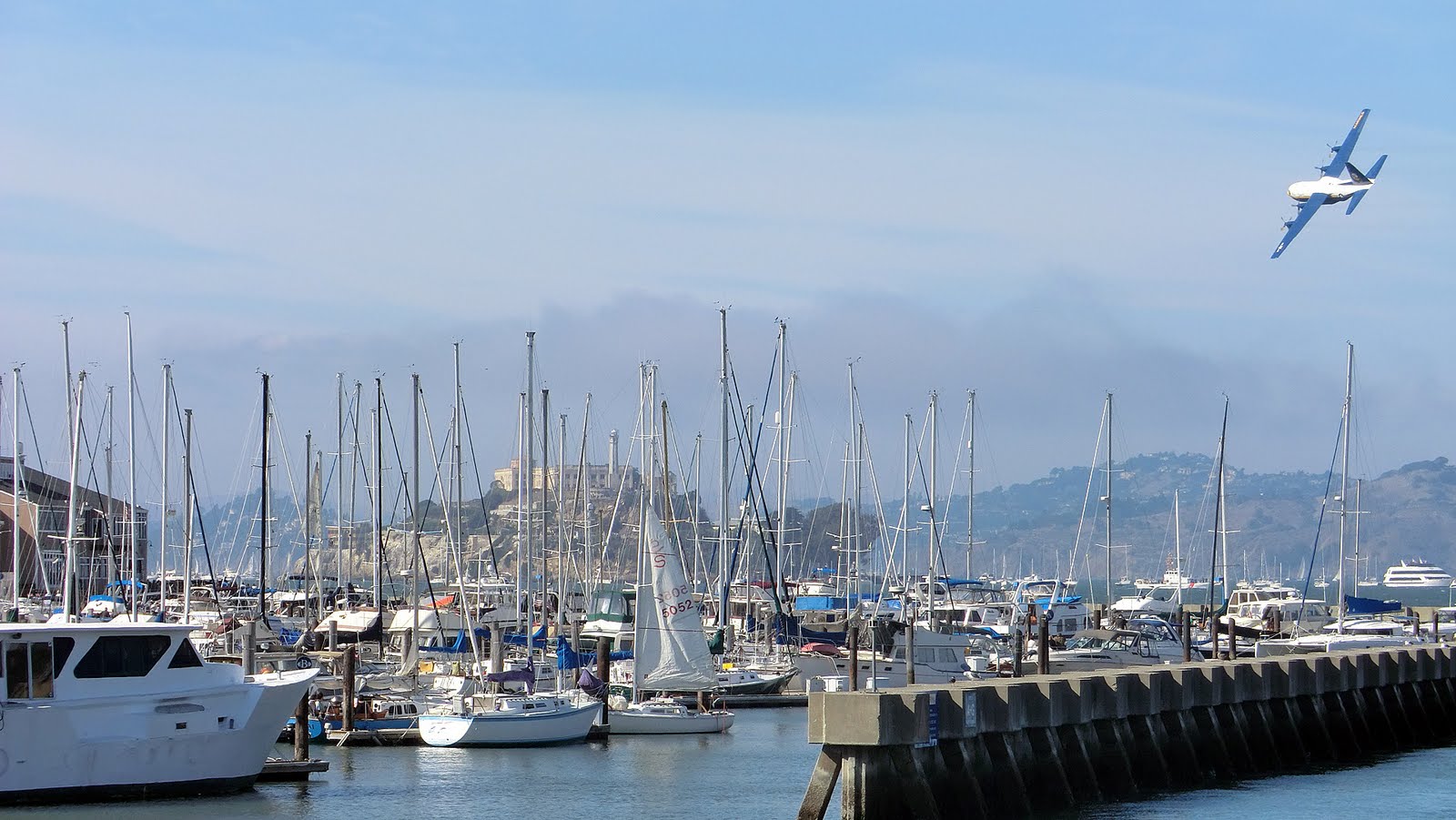
The fog, seen here over Alcatraz, which caused the Blue Angels to cancel  their Sunday performance.

Thursday, October 6, 2011

Life goes on after people die, even Steve Jobs ... or my mom

Apple's webpage the night Steve Jobs died.

Today is a sad anniversary for me. Two years ago tonight, my mother lost her short battle with cancer.

Yesterday, another personal icon, Steve Jobs, lost his much longer fight against another form of the same scourge.

Death is a funny thing. For one person, it’s obviously the end, at least on this plane of existence. For those close to the deceased, depending how close, their lives can sometimes also be measured as “before” and “after.”

But last night, as I walked into my downtown San Francisco classroom after reading about Jobs’ death, I realized that for others, life goes on. My classmates were concerned about finishing their papers, discussing the ethics of California’s High-Speed Rail project (our assignment for the week), and curious about their colleagues' job prospects. Traffic along Market Street was as busy and frantic as ever. I couldn’t see the Apple Store a block away, but I’ll bet it was bustling, albeit with a sense of sadness.

But all in all, it looked rather normal, and I wondered, “is that fair?”

My mom and my son bond about three
months before her death.
It reminded me a bit of two years ago, after my mom died. I remember going out into the streets of Klamath Falls and seeing people moving along, doing their business. They read, laughed, ate, walked as if everything was the same as it ever was. I wanted to go up to people who seemed chipper and ask something along the lines of, “What the hell’s the matter with you? Don’t you know my mom died?”

But no, these people didn’t know my mother, nor did I know theirs. If their mothers were dead, even if I’d known it, I might feel sad for them, but I’d recognize the need to carry on – and I would, just like they did.

Those of us who’ve worked in the news business are familiar with the phrase, “One death is a tragedy, thousands of deaths is a statistic.” Yet, we’ve all seen how a single death can seemingly go unnoticed.

But do they really go unnoticed just because people haven’t changed their routines?

One of the best tributes to Steve Jobs is that so many people read about his death on devices he had a hand in creating, then went back to their business on another one of his devices. Jobs’ legacy lives on, just like I think that one of the best legacies of my mom is the love and understanding I give my own children.

We all incrementally contribute to the human race. One man might invent a better way to listen to music. Another woman might instill a sense of dedication to one’s family in her offspring. In the end, though, any single individual’s contribution – even an individual as famous as Steve Jobs – might seem negligible (heck, there are roughly seven billion of us).

But multiply the contributions, however small, of that individual by a few billion times and you can see that every life has a meaning and is important in its own way. My little contribution to society is important to its continuing development, and so is yours (whoever you may be). When a person dies, we may have lost their contribution, but they also did their part to build this society (no matter how screwed up it is).

In fact, it would be an insult to not carry on after they’re gone.

Thursday, September 29, 2011

Why the Giants failed in 2011

The Colorado Rockies beat the San Francisco Giants 6-3 at AT&T Park on Wednesday, Sept. 28, 2011.

It was an amazing day for baseball on Wednesday as four simultaneous elimination games determined the final wild card participants in the playoffs.

At San Francisco’s AT&T Park, however, it was a bittersweet day as the Giants officially relinquished their status as defending World Champions. It was a disappointing finish for the hometown fans, as the visiting Colorado Rockies won, 6-3.

The game was in some senses a microcosm for the G-Mens’ year. They fell behind early, made a spirited charge, missed scoring chances, then ran out of gas.

The residual buzz of 2010’s World Championship brought a franchise-record 3,387,303 people through the turnstiles in 2011, but the Giants could never get on track this season.

The main culprit was undoubtedly the horrendous injury suffered in May by 2010 Rookie of the Year Buster Posey, which cost San Francisco an MVP candidate and a big bat. Other injuries to All Stars Freddie Sanchez and Pablo Sandoval, when coupled with a mid-season cold streak and a late-season Arizona hot streak, made the loss of Posey difficult to overcome. Essentially, the rest of the Giants couldn’t mount any offense.

As it turns out, the Giants needed less of this:

Pat Burrell striking out in the sixth inning of Wednesday's game.

And more of this:

Rookie Brett Pill doubles in the sixth inning Wednesday, during a three-run Giants rally.

Wednesday's game also likely marked the final appearances in a Giants uniform for 2010 standout Pat Burrell, who is likely to retire, and Mark DeRosa, the oft-injured utilityman who never got a chance to shine with the Giants (although he had two RBI during the game).

Next year the Giants will likely be back in contention. While it’s almost certain to lose free agent slugger Carlos Beltran, the team will feature a healed Posey, possibly a healed Sanchez, a Brandon Belt who’s a year older and wiser, and the returning core of its rich pitching rotation.

San Francisco will again fill AT&T Park to the brim, and young fans like the one below (my son), who never lost faith, will lead the charge.

Ian Baker is no bandwagon fan.

Sunday, September 25, 2011

Turandot or Turandon't? San Francisco Opera at the Ballpark

Our view from the Club Level as the SF Opera Company's performance of "Turandot" was simulcast at AT&T Park.
I have to admit, as cultured as I like to pretend to be, I have never been to been to a live opera (I've never been to the ballet either, but I did have tickets for the Boshoi's 1992 tour of Los Angeles that was cancelled due to the Rodney King Riots). So when the family was invited to the San Francisco Opera's annual performance at AT&T Park on Sunday, I jumped at the chance to see Turandot. And, to live Tweet it for a class:

Tuesday, August 30, 2011

Guy Fawkes is no hero, Anonymous BART protestors

Guy Fawkes is not the hero "Anonymous" makes him out to be.

On Jan. 1, 2009, a police officer employed by the BART transit agency shot and killed a subdued man named Oscar Grant, who was suspected of fighting on a train. The officer who fired the shot said he thought he was holding his TASER at the time, and was later convicted of involuntary manslaughter. The shooting and the verdict brought massive protests in parts of the Bay Area. In July 2011, another BART officer shot and killed a man named Charles Hill at Civic Center station. Hill was reported to police after reportedly seeming belligerent and intoxicated.

A large protest against Hill's death and alleged heavy-handed techniques of BART officers briefly closed the Civic Center Station later that month. When another demonstration about the shootings was scheduled for August 2011, BART officials, mindful of how social media is used to coordinate protests in this day and age, ordered cellular phone repeaters in the underground stations be shut down in an attempt to corral protests.

The effort backfired spectacularly, as people from First Amendment supporters to tech columnists lambasted the move and multiple protests against the cell service shutdown have shut down stations and frustrated commuters. Key organization for the protests has been supplied by the loose association of individuals known as "Anonymous," which initially gained widespread notoriety by supporting the information-sharing website Wikileaks.

It's here where it gets interesting. "Anonymous" supporters, in protests from London to San Francisco, have taken to wearing Guy Fawkes masks like those sported by the anti-hero "V" in Alan Moore's classic early 1980s comic "V for Vendetta." These protesters, as seen at the top of the page, apparently seek to emulate the anarchist hero (seen below) of the comic-books (later collected in graphic novel form). At the end of the movie adaptation of the books, scores of protesters in Guy Fawkes masks are symbolically seen helping to bring down a fascist British government.


The problem is that Guy Fawkes was no hero. He planned to blow up Parliament, killing the King, Lords, and MPs inside, in order to found a repressive Catholic theocracy. While V had a specific reason to wear a Guy Fawkes mask because he also intended to blow up Parliament (which is done on page 7 of the comics and at the climax of the movie), I'm not seeing why Anonymous has adopted the symbol. Yes, the comic V was an anarchist, as no doubt are some Anonymous supporters, but Fawkes himself was very much the man these people would be fighting against -- a mercenary for hire who fought for a number of countries that supported his religious philosophy. Indeed, basically a Christian jihadist. Fawkes thus has no place being the figurehead of a non-violent protest movement.

But, BART is also not blameless here. When officials such as spokesman Linton Johnson claim "there's no right to free speech" on train platforms, they may be legally correct but morally wrong. Preventing communications in order to disrupt a protest does, in fact, remind me of the repressive government in "V for Vendetta," who are always letting the public know they are in charge (see right).

Of course, this thing makes me wonder: how many Anonymous folks read Moore's other seminal work, Watchmen, where good intentions went very awry (in form of exploding squid)?