Thursday, October 20, 2011

Berlyn Cosman taught me that life was fleeting - RIP as her killer goes free

Sometimes one is reminded of a almost-forgotten chapter from their past by a random smell, hearing a special song, or finding an old trinket.

Or seeing a newspaper headline like the one I saw today: "Man convicting of killing CV student on prom night granted parole."

Berlyn Cosman (1973-1991)
Berlyn Cosman was a promising all-league basketball player at Crescenta Valley High in the early 1990s. She had earned a basketball scholarship to a university in Missouri and was expected to do well in college. She was young, pretty, smart and could drain shots from all around the key.

On May 31, 1991, three weeks from graduation, she attended her senior prom in Los Angeles and then drove down with friends to the Disneyland area for an all-night party, to be followed a trip to the theme park the next day. At some point during the night, there was an argument with a non-student friend of one of the partygoers named Paul Crowder. Cosman retreated to a different room in the hotel to sleep. Some time later, Crowder came into the room carrying a gun. He said he tripped entering the room and the gun went off. Prosecutors said he intentionally fired into the room.

Whatever the case (and I'm inclined to believe the latter), a bullet hit Cosman in the head and she died the next day. The community mourned, and Crowder was convicted of second-degree murder and sentenced to 19 years-to-life. He was -- as the headline says -- granted parole this week. A letter to the court from Mark Cosman, Berlyn's father, saying he approved of the parole was a key factor in the decision.

Friends and I (top row, second from left) at the 
1991 Crescenta Valley High School prom.
I didn't know Berlyn personally, but I was at that Prom (though not at the party) that night as a recent CV High grad accompanying a current student (a Japanese exchange student named Tomoko, whom I was friends with). That's me in the top row, second from left in the photo to the right.

I had followed Berlyn's basketball career in the Glendale News-Press, where I was to begin sportswriting within a year. The afternoon after the prom, I was coincidentally walking by Crowder's house on Honolulu Avenue at the exact same time he was arrested after fleeing to his home (I saw police surrounding the building and a helicopter overhead).

I went to Berlyn's funeral later that week in Montrose. I later became friends with others who were at the party (they were frequent customers of the late, great Enterprise Arcade on Foothill Boulevard -- where parts of the movie "River's Edge" were filmed and I worked at the time). Paul Crowder's brother Mike played basketball at CV the next couple years while I covered the team and he obviously had to live with what his brother did.

I closely followed News-Press reporter Amy Koval's accounts of Crowder's trial that fall and recently bought a book written by Mark Cosman about dealing with the loss of a child to get his perspective. Obviously, then, I was strongly affected by what happened that night.

Why? Because what occured in that Orange County hotel room was my first real exposure to the fact that life was fleeting, that horrible things can happen to people you know. I've seen a lot of terrible things in the 20 years since, but Berlyn's death still affects me to this day.

But I also have to say that Mark Cosman's apparent forgiveness of Crowder is one of the most gracious things I have ever seen. My wife and I recently welcomed our daughter to the world, and I don't know if I could be so forgiving after such a horrible loss. He's a better man than I am.

Tuesday, October 18, 2011

Omni predicts the distant future of 2010 -- Part II: Technology

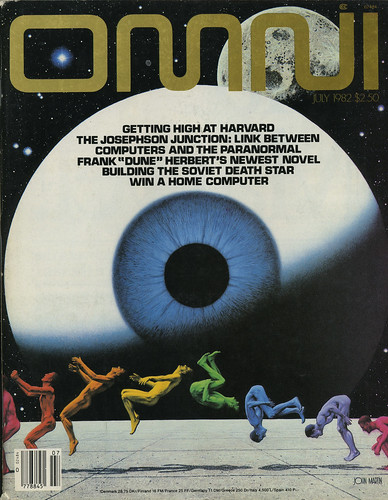
Omni Magazine, July 1982
Cover of Omni's July 1982 issue.

A while back, I outlined some of the wildly incorrect predicted 2010 prices from 1980's The Omni Future Almanac. Today, I want to point out some things the Omni editors got right.

And, because it's funnier, some more stuff they got wrong.

Successes
First, a couple slam dunks. On page 206, the editors wrote that video recording technology (initially the VCR) would not only let people watch what they want, when they wanted it, but that the practice would drive programmers and ad people crazy. They even got the terminology right:

The use of home video recorders for this type of "time shifting" will cause major problems for broadcasters who must predict to their advertisers which market will be watching which program at a specific time. Fans of daytime television programs, for example, will watch soap operas when their schedules permit — probably in prime time — utterly skewing ratings and confusing advertising plans.

Another swish -- e-mail would quickly become a communications medium to be reckoned with. While it sings the praises of the yet-to-come “paperless office” Omni's Almanac also (on page 181) talks about the amazing new technology of “electronic mail.” Apparently, in this miracle technology:

Messages are typed into the computer, which instantaneously sends the letter to its destination and files all requested copies. The recipient gets the message — either on his screen or through his printer — when he asks his computer for the mail.

E-mail was predicted to be common in interoffice business by 1990 and most correspondence would be e-mail (though that term wasn’t used by Omni) by the year 2000. The book also said the post office would struggle to compete. That much is true.

Mixed bags
On some matters, Omni had a mixed track record. Take health care costs. Omni predicted (on page 157) that an average familiy's health care costs would drop from 10.1 percent of a family's income in 1980 to about eight percent in 2000. Well, three failed decades of health care policy later, A middle-income family with individual coverage spends on average 22 percent of household income on health care -- and some spend up to 50 percent. A similar middle-income family with employer based coverage spends 8 percent percent of their income on health care costs.

In business, Omni suggested that General Motors would be profitable for many years thanks to fuel cell technology in its vehicles, ”but by 2010 the Detroit giant could vanish from the leading ranks of corporate conglomeration” (p. 178). Well, they got that last part right (still waiting on the fuel cells).

In the wishful thinking department, Omni's predicted the success of Genentech, still based on a sprawling South San Francisco campus but recently acquired by Roche. Of course, Omni also said that Genentech and or Cetus (another biotech company bought by Chiron in 1991 after staggering loses) “will create pharmaceuticals that will effectively cure diabetes and suppress the cancer tendencies in smokers.” Say what?

Just plain wrong
While Omni got some things right, or at least right to a degree, it was very off in other areas. Take basic economics. The magazine's editor thought that the average amount of their income spent by an American family on housing would drop from 21.3 percent in 1980 to about 19 percent in 2000. Well, in 2009, the average US family spent about 34 percent of their income on housing. (I blame the torrid San Francisco housing market!).

Of course, no discussion about the "future" is complete without a section on robots. On page 178, the Future Almanac predicts that the Soviet Union "will standardize the robots industry." Widespread use of robots would give the proletariat workers more free time and thus result in more political tension. Nothing about the Berlin Wall falling, however.

In the United States, Omni predicted, robots will be used extensively in office, service industries and manufacturing. Occupations which would become obsolete include bank tellers, supermarket cashiers, "movie ticket operators," car wash workers and stock clerks. "Factory assembly lines will be a nostalgic reminder of the past." Tell that to the population of Flint.

Another interesting area would be the use of robots in the restaurant business:

Short-order food preparation also appears likely to be overtaken by robotics. These firms could implement a robot food-serving system as early as 1985. Gas stations will also be totally serviced by robots. While the tank is being filled, a credit card will be put into the machine to register payment and complete the transaction.

That sounds like this:
Courtesy: The Fiscal Times

Omni predicted widespread use of robots only among the wealthy and upper middle class, however. That's probably why you don't have one. Except maybe a Roomba.

I was going to give Omni credit for its prescience in saying that robot space probes would be very successful -- until the book said that robot space probes would probe "other solar systems." No robot will make it to another solar system in the next 10,000 years, barring breakthrough in warp drive.

Still, we should be glad that robots aren't quite as widespread as Omni thought they would be:

Friday, October 14, 2011

Dexter Clay, a 'redshirt' who survived to write about leadership

Let's face it: it didn't pay to wear a red shirt on the original Star Trek series.

Red, the uniform color of security officers (and engineers) on the show, was a practical death sentence. One estimate showed about 1 in 7 of the Enterprise's crew was killed in Star Trek, the original series. Of those corpses, a staggering 70 percent wore red shirts.

The "red shirt" phenomenon -- when a bunch of main cast members and a guy in a red shirt face a deadly situation, it's the guy in the red shirt who dies -- became a TV trope, even parodied to great success in Galaxy Quest. So it's no surprise that when Star Trek: The Next Generation (TNG) began in 1987, they gave security officers another color (yellow) to wear. Still, security was a hazardous job and you kept expecting security officers to die with regularity. And, informally, us fans still called them "redshirts."

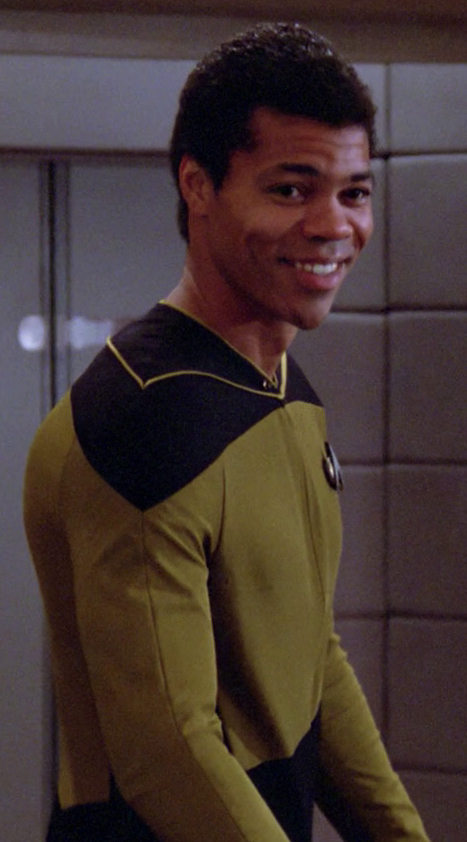
So it was somewhat unexpected during the first two years of the show when a certain officer kept reappearing. He got into a number of scraps, for sure, but the tall African-American security officer made appearance after appearance. He never got a line. He was never named. But he was never killed, either.

My real name is Dexter Clay, but my Star Trek
character never got one.
Flash-forward 20-something years, and we now have the Internet (and DVDs of the entire series). After two decades of exposure to his face, I finally got curious enough the other day to try and find out the security officer's name.

It was no easy task, even for an accomplished Googler such as myself. No name, either for the actor or the character? Enter Memory-Alpha, the Star Trek wiki. The security officer didn't make an appearance in any credits, making my job difficult. I first tried perusing a list of Enterprise-D crew members with no luck. Then, finally, I decided to examine entries for episodes he was in, in an attempt to get a name. Sure enough, in the entry for the pilot, "Encounter at Farpoint," there he was in the uncredited co-stars list: Dexter Clay -- Security Guard.

A quick, conventional Google search helped from there. With the IMDB showed only a couple credits (one episode of TNG and a bit part in a movie), Memory-Alpha showed that Clay had actually appeared in 29 episodes! That's more than such "regular" crew members as Guinan or Pulaski.

And no, he never was named or given a line.

It turns out that, prior to acting, Clay had been a professional football player, for both the 1980 Houston Oilers and the 1981 New York Jets, although he apparently never got into a game due to injuries. Besides playing the security guard in two TNG seasons, Clay also served three years as a stand-in for Michael Dorn (Worf).

Since his time on Star Trek, Clay has become a writer. His 2007 book about a high school football team, KatyNation, got good reviews on Amazon, as did his 1998 look into race relations, Black Eye on America.

Clay has apparently made it a goal of his to find out what makes good a good leader (although looking at Capt. Picard's thoughtfulness might be a good place to start), and has made numerous radio appearances in support of his book and philosophy.

While there are no copies of Clay's books at local libraries for me to review, it's sure gratifying to see at least one "red shirt" who didn't succumb to curiosity.

Unlike these guys:

Thursday, October 13, 2011

Your brand is more than just a label, it's what people think you are


Every Facebook post, every Tweet and every blog a writer uploads contribute to the formation of an online identity, but what contributes to the writer's "brand?"

That key question was addressed this week by a guest lecturer to a San Francisco State University journalism class.

According to Pueng Vongs, the San Francisco Bay editor for Yahoo! Local (and the class instructor), one of a journalist's most-important tools is their "brand." A good brand can open doors, bring (or push away) credibility on a subject and drive readership.

To that end, Vongs arranged for Sherbeam Wright, founder of AndaCommunications, to address students at SFSU's "Social Media for Journalists" seminar on Wednesday. Wright's bio states she has developed and driven communications programs and supported the sales efforts of market-leading high tech companies.

Sherbeam Wright addresses a class at SFSU.
A journalist's brand is "a personal identity that stimulates precise, meaningful perceptions in an audience about the values and qualities of the person," Wright said. That statement means that a brand is not necessarily who you actually are, but what the public thinks you are from the content you produce.

According to Wright, before the advent of the Internet, a journalist's "brand" was actually that of the organization for which they worked. There was little opportunity for the general public to actually engage with a working journalist, or vice-versa.

Now, however, the trend is for news to be a "conversation," rather than simply a broadcast. Aspiring journalists (or public bloggers at large) are expected to have their own brand, be it through blogging, Twitter or some other form of social media.

So how does one build a brand? First, one has to decide ahead of time what they want their brand to be. Wright said that if you want to cultivate a business brand, get involved with LinkedIn. If one has a desire to be a breaking news source, invest heavily in Twitter. Facebook will generate fans, but a personal blog illustrates personality and builds readership.

Wright pointed out a couple examples of people she thinks have been successful in promoting an outstanding online brand. One was Derrick Ashong, who Wright said turns social media into "socially meaningful" media. Another was MSNBC commentator Rachel Maddow, who "blew up" past her radio roots due to social media.

While many online media promoters suggest one specializes in a few topics (vertical integration) in order to become a "go-to guy," Wright said covering a wide-range of topics can also pay off, but you "have to know how to package it." In other words, be consistent. You can address many subjects if you, for example, put your own consistent spin on it -- tie it into your locality, put your own humorous take on it, or analyze everything in one certain way.

That revelation prompted Vongs to concede, after some debate, that "horizontal is the new vertical."

Great news for me ... this blog goes all over the place!

The fog of war(planes)

Blue Angels: "We came, we saw, we flew off."

On Sunday I decided to brave the Embarcadero crowds and take one of the young'uns downtown to see the Blue Angels.

The Blue Angels, the US Navy's premier aerial acrobatics team have been a fixture of San Francisco's Fleet Week for decades. The have brought cheers and also jeers, mainly due to noise complaints, but also their symbolism in an area where the military can be unpopular.

The Snowbirds complete
a loop.
We exited BART at Embarcadero Station and walked about a mile-and-a-half up to Pier 37, where we set up a picnic about two hours prior to the scheduled start of the Blue Angels' demonstration. Luckily, there were a few opening acts.

First up were our neighbors from our north, the Snowbirds (left), representing Canada's Armed Forces. While their jets weren't quite as fast or powerful as the Blue Angels' F-18s, the Snowbirds made up for it by using their greater numbers (nine CT-114 jets). The numbers enabled the Snowbirds to pull off some pretty complicated tricks -- such as drawing a heart in the sky with smoke, then piercing it -- back-to-back-to-back as smaller groups broke off and performed along various parts of the waterfront.


Canada's Snowbirds fly in tight formation during their Oct. 9, 2011 show in San Francisco.


F-15 on afterburner.
Next up were a couple single-plane demonstrations, a Marine Corps F/A-18 and a US Air Force F-15, which delighted the crowd with very-low (and very loud), high-subsonic passes on afterburner (right). It also did a fairly good cobra maneuver and generously showed its high-thrust abilities with quick climbs from the deck to about 15,000 feet and back down again.

Another highlight was seeing a United Airlines 747 pass low and do some pretty tricky tight turns that you don't want done on your next flight to Chicago, but are pretty impressive at an air show. The big, lumbering jumbo jet was a surprisingly exciting part of the show.

(Click on the pictures to "embiggen." The photos are perfectly cromulent.)


A United Airlines 747-400 does some impressive low passes over the San Francisco waterfront.

My son and I had enjoyed the show, thus far, and its a good thing we did, too. When the Blue Angel's C-130 support craft, "Fat Albert," (below) appeared and did a few tricks, the crowd was led to believe the main show was about to start and got excited. As "Albert" left, the F-18s came into sight and began circling.

And circling.

And circling.

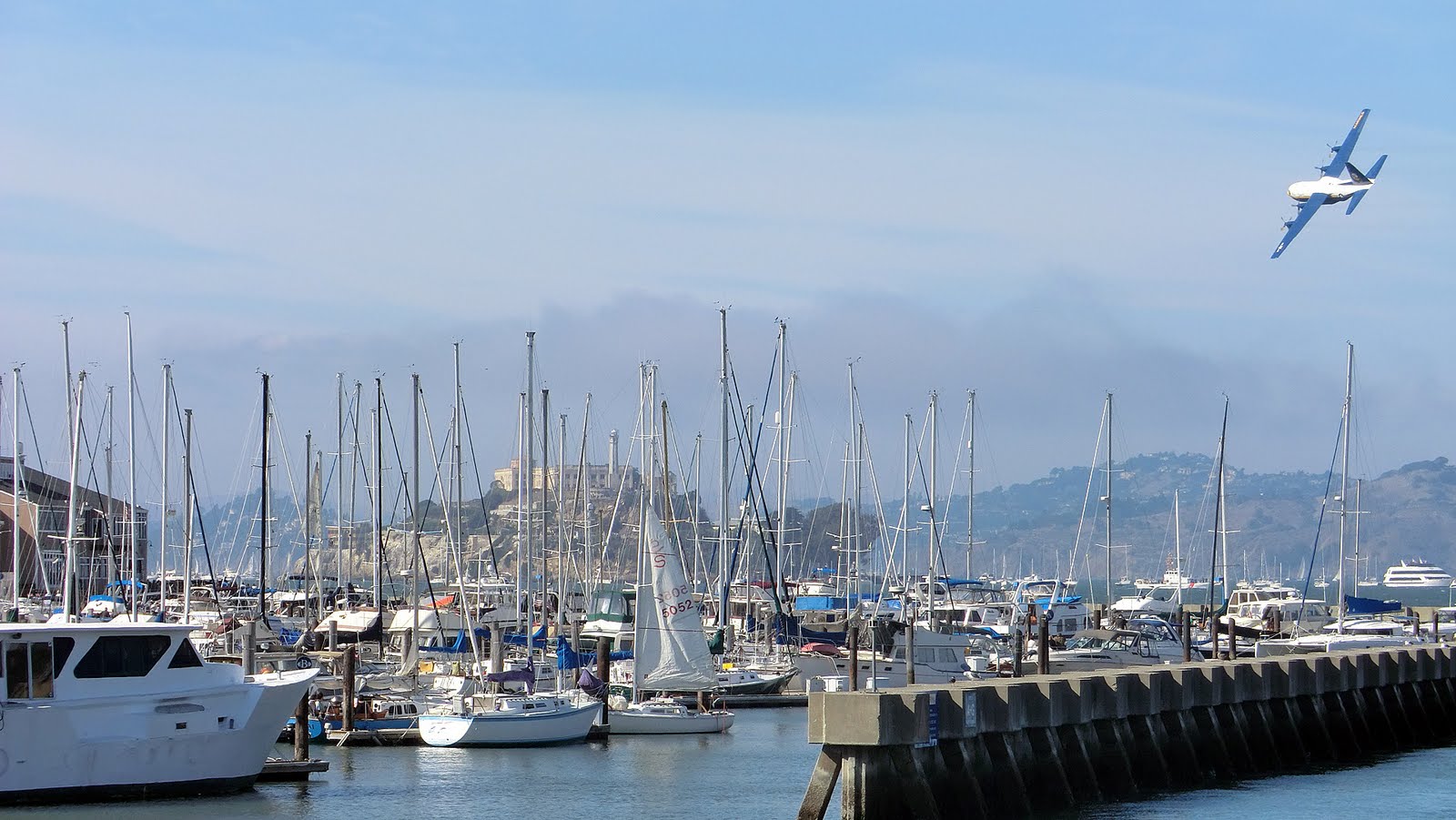
The Blue Angels' C-130 support plane, "Fat Albert," does low-level turns for the fans.

Turns out some fog had rolled in, and the Blue Angels didn't feel that conditions were safe to fly 18 inches apart 20 feet above the water. They eventually had to cancel the demonstration. Alas, while the crowd was disappointed, I think a majority understood. Certainly, we had been amused in the meantime.

The fog, seen here over Alcatraz, which caused the Blue Angels to cancel  their Sunday performance.

Thursday, October 6, 2011

Erasure pops at the Fox

Erasure performs at Oakland's Fox Theater on Oct. 4, 2011. Photo by John Baker.

Way back in high school, in the summer of 19(mumble, mumble), I went to "yearbook camp" in San Diego in order to learn the proper way to arrange page layouts and proportion photos. Someone brought in a cassette from some pop band I'd never heard of.

The tape was Erasure's "The Innocents," and -- enraptured by the smooth lyrics, bouncy electronics and the (then) quirkiness of a lead singer who was out and proud -- I began a long association with the band that continues to this day.

Andy Bell
Fronted by flamboyant singer/frontman Andy Bell, the English duo has had limited mainstream US success, mostly in the late 1980s, but has charted 34 top-40 singles in their native UK. Erasure is currently touring in support of its new album, Tomorrow's World, which will be released stateside next week.

On Tuesday, the tour came into Oakland's Fox Theatre. I got in line about three hours before the scheduled 8 p.m. start and ended up with a space in the second row (I would've been on the rail, but I had to use the restroom after standing in line for three hours). The show was fantastic. Bell, who admittedly sounded less than prime and was a bit soft the last time I saw the group perform, was svelte and in top form.

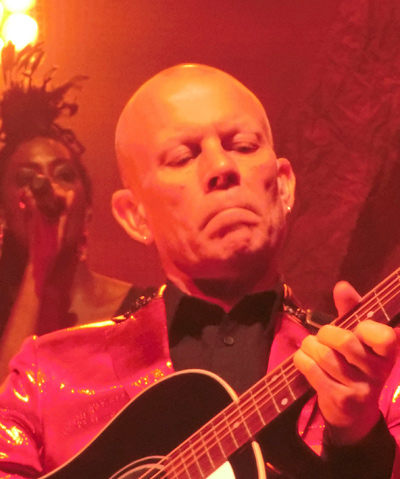
Vince Clarke
Clarke, who cut his teeth as a founder of Depeche Mode before forming first Yazoo (Yaz in the United States), then Erasure, has always been the "look at him"-type when compared to Bell's "look at me" demeanor. But he's always been a genius on the keyboard and lately has been becoming more and more involved with the live shows. He spent an extensive time at the fore of the stage on Tuesday carrying a guitar -- a relatively new instrument in Erasure's repertoire.

The show went off with nary a hitch, save for a brief flub in the lyrics of "Blue Savannah" by Bell. The setlist of 22 songs (13 from 1992 or before) was a good mix of the classic and the modern, with the five songs off the new album -- including the first single, "When I Start to (Break it all Down)" -- received well.

Personally, it was the closest I'd ever been to the front at a concert, making pictures and video a snap. I'm not normally a fan-cammer, but I was impressed with the quality of video taken by my relatively new camera. Below: A brief snippet of "Sometimes."


This was my seventh Erasure concert, and it was among the best. The enthusiastic crowd (admittedly dominated by gay men in their mid-to-late 40s), Bell's better physical shape (which led to better showmanship) and a great set list all contributed to a perfect show.

Not bad for a synthpop group that's been together 26 years now.

Erasure bows off the stage following its encore performance of "Oh L'amour."

Life goes on after people die, even Steve Jobs ... or my mom

Apple's webpage the night Steve Jobs died.

Today is a sad anniversary for me. Two years ago tonight, my mother lost her short battle with cancer.

Yesterday, another personal icon, Steve Jobs, lost his much longer fight against another form of the same scourge.

Death is a funny thing. For one person, it’s obviously the end, at least on this plane of existence. For those close to the deceased, depending how close, their lives can sometimes also be measured as “before” and “after.”

But last night, as I walked into my downtown San Francisco classroom after reading about Jobs’ death, I realized that for others, life goes on. My classmates were concerned about finishing their papers, discussing the ethics of California’s High-Speed Rail project (our assignment for the week), and curious about their colleagues' job prospects. Traffic along Market Street was as busy and frantic as ever. I couldn’t see the Apple Store a block away, but I’ll bet it was bustling, albeit with a sense of sadness.

But all in all, it looked rather normal, and I wondered, “is that fair?”

My mom and my son bond about three
months before her death.
It reminded me a bit of two years ago, after my mom died. I remember going out into the streets of Klamath Falls and seeing people moving along, doing their business. They read, laughed, ate, walked as if everything was the same as it ever was. I wanted to go up to people who seemed chipper and ask something along the lines of, “What the hell’s the matter with you? Don’t you know my mom died?”

But no, these people didn’t know my mother, nor did I know theirs. If their mothers were dead, even if I’d known it, I might feel sad for them, but I’d recognize the need to carry on – and I would, just like they did.

Those of us who’ve worked in the news business are familiar with the phrase, “One death is a tragedy, thousands of deaths is a statistic.” Yet, we’ve all seen how a single death can seemingly go unnoticed.

But do they really go unnoticed just because people haven’t changed their routines?

One of the best tributes to Steve Jobs is that so many people read about his death on devices he had a hand in creating, then went back to their business on another one of his devices. Jobs’ legacy lives on, just like I think that one of the best legacies of my mom is the love and understanding I give my own children.

We all incrementally contribute to the human race. One man might invent a better way to listen to music. Another woman might instill a sense of dedication to one’s family in her offspring. In the end, though, any single individual’s contribution – even an individual as famous as Steve Jobs – might seem negligible (heck, there are roughly seven billion of us).

But multiply the contributions, however small, of that individual by a few billion times and you can see that every life has a meaning and is important in its own way. My little contribution to society is important to its continuing development, and so is yours (whoever you may be). When a person dies, we may have lost their contribution, but they also did their part to build this society (no matter how screwed up it is).

In fact, it would be an insult to not carry on after they’re gone.

Friday, September 30, 2011

Omni predicts the distant future of 2010 -- Part I: Inflation

Omni magazine predicted the future, or did it?

Omni was a strange combination of a science magazine and a science fiction journal that published from 1978 to 1996. It specialized in "gonzo" science journalism, as well as publishing cutting-edge sci-fi.

In 1980, the editors published The Omni Future Almanac, which aimed to predict the trends of the next 30 years or so. Some predictions, they got pretty close on -- I plan to look at their views on e-mail and the Internet later. Some predictions were not so good -- the geo-political ones, for example (who saw that darn Berlin Wall falling within the next ten years?).

One area that Omni tried to predict was consumer costs. As the chart below shows, and remember that these predictions were made during the stagflation of the late Carter Administration, they were not so accurate about 2010 prices:

From Omni predicts 2010 prices

Wow! Obviously the rate of inflation has gone down. My local Safeway wants $1.49 (club card price) for a head of iceberg lettuce, not $5. The most-recent Big Mac index I could find shows the sandwich goes for about $4.07 in the United States, making $22 for a pound of ground beef seem high. The average monthly rent for a three-bedroom apartment in the San Francisco market is $2,662, not $10,000 (although a million dollars for a home purchase is close!). Current New York MTA subway fare is $2.25, not $20. The average US car sold for $28,000 in 2009, not $70,000. $2.75 for a daily newspaper? What's a newspaper?

The price of gas mark is interesting. Omni thought that better fuel efficiency in cars would drive down demand and greater drilling in Alaska and elsewhere would increase supplies, making the costs of fuel DROP significantly after 1990 to about $2 per gallon in 2010. The average price of gas in California right now is $3.84 per gallon. Interesting to see how geopolitics (and SUVs) affected gas price predictions.

To be fair, Omni also predicted that secretaries would now be making $95,000 a year and the average public high school teacher would pull in $110,000, over-estimating current rates in both cases. Of course, Omni also said a Major League Baseball player with "average skills" would make $330,000 per year. In 2010, the mean salary for a MLB player was about $3.3 million!

So the next time you see an economist predict the rate of inflation, take it with a grain of salt.

Thursday, September 29, 2011

Why the Giants failed in 2011

The Colorado Rockies beat the San Francisco Giants 6-3 at AT&T Park on Wednesday, Sept. 28, 2011.

It was an amazing day for baseball on Wednesday as four simultaneous elimination games determined the final wild card participants in the playoffs.

At San Francisco’s AT&T Park, however, it was a bittersweet day as the Giants officially relinquished their status as defending World Champions. It was a disappointing finish for the hometown fans, as the visiting Colorado Rockies won, 6-3.

The game was in some senses a microcosm for the G-Mens’ year. They fell behind early, made a spirited charge, missed scoring chances, then ran out of gas.

The residual buzz of 2010’s World Championship brought a franchise-record 3,387,303 people through the turnstiles in 2011, but the Giants could never get on track this season.

The main culprit was undoubtedly the horrendous injury suffered in May by 2010 Rookie of the Year Buster Posey, which cost San Francisco an MVP candidate and a big bat. Other injuries to All Stars Freddie Sanchez and Pablo Sandoval, when coupled with a mid-season cold streak and a late-season Arizona hot streak, made the loss of Posey difficult to overcome. Essentially, the rest of the Giants couldn’t mount any offense.

As it turns out, the Giants needed less of this:

Pat Burrell striking out in the sixth inning of Wednesday's game.

And more of this:

Rookie Brett Pill doubles in the sixth inning Wednesday, during a three-run Giants rally.

Wednesday's game also likely marked the final appearances in a Giants uniform for 2010 standout Pat Burrell, who is likely to retire, and Mark DeRosa, the oft-injured utilityman who never got a chance to shine with the Giants (although he had two RBI during the game).

Next year the Giants will likely be back in contention. While it’s almost certain to lose free agent slugger Carlos Beltran, the team will feature a healed Posey, possibly a healed Sanchez, a Brandon Belt who’s a year older and wiser, and the returning core of its rich pitching rotation.

San Francisco will again fill AT&T Park to the brim, and young fans like the one below (my son), who never lost faith, will lead the charge.

Ian Baker is no bandwagon fan.

Sunday, September 25, 2011

Turandot or Turandon't? San Francisco Opera at the Ballpark

Our view from the Club Level as the SF Opera Company's performance of "Turandot" was simulcast at AT&T Park.
I have to admit, as cultured as I like to pretend to be, I have never been to been to a live opera (I've never been to the ballet either, but I did have tickets for the Boshoi's 1992 tour of Los Angeles that was cancelled due to the Rodney King Riots). So when the family was invited to the San Francisco Opera's annual performance at AT&T Park on Sunday, I jumped at the chance to see Turandot. And, to live Tweet it for a class: